 EN
ENA major interdisciplinary research initiative named PIRATE has officially launched in Germany to significantly enhance the precision of individualized risk assessment for patients diagnosed with intracranial aneurysms. Bringing together leading experts in medicine, advanced diagnostic imaging, computer science, and computational fluid dynamics, the collaborative project aims to transform how clinicians evaluate the growth and rupture hazards of cerebral vascular outpouchings. The official kick-off meeting took place on August 26, 2026, at the Universität Greifswald. For international patients seeking advanced neurovascular diagnostics and treatment in Germany, this initiative represents a pivotal shift toward highly tailored, data-driven therapeutic strategies.
Understanding Intracranial Aneurysms and Current Clinical Management
An intracranial aneurysm is a localized ballooning or bulging of a weakened arterial wall within the brain. Epidemiological data indicate that approximately three out of every one hundred adults carry an intracranial aneurysm, which corresponds to roughly two million affected individuals in Germany alone. In the vast majority of cases, these vascular malformations remain entirely asymptomatic and are discovered incidentally during neuroimaging performed for unrelated symptoms such as headaches or dizziness. However, if an aneurysm ruptures, it precipitates a subarachnoid hemorrhage, a catastrophic bleeding event within the brain tissue that carries a high mortality rate and often results in severe, long-term neurological impairment.
In contemporary German neurovascular centers, the diagnostic process relies on sophisticated high-resolution imaging modalities to evaluate the precise geometry and structural characteristics of the vessel wall. Magnetic resonance angiography, computed tomography angiography, and digital subtraction angiography allow neuroradiologists to measure the dimensions, dome-to-neck ratio, and exact anatomical location of the aneurysm relative to adjacent cerebral arteries. These diagnostic tools are essential for categorizing aneurysms and identifying subtle morphological changes over time.
The fundamental clinical challenge when managing an unruptured intracranial aneurysm is determining whether conservative monitoring or preventive intervention offers the safest outcome for the patient. Clinicians must carefully balance the calculated statistical risk of future rupture against the potential procedural complications associated with treatment. Preventive interventions currently include minimally invasive endovascular techniques, such as microcoil embolization and the placement of flow-diverting stents, as well as open neurosurgical microsurgical clipping. Because every intervention carries inherent risks, medical teams require precise criteria to select the optimal approach for each individual.
The PIRATE Research Initiative and Advanced Risk Stratification
The PIRATE project, which stands for Personalisierte intrakranielle Risikobestimmung von Aneurysma-Patient*innen zur Therapie-Evaluation, addresses the complexity of clinical decision-making by fusing multi-modal medical data into unified predictive models. The project is led by Prof. Susanne Schnell, Professor of Medical Physics at the Institut für Physik of the Universität Greifswald. Clinical neuroradiological expertise is provided by Dr. Eiko Rathmann, a specialist in radiology and neuroradiology at the Universitätsmedizin Greifswald. The core research consortium also integrates scientists from the Hochschule Stralsund, the Universität Rostock, and the Universitätsmedizin Rostock.
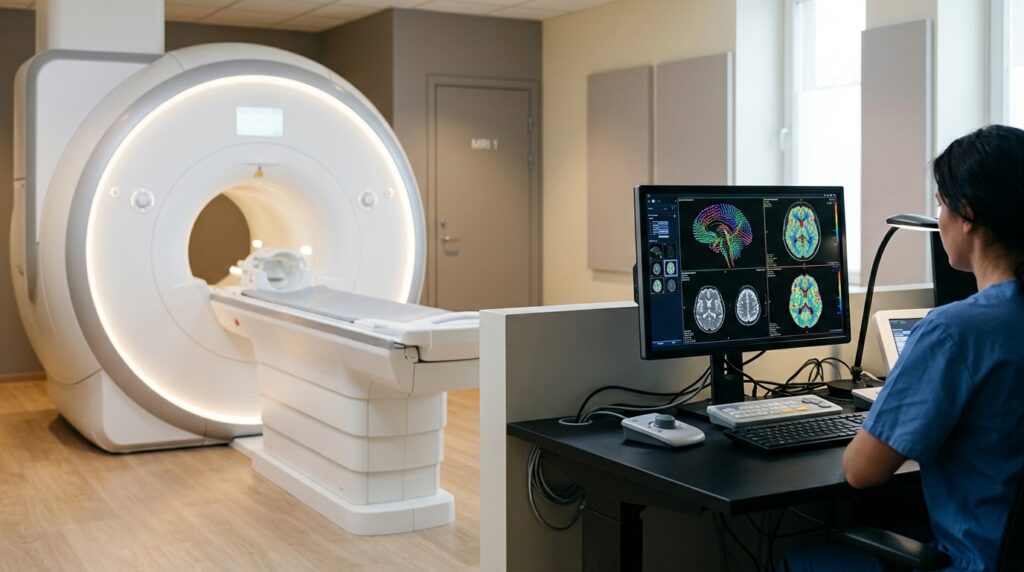
The scientific work within PIRATE is structured across four primary work packages designed to bridge raw imaging data and clinical application. A central focus is image-guided risk stratification through the standardization of 4D-Fluss-MRT techniques. This specialized magnetic resonance imaging method captures blood flow through cerebral blood vessels in three spatial dimensions over the temporal cardiac cycle, enabling researchers to quantify exact flow velocities, wall shear stress, and flow directionality. These measurements serve as the foundation for patient-specific computational fluid dynamics models.
To validate computational simulations, researchers utilize physical aneurysm models to analyze hemodynamics under rigorously controlled experimental settings. The final core work package focuses on automated data integration and machine learning. By analyzing complex datasets encompassing hemodynamics, vessel geometry, wall tissue alterations, and patient health profiles, artificial intelligence models aim to uncover subtle correlations that predict individual aneurysm stability or progression.
The initiative is bolstered by key associate partners, including the Department of Molecular Medicine and Surgery at the Karolinska Institutet in Stockholm, the Department of Radiology at Northwestern University, the Enradia Zentrum für Radiologie, Nuklearmedizin, Endokrinologie in Greifswald, and specialized neurosurgical and anatomical departments at Universitätsmedizin Greifswald and Universitätsmedizin Rostock. This international collaboration ensures a comprehensive synthesis of biomechanical engineering and clinical neurosurgery.
Clinical Implications and Future Guidance for International Patients
The PIRATE project represents an ongoing, multi-year research endeavor currently focused on technology optimization, algorithm training, and software development. The formal launch on August 26, 2026, attended by representatives from the Ministerium für Wissenschaft, Kultur, Bundes- und Europaangelegenheiten des Landes Mecklenburg-Vorpommern and the Projektträger Jülich, marks the beginning of intensive translational research. The ultimate objective is to deliver validated clinical decision-support software for routine hospital use in the coming years.
For international patients traveling to Germany for neurovascular evaluation, the project highlights the rigorous, multidisciplinary standards already governing German neurovascular care. At top university hospitals, patient cases are routinely reviewed in interdisciplinary neurovascular boards comprising neuroradiologists, neurosurgeons, and neurologists. The integration of advanced hemodynamic modeling techniques into clinical practice promises to further refine these evaluations, providing patients with highly individual risk profiles rather than generic statistical averages.
Patients seeking specialized second opinions or treatment planning in Germany should prepare comprehensive medical records, including high-resolution MRI or CT angiograms saved in standard DICOM format. Key topics to discuss with attending specialists include whether the physical shape and flow dynamics of the aneurysm favor active treatment or serial imaging surveillance, the specific procedural risks of endovascular versus surgical options, and the recommended follow-up interval for monitoring vascular stability.
Source: Universität Greifswald