EN
Eye and vision treatment in Germany means different things to different people: freedom from glasses, saving the sight that glaucoma has left, cataract surgery, or checking a child’s eyes.
These paths start differently: with tests and monitoring, with surgery, or with the honest answer that lost sharpness will not return but decline can be slowed. For an overview, see eye clinics in Germany.
What is actually called vision treatment
Vision treatment covers two situations: an optical defect and an eye disease. In short sight, long sight and astigmatism a healthy eye focuses poorly, which glasses, lenses or surgery correct; in disease the tissue is damaged, and expectations differ.
Most patients come with cataract, age-related macular degeneration, retinal detachment or diabetic retinopathy, glaucoma or corneal disease; children with squint, amblyopia (‘lazy eye’) or congenital cataract. The later amblyopia treatment starts, the more often it fails. Small children have refraction measured after drops that relax focusing, so their visit is planned separately. Squint has its own page.
With some diagnoses the aim is to stop the decline, not to improve sight: nerve fibres lost to glaucoma do not recover, and sight lost to undertreated wet macular degeneration is not always regained. A careful doctor says so before surgery, as German law requires (§ 630e BGB).
How an appointment at a German clinic starts
An appointment starts with a basic examination: visual acuity and refraction, eye pressure, and the retina viewed through pupils widened with drops. For a few hours afterwards vision is blurry and bright light dazzles; German ophthalmology bodies DOG and BVA rule out driving with dilated pupils.
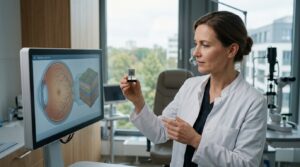
Instruments supply the decisive data: optical coherence tomography (OCT), a contact-free layered scan of the macula, the retina’s centre; visual fields in glaucoma; corneal topography, a curvature map, and corneal thickness before any refractive surgery; and angiography of the retinal vessels where needed.
This is repeated even if done at home, because millimetres and micrometres on these images decide the lens, the extent of surgery and whether it is possible at all.
The main areas of care
The four main areas are cataract, the retina, glaucoma and the cornea. Cataract treatment in Germany, one of the country’s most common operations, replaces the clouded lens with an artificial one under local anaesthesia; it takes about 20 to 30 minutes, and the best sight may take weeks to months. The lens type, agreed in advance, decides whether glasses are still needed. The WHO fact sheet names refractive errors and cataract as the leading causes of vision impairment.
Retina treatment in Germany uses laser, injections into the vitreous and surgery. Anti-VEGF injections, which block a vessel growth factor, are standard in wet age-related macular degeneration; in diabetes they treat swelling at the macula’s centre, while laser treats fragile new vessels. Detachment and severe diabetic complications need vitreoretinal surgery. Timing matters: sudden flashes or a curtain over the eye may mean a detachment, an emergency.
Glaucoma, a chronic optic nerve disease, takes sight quietly and irreversibly: the gaps go unnoticed and damaged fibres do not recover. Treatment lowers eye pressure with drops, laser or surgery, and monitoring never stops. More on glaucoma treatment in Germany.
The fourth area is the cornea. In keratoconus it thins and bulges into a cone; cross-linking with riboflavin and ultraviolet light stiffens it to stop the disease, and for scars or lasting opacity a transplant is discussed. More on keratoconus treatment in Germany.
When it is correction rather than disease
If a healthy eye focuses poorly, the answer is correction: laser treatment of the cornea or an implanted lens. Not everyone qualifies: the DOG and BVA refractive surgery commission (KRC) advises against laser correction with a too-thin cornea, progressive corneal disease including early keratoconus, certain other eye diseases, and in minors; unstable refraction, some general illnesses and pregnancy also rule it out. An honest forecast is ‘you will probably manage without glasses for distance’, not a guarantee: many still need glasses in low light and with age.
After LASIK vision is reduced for the first hours, after surface treatment and SMILE for the first days. A full examination beforehand decides whether the method suits the eye; check-ups follow because part of the effect may fade in the first weeks. For prices, see laser eye surgery and eye surgery prices in Germany.
How the trip is organised
A consultation with examination usually needs one day, planned surgery a few days, and some procedures mean waiting for the check-up or arranging follow-up at home. Flying after surgery inside the eye is postponed on the doctor’s instruction: with a gas bubble in the eye you must not fly or travel to high altitudes.
Before booking, ask who operates and their specialty, which tests are billed, which lens the estimate assumes, when the check-up is, and what to do about warning signs at home.
The bill covers examinations, the procedure, the lens, one eye or both, anaesthesia and check-ups; amounts come only from the clinic’s written estimate, which the prices page above breaks down.
Frequently asked questions
Can sight that has already got worse be restored?
It depends on the cause. Glasses, lenses or surgery correct an optical defect, and in cataract a new lens restores clarity if the retina and nerve are healthy. Where tissue is damaged, treatment preserves what is left: nerve fibres lost to glaucoma do not recover.
Why bring old scans if the tests will be repeated?
Old scans show how the disease has changed: in glaucoma and retinal disease, comparison reveals whether it is progressing. Tests are still repeated, because nerve fibre thickness on different OCT instruments cannot be compared directly, and the lens is calculated from measurements before surgery.
When should you not wait for the trip and get help locally?
When sudden flashes, many new floaters, a shadow or a ‘curtain’ appear in your vision. These can signal retinal detachment, an emergency: go to an eye doctor or emergency room right away, wherever you are. The outcome depends on how long the detachment lasts.
How AlenMed arranges eye treatment in Germany
AlenMed sends records and previous images to an eye clinic; the doctor says what can be done and how soon, and the clinic issues a written estimate. Then come the visa invitation and an interpreter for appointments and results.
Plan how many days to stay, including check-ups, how to get reports and prescriptions in your language, and how to reach the doctor afterwards.
This material is for information only and is not an offer; a doctor decides the diagnosis and treatment plan in person.
News on this topic
New Retinal Chip PRIMA Restores Central Vision in Geographic Atrophy
A newly approved photovoltaic subretinal chip offers restored visual function for patients with central vision loss from geographic atrophy due to dry AMD.