EN
Glaucoma almost never hurts. Optic nerve fibres die over years, people notice only once their field of vision has narrowed, and what is lost does not return. The exception, an acute angle-closure attack with sudden pain in the eye and head, a red eye, blurred vision with coloured halos around lights and nausea, is an emergency that needs help on the spot, not after a trip. According to the World Health Organization, at least 2.2 billion people live with vision impairment, and glaucoma is among the leading causes of irreversible blindness.
Glaucoma treatment in Germany is care for a chronic condition: it is not cured once but kept under control through precise measurements, regular review of the plan and gentle surgery when drops are no longer enough. The place of treatment is chosen to fit the form of the disease: AlenMed works with 86 partner clinics in 38 German cities. Other eye conditions are covered under ophthalmology in Germany.
Glaucoma treatment in Germany: target pressure and eye drops
The aim of treatment is to lower eye pressure to a level at which nerve fibre loss stops or slows sharply. This target pressure is individual: it depends on how much damage the nerve has suffered, how fast it is changing, the untreated pressure, age and other illnesses. With a thin cornea, low blood pressure at night or visible gaps in the visual field, the bar is set lower.
Treatment usually starts with drops: some reduce the fluid the eye produces, others help it drain. Prostaglandin analogues are prescribed most often, beta-blockers and carbonic anhydrase inhibitors less so; if the eye becomes red and irritated, preservative-free forms are used. Doctors keep bottles to a minimum: the simpler the routine, the fewer people give up. The order of steps follows the guideline of the German Ophthalmological Society (DOG): drops or laser first, surgery when these are not enough.
Diagnosis: OCT, visual fields and the daily pressure profile
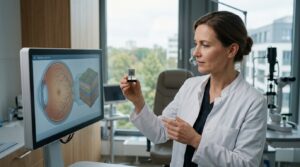
Glaucoma is assessed with several tests, never with a single reading. Optical coherence tomography (OCT), a light-beam scan with no needles or contrast agent, measures the thickness of the nerve fibre layer around the optic disc in micrometres. Pachymetry measures corneal thickness: a thin cornea makes tonometer readings too low and can hide high pressure. Computerised perimetry maps the visual field and finds gaps people do not notice themselves.
Gonioscopy, a look at the drainage angle through a special lens, shows whether the outflow is open and tells open-angle, angle-closure and secondary forms such as pseudoexfoliation apart. For a daily profile, pressure is measured several times, including early morning and late evening, to catch rises a daytime visit misses. In normal-tension glaucoma the nerve is damaged despite normal readings, and the strategy differs. Comparing new scans with old ones after six to twelve months is the only way to see whether the disease is progressing, so the examination makes most sense where treatment will follow.
Laser and minimally invasive glaucoma surgery
Laser lowers pressure without incisions and can replace or supplement drops; when it is not enough, minimally invasive surgery improves drainage. Selective laser trabeculoplasty (SLT) is an outpatient procedure of a few minutes under anaesthetic drops: short pulses act on the trabecular meshwork, the eye’s drainage filter. The effect is neither immediate nor universal, so pressure is rechecked after a few weeks; it wears off over time, and SLT can be repeated. A micropulse laser delivers energy in short bursts with pauses, heating the tissue less.
Minimally invasive glaucoma surgery (MIGS) works through a 1–2 mm incision: a tiny stent is placed or the natural outflow routes are widened. Recovery is faster, but long-term data are still limited. In advanced stages, surgeons perform a trabeculectomy, which creates a new drainage route under the conjunctiva (the eye’s thin outer membrane), or fit a drainage implant, a small tube that carries fluid away. How long to stay in Germany depends on the procedure: the pressure check a few weeks after laser can be done at home, while after a trabeculectomy or a drainage implant frequent check-ups are needed in the first weeks, so the stay and return flight are planned on the surgeon’s word.
MIGS is often combined with cataract removal: one operation, one anaesthetic, one trip. If the lens is already clouding, raise this with the surgeon in advance; cataract treatment has its own page.
Where glaucoma is treated: glaucoma departments
Complex cases and glaucoma surgery go to eye hospitals with a dedicated glaucoma service. At Tuebingen University Eye Hospital it is led by Prof. Bogomil Voykov, currently also acting director of the hospital; at the Eye Center at Cologne University Hospital, by Prof. Thomas Dietlein. How to recognise the right specialist, and why “who is the best” is the wrong question, is explained in “The best glaucoma doctor: how to find one”.
At the Herzog Carl Theodor Eye Clinic in Munich, glaucoma surgery, including drainage implants and laser surgery, is among the fields of Prof. Thomas Klink, and MIGS implants among those of Prof. Michael Koss. Patients treated in Germany keep reporting the same impression: nobody rushes to operate, and nobody delays either. How to read such accounts is covered under glaucoma treatment reviews.
Frequently asked questions
What can be done to stop glaucoma?
Lower the eye pressure to the target level and keep it there. Drops, laser and surgery serve this purpose; the doctor chooses after the examination. Regular monitoring of pressure, visual fields and OCT matters just as much, so that any progression is caught and the plan adjusted. Treatment cannot restore lost vision, but it helps preserve what remains.
When is surgery needed for glaucoma?
Surgery is discussed when drops and laser do not bring the pressure to target, when scans show the nerve fibre layer still thinning, or when drops are poorly tolerated. The decision also weighs corneal thickness, the drainage angle, the pace of change, age and other illnesses. Minimally invasive procedures do not suit every stage; advanced glaucoma usually calls for a trabeculectomy or a drainage implant.
What should I do during an acute glaucoma attack?
Get emergency help at once wherever you are, at the nearest eye hospital or emergency department. Sudden pain in the eye and head, a red eye, blurred vision with coloured halos and nausea signal a sharp rise in pressure. Such an attack is treated immediately; treatment in Germany can be planned once the pressure is down.
How AlenMed arranges glaucoma treatment
It starts with paperwork: medical reports, visual field printouts, OCT reports, your pressure diary if you keep one, and the list of drops with doses; you do not need to translate anything. AlenMed passes them to glaucoma specialists at partner clinics, who say which tests are missing, so that no days are lost on them in Germany.
The clinic draws up a cost estimate, the Kostenvoranschlag, with itemised entries: the diagnostic visit with OCT, perimetry and, if needed, a daily pressure profile; outpatient laser or surgery with or without a hospital stay; follow-up visits. Patients from abroad pay for consultations privately under the GOÄ fee schedule. As glaucoma is chronic, where drops and check-ups will continue at home is agreed in advance. The clinic issues a visa invitation; AlenMed arranges airport pick-up, accommodation near the clinic and an interpreter for the appointment, because an eye consultation is made of figures that must be understood word for word. The coordinator stays in touch for follow-up visits. AlenMed’s office is in Munich.
This page is for reference only and is not an offer. Treatment is decided by a doctor at an in-person consultation; the plan and exact cost are set after an examination at the clinic.
News on this topic
New Retinal Chip PRIMA Restores Central Vision in Geographic Atrophy
A newly approved photovoltaic subretinal chip offers restored visual function for patients with central vision loss from geographic atrophy due to dry AMD.