 EN
EN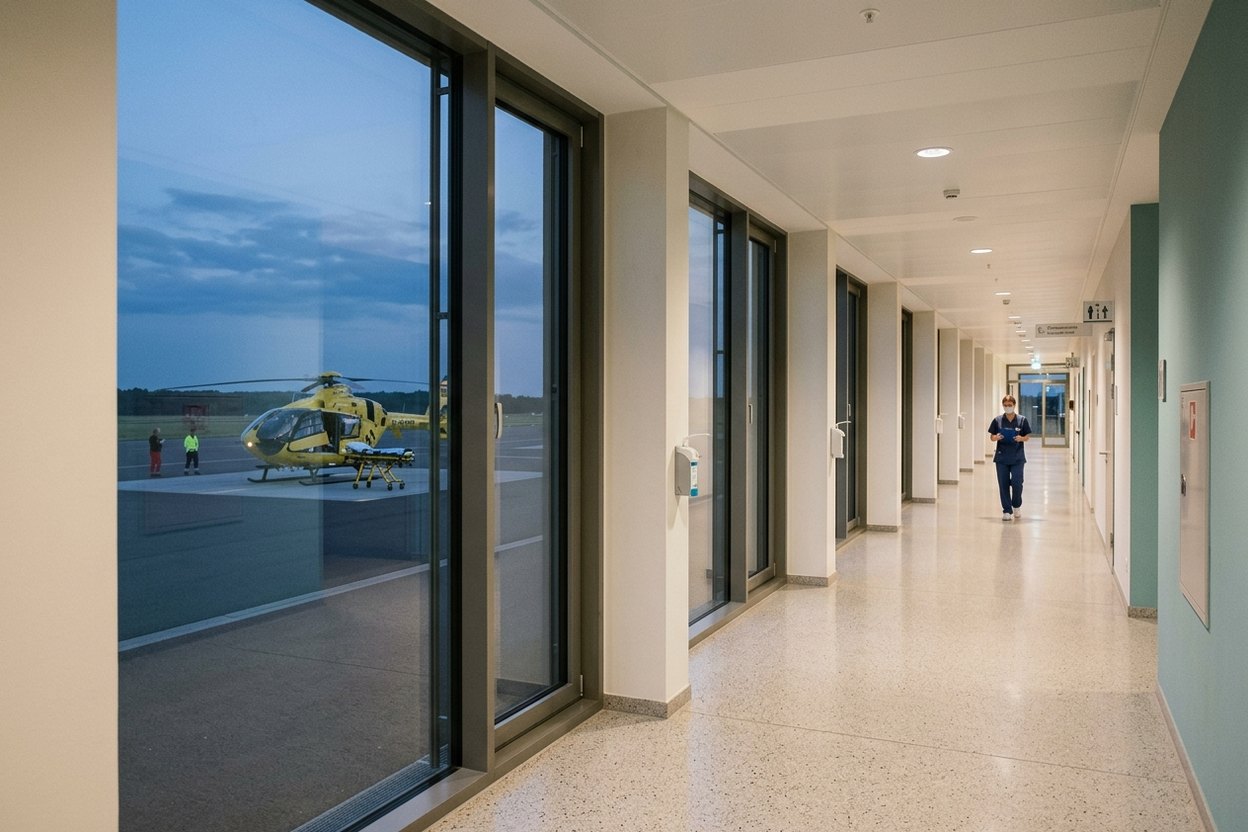
There are cases where a patient has to be brought to a German hospital quickly and an ordinary flight will not do — either because of their condition or because of the timing. That is where medical aviation comes in. Below is how an urgent transfer for treatment works and what follows what, calmly and in order.
When an air ambulance is needed
An air ambulance is needed where the patient cannot be seated in an ordinary aircraft seat: they must lie down, they need continuous monitoring, oxygen or life-support equipment. Such an aircraft is in effect a flying ward — with a stretcher, a monitor, oxygen and, where necessary, a ventilator. In flight the patient is accompanied by a medical crew rather than simply carried by an airline.
There is an intermediate option too — travel on a scheduled flight with a doctor escorting and some of the equipment, where the condition allows it. Which suits a particular case is decided by a doctor, judging whether the patient will withstand the journey and in what mode.
The “bed to bed” principle
The key idea of medical aviation is continuity. The transfer is arranged bed to bed: medical staff collect the patient from the hospital, take them to the aircraft, accompany them in flight and hand them over to the doctors at the German hospital. Between those links the patient is never left unobserved. For a seriously ill patient it is that, rather than speed in itself, that determines how safe the transfer is.
A further advantage of private and air-ambulance aircraft is access to far more airports than scheduled aviation has. That makes it possible to choose an airfield closer to the hospital and shorten the road leg, which for a seriously ill patient is often harder than the flight itself.
Children and newborns
For children the transfer is arranged separately. Newborns are carried in a special incubator that maintains the right temperature and breathing parameters, and as a rule one parent travels on board with the child. That takes some of the anxiety off both the smallest patient and the family.
What has to be in place before the flight
Medical aviation works around the clock, so technically a flight is possible at any hour. But before an aircraft can depart, several things must be settled. First the medical side: recent discharge letters and examinations, from which the doctor judges fitness to travel and chooses the type of aircraft and its equipment. Second, the receiving hospital must confirm that it will take the patient. Third, the formalities: the visa (for treatment, a national visa), flight permissions, and connecting the ground transport at both ends.
In practice the order is this: the medical documents are collected, confirmation of admission is obtained from the hospital, the doctor decides on the means of transfer, a quotation is prepared with the type of aircraft and equipment — and only then is the flight itself planned. The fuller and earlier the documents are together, the less time the preparation takes.
This material is for information only and does not replace a consultation with a doctor. Fitness to travel, the means of transfer and the equipment on board are determined by a doctor on the basis of the patient’s condition. If life is at risk, call the emergency services on 112.