 EN
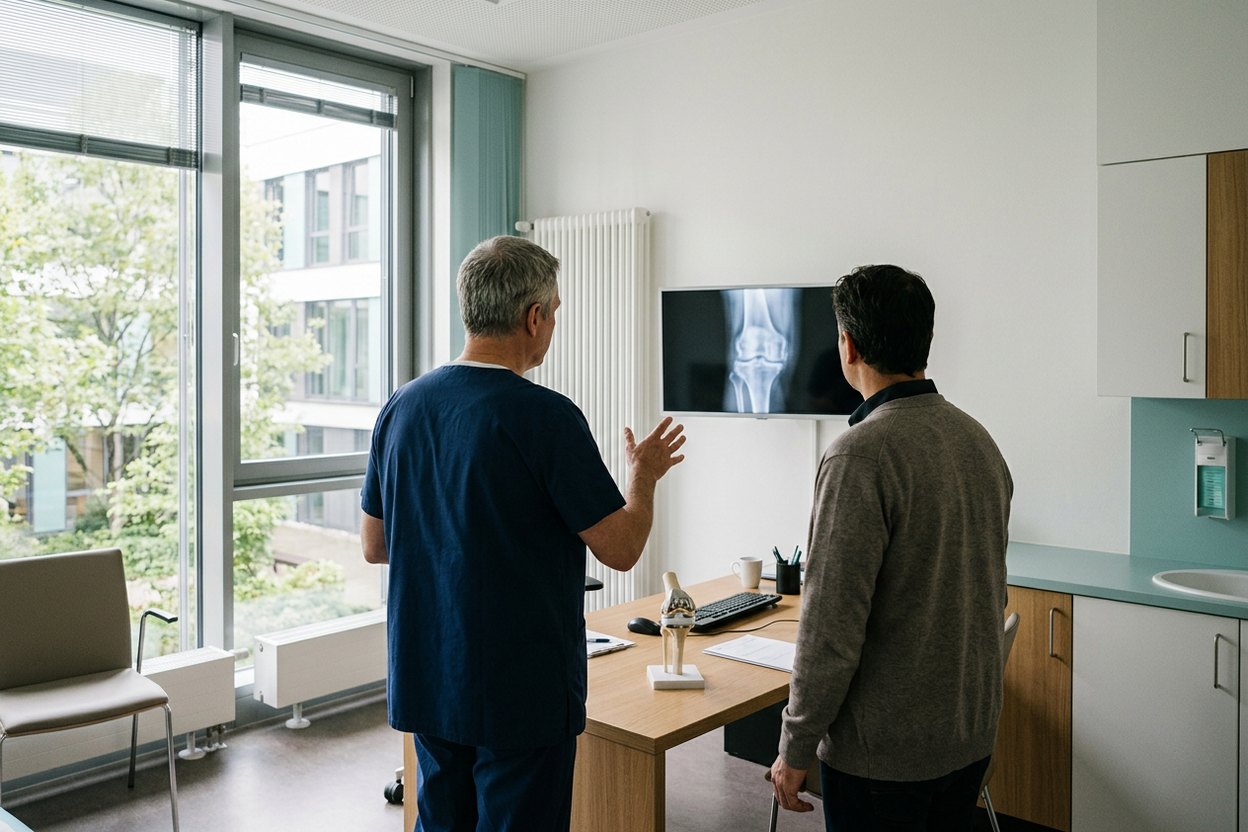
“Who is the best doctor for knee replacement surgery?” The honest answer is not a name. A surgeon who is right for a straightforward first knee in a 68-year-old is not automatically right for a failed, infected implant.
Instead, this page gives four things to verify before booking: how often the surgeon does this exact operation, what the hospital is certified for, whether revisions (repeat operations on an existing implant) are done in-house, and who sees you after discharge. The answers are in public German documents; the sections below show where. For the operation itself, see Knee joint replacement in Germany.
Why the question has no single answer
Because a new knee is the work of a team, not of one pair of hands: surgeon, anaesthetist, implant planning, ward and the physiotherapist who first gets you on your feet. A famous name in a hospital doing forty knees a year is, on average, a worse bet than a quiet chief in a department doing eight hundred. See also Orthopaedic surgeons in Germany.
Magazine rankings and doctor lists rest partly on peer surveys, patient ratings and publication counts. They show how well known a doctor is, not how many of these operations he or she did last year, how often patients needed a new implant, or anything about your knee.
A better question is: who does cases like mine often, and what happens if something goes wrong? The rest of this page answers it.
What actually predicts a good knee
One of the main predictors is how many of these operations the surgeon and department do each year, by type: total knee, partial (unicompartmental) knee or revision. In Germany, EndoCert certification registers surgeons as Hauptoperateur or Senior-Hauptoperateur only above a set annual number of operations; you may ask which role yours holds. To compare departments by volume, see Knee replacement hospitals in Germany.
Experience with awkward cases counts too: a loosened or infected implant, severe deformity, a previously operated knee. A department that treats periprosthetic infection (infection around the implant) itself need not send you elsewhere when one appears.
Finally, planning and follow-up: how implant size and leg axis are worked out beforehand, whether the same surgeon does the check-up, and who answers questions once you are home. How long implants last and why they are replaced is reported in the annual reports of the German arthroplasty registry EPRD.
How to check a German knee surgeon before you fly
Check three things: qualifications, public hospital documents and the answer to a written question. Facharzt für Orthopädie und Unfallchirurgie is the basic specialist title in orthopaedics and trauma surgery; Spezielle Orthopädische Chirurgie is a further qualification for complex orthopaedic surgery. A professorship says something about research and teaching, not about the number of knees.
German hospitals must publish a structured quality report (Qualitätsbericht) every year, listing each department’s operations by procedure code. The EndoCert certificate names the centre type: EndoProthetikZentrum, or EndoProthetikZentrum der Maximalversorgung at the highest level. This is where a search for the best knee replacement surgeon in Germany actually ends up: in a table of case numbers, not a ranking.
In your first written contact, ask: how many of these operations did you do last year, do you operate on revisions yourself, will you operate personally, and who sees me at six weeks? A department that answers in writing already tells you a lot. For another specialist’s view of your X-rays, see Second opinion from a German doctor. Whether surgery is needed at all is judged by the AWMF guideline on indications for knee replacement.
Surgeons and centres we work with
Our partners include departments where knee replacement is everyday work. Professor Yves Gramlich, chief of orthopaedics and trauma surgery at the Agaplesion Markus Krankenhaus in Frankfurt, works on hip and knee replacement, complex revisions and periprosthetic infection. He is an EndoCert-certified Senior-Hauptoperateur, a board member of the German Society for Endoprosthetics (AE) and head of its periprosthetic infection working group.
The Helios ENDO-Klinik in Hamburg, founded in 1976, calls itself Europe’s largest specialist hospital for joint replacement, sports orthopaedics and spine surgery, with a separate septic surgery department for infected implants (see Helios ENDO-Klinik Hamburg). Two more: the knee, hip, shoulder and elbow centre at the Schön Klinik München Harlaching and the joint replacement centre of the Orthopädische Klinik Markgröningen, both EndoCert-certified at the highest level.
At the DRK Kliniken Berlin Köpenick, chief physician Dr Matthias Hesse leads the trauma and orthopaedic clinic, which includes the Endoprothetikzentrum Berlin; the centre itself is headed by Dr Matthias Möller, whose work includes hip and knee replacement. These are examples, not a ranking: each match is made case by case.
Frequently asked questions
How many operations a year is enough?
For hospitals, Germany sets a binding minimum: at least 50 total knee replacements a year under Federal Joint Committee (G-BA) rules, rising to 100 from 2028 and 150 from 2030. Separate minimums for partial knees and for replacing an existing implant start in 2028. For surgeons, the yardstick is their EndoCert role.
Should my knee surgeon be a professor?
Not necessarily. In Germany a professorship is awarded for research and teaching and says nothing about how many knees a doctor operates on. Many experienced joint replacement surgeons are senior physicians without the title. More important are their EndoCert role, case numbers and whether they will operate on you personally.
Can I choose who operates on me?
Yes, if it is agreed in advance. In a German hospital, treatment by a doctor of your choice, usually the head of department, is an optional extra service (Wahlleistung), and the law requires it to be agreed in writing before treatment starts. Ask for the operating surgeon to be named in writing.
How AlenMed matches a patient to a surgeon
The match starts from your records: weight-bearing X-rays of both knees, any MRI, previous operations on that leg, and a note on weight, age and what you want to get back to. Two or three departments review them; each says whether they would operate, with what implant concept and in what order. For guide figures, see Knee replacement cost in Germany.
AlenMed works with 86 partner hospitals in 38 cities and 345 doctors; the company office is in Munich. A coordinator books the consultation, interprets at the appointment and collects the discharge letter, implant passport and rehabilitation plan before you fly home.
This material is for information only and is not an offer. The indication for surgery is set by a doctor at a face-to-face examination.