 EN
ENA novel digital diagnostic algorithm named ACS Pathfinder, developed at Universitätsklinikum Hamburg-Eppendorf (UKE), has recently received official CE certification as a Class IIb medical device and a European patent. This web-based software uses machine learning to combine troponin blood values with routine clinical parameters to calculate a patient’s individual likelihood of having a heart attack. Supported by Deutsches Zentrum für Herz-Kreislauf-Forschung (DZHK), this technology allows physicians in emergency departments to safely exclude acute myocardial infarction after just a single blood test in significantly more patients than previous standard protocols. For individuals seeking urgent medical evaluation or specialized cardiovascular care in German hospitals, this development promises faster diagnostic clarity, reduced hospital waiting times, and a lower risk of unnecessary invasive procedures during emergency visits.
Diagnostic challenges in acute chest pain
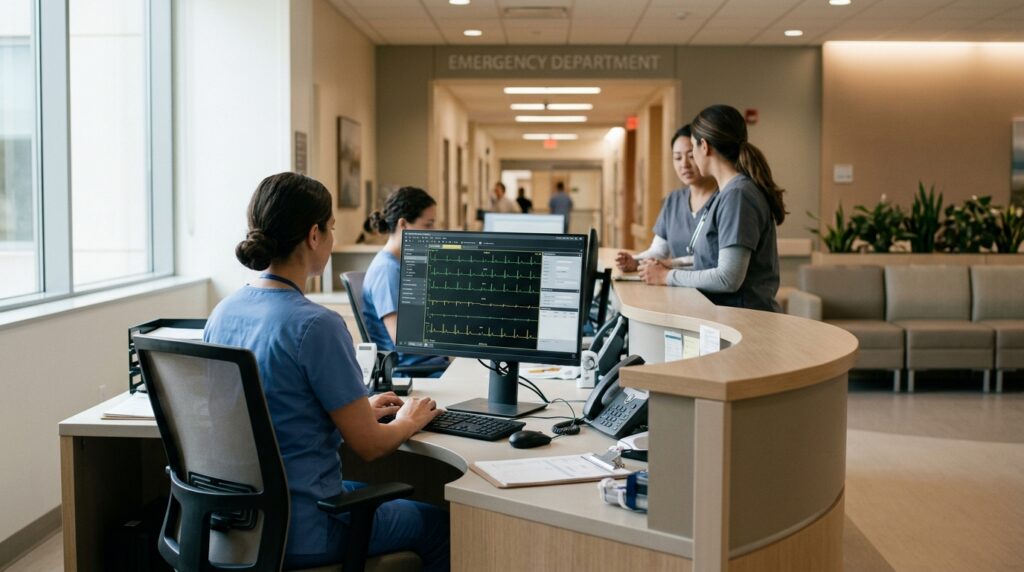
Acute chest pain is one of the most frequent reasons why patients present to hospital emergency departments worldwide. When a person experiences sudden tightness, pressure, or burning sensations in the chest, the primary clinical objective is to rapidly determine whether an acute myocardial infarction, commonly known as a heart attack, is taking place. A heart attack occurs when a coronary artery becomes blocked, depriving a portion of the heart muscle of vital oxygen and potentially causing irreversible tissue damage. However, chest discomfort can stem from numerous other conditions, ranging from benign muscle strain and digestive issues such as heartburn to pulmonary embolisms or spinal disorders. Distinguishing these causes quickly and accurately is critical for patient safety and hospital logistics.
In contemporary emergency medicine, the diagnostic routine for suspected heart attacks relies on a combination of patient history, physical examination, an electrocardiogram (ECG) to measure electrical activity in the heart, and laboratory tests for specific cardiac biomarkers. The primary biomarker utilized globally is cardiac troponin, a specialized protein released into the bloodstream when myocardial cells suffer injury. While troponin testing is highly sensitive, elevation in troponin levels can sometimes take several hours to become fully detectable after symptom onset, or can be caused by chronic cardiac conditions unrelated to an acute arterial blockage. Consequently, standard diagnostic pathways often require patients to undergo serial blood draws taken several hours apart to observe whether troponin levels remain stable or rise significantly over time.
This necessary waiting period creates significant anxiety for patients and places a substantial burden on emergency department resources. While awaiting repeated blood tests and observational telemetry, patients remain admitted to observation units, consuming valuable clinical space and physician time. For international patients traveling for specialized care or those experiencing acute symptoms while abroad, prolonged observation periods in busy emergency rooms can add further stress. Accelerating this diagnostic process without compromising patient safety has thus remained one of the most sought-after goals in modern emergency cardiology.
Machine learning and clinical validation of ACS Pathfinder

To address this diagnostic delay, researchers at Universitätsklinikum Hamburg-Eppendorf (UKE) developed ACS Pathfinder, an innovative web-based application driven by machine learning algorithms. The system functions by combining initial laboratory cardiac troponin concentrations with basic clinical parameters that are routinely collected upon admission, such as patient age, heart rate, and specific electrocardiogram findings. By analyzing these parameters concurrently, the algorithm calculates a precise, individualized probability score indicating whether the patient’s symptoms are caused by an acute coronary syndrome. The foundational development and initial clinical validation of this artificial intelligence tool were supported by Deutsches Zentrum für Herz-Kreislauf-Forschung (DZHK) and incorporated comprehensive data from more than 27,000 patients across nine countries.
The practical efficiency of ACS Pathfinder lies in its ability to safely rule out a heart attack much earlier in the diagnostic pathway. In preliminary clinical investigations, the algorithm successfully and safely excluded acute myocardial infarction after a single blood troponin measurement in an average of 36 percent of presenting patients. By comparison, established standard reference diagnostic protocols are able to safely rule out a heart attack after the first blood test in only about 14 percent of patients. By more than doubling the proportion of individuals who can be safely reassured after a single blood sample, the tool significantly reduces unnecessary hospital stays, prevents redundant diagnostic tests, and enables healthcare teams to focus their resources on critically ill individuals who require immediate interventional procedures.
Following these promising initial results, the academic founders established ART-EMIS Hamburg GmbH in 2023 as a dedicated spin-off company of UKE to further refine and commercialize the software for routine clinical use. A major regulatory milestone was achieved when ACS Pathfinder received CE certification as a Class IIb medical device, alongside the granting of a European patent in September 2026. CE certification within Class IIb confirms that the software meets stringent safety, performance, and risk management standards required for active diagnostic software operating in high-stakes clinical environments within the European Union.
Clinical trials and future outlook for patients

While CE certification permits the commercial availability of the software, rigorous clinical evaluation in everyday hospital operations continues. Deutsches Zentrum für Herz-Kreislauf-Forschung (DZHK) is funding a major prospective study designated as CHASE-MI-DZHK33 to evaluate the algorithm under real-world conditions. Co-led by study directors and co-inventors Prof. Johannes Neumann and Prof. Raphael Twerenbold from UKE, the study involves 658 patients presenting with clinical suspicion of acute myocardial infarction across emergency departments at six participating German medical centers. In this randomized clinical trial, scheduled to begin in late 2026, patients will be randomly evaluated using either current standard diagnostic pathways or the ACS Pathfinder protocol to directly measure discharge rates and diagnostic safety after the initial troponin assessment.
As Prof. Johannes Neumann and Prof. Raphael Twerenbold emphasize, proving the efficiency and safety of ACS Pathfinder in real-world clinical practice is essential before widespread integration into routine emergency care. For international patients seeking emergency care or comprehensive cardiovascular check-ups in German university hospitals, the ongoing integration of such AI-assisted tools reflects Germany’s leadership in high-tech cardiology. Patients visiting top-tier centers in Germany can benefit from advanced diagnostic infrastructure where cutting-edge algorithms work in tandem with experienced cardiologists to deliver precise risk stratification within hours of admission.
Patients and their families considering diagnostic evaluation or cardiovascular care in Germany should understand that ACS Pathfinder is designed as a supportive decision tool for medical professionals, not a standalone replacement for clinical judgment. When consulting with German specialists, patients may inquire whether the medical center utilizes algorithm-supported biomarker evaluation in their emergency or chest pain units. Understanding these advancements helps patients appreciate how modern German hospitals combine multi-center clinical research, strict regulatory oversight, and innovative digital health solutions to deliver rapid, safe, and highly personalized cardiac care.