 EN
Researchers from Germany and the United States have established a novel approach to evaluating therapeutic success in ulcerative colitis based on the individual speed of clinical improvement. In a joint study published in the journal Nature Medicine, teams from the Excellence Cluster PMI in Kiel and the Center for Human Immunobiology at Northwestern University Feinberg School of Medicine in Chicago demonstrated that patients fall into four biologically and clinically distinct trajectory groups. For international patients seeking specialized care in German medical centers, these findings highlight the growing potential of early personalized monitoring to optimize therapeutic outcomes and prevent long-term complications.
Understanding Ulcerative Colitis and Its Daily Impact on Patients

Ulcerative colitis is a chronic inflammatory bowel disease that primarily affects the mucosal lining of the large intestine. The condition frequently presents in adolescents and young adults, disrupting crucial stages of education, professional development, and personal life. Common clinical manifestations include persistent diarrhea, severe abdominal cramping, rectal bleeding, and overwhelming physical exhaustion. Because the disease follows a course characterized by unpredictable flare-ups and periods of temporary remission, affected individuals often struggle to maintain routine social activities or work commitments.
When mucosal inflammation remains uncontrolled over prolonged periods, the risk of serious disease complications increases significantly. Patients may experience severe intestinal hemorrhaging, acute colonic dilation, or progressive tissue damage that eventually necessitates surgical intervention, including total removal of the colon. Furthermore, chronic inflammation of the colonic tissue over many years elevates the long-term risk of malignant transformation. Consequently, modern gastroenterology aims to achieve deep, durable mucosal healing and long-term disease control rather than temporary symptom relief.
Traditionally, clinical evaluation of treatment response relied on binary endpoints assessed many months after initiating therapy, categorizing individuals simply as responders or non-responders. However, this static approach failed to account for early functional dynamics and biological variations between individual patient courses. Recognizing the clinical significance of early treatment velocity represents a fundamental shift toward more responsive, individualized patient care strategies.
Current Standards of Diagnosis and Medical Care in German Hospitals
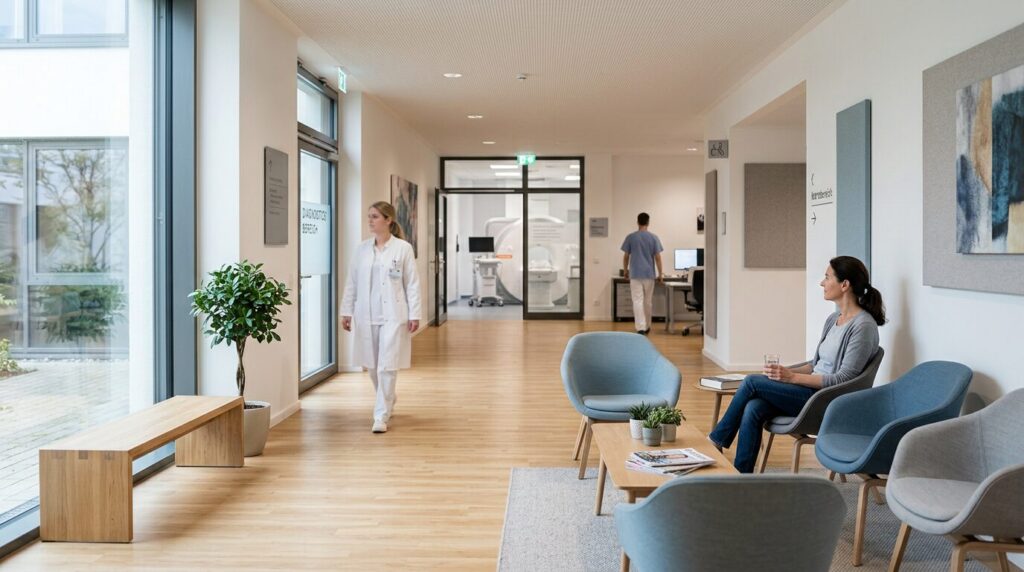
University hospitals in Germany employ comprehensive, evidence-based diagnostic and therapeutic protocols for managing chronic inflammatory bowel diseases. The diagnostic workup routinely includes high-definition video endoscopy, detailed histological evaluation of tissue biopsies, and non-invasive monitoring of inflammatory biomarkers. German gastroenterologists utilize these precise diagnostic tools to accurately determine disease extent, structural mucosal damage, and inflammatory activity before tailoring individual treatment plans.
For moderate to severe forms of ulcerative colitis, medical management in Germany relies heavily on advanced targeted biologic therapies. Key options include integrin receptor antagonists such as vedolizumab and tumor necrosis factor inhibitors such as adalimumab. These biological agents target specific molecular pathways to block the migration of inflammatory white blood cells into the bowel wall or neutralize systemic inflammatory signals responsible for mucosal destruction.
Selecting the appropriate biologic agent requires careful clinical evaluation, considering individual risk profiles and prior treatment history. While these targeted therapies have transformed disease management, a subset of patients fails to achieve adequate clinical response. German academic centers continually refine monitoring strategies to detect treatment non-response early, ensuring timely adjustment of therapeutic regimens while maintaining high safety standards.
Scientific Discoveries by the Kiel and Chicago Research Consortium

The scientific collaboration led by Professor Stefan Schreiber of CAU and UKSH in Kiel and Dr. Parambir Dulai from Northwestern University Feinberg School of Medicine analyzed detailed clinical data from the VARSITY trial involving 768 participants. This direct head-to-head clinical trial evaluated the comparative efficacy of the integrin blocker vedolizumab against the TNF inhibitor adalimumab. The research team further validated their findings using an independent cohort of 576 patients from Takeda approval trials for vedolizumab.
The study revealed that patients receiving either medication can be classified into four distinct trajectory groups based on how quickly their clinical symptoms improve. Individuals exhibiting rapid early improvement were significantly more likely to achieve comprehensive long-term disease control. Over a seven-year observation period, these fast responders experienced substantially fewer hospital admissions and a lower rate of surgical colon removal compared to slow or non-responding groups.
Using high-resolution single-cell and spatial tissue analysis, the researchers identified a cellular mechanism explaining why vedolizumab is ineffective in certain individuals. They discovered that activated SPP1-positive macrophages reside near blood vessels in the intestinal lining but lack the specific integrin docking molecules targeted by vedolizumab, allowing inflammation to persist via alternative pathways. Additional observational analysis of the US databases TriNetX and Optum, comprising 8,835 patients with ulcerative colitis and high blood pressure, indicated that concomitant use of blood pressure medications such as ACE inhibitors or ARBs enhanced the clinical effectiveness of vedolizumab.
Clinical Implications for International Patients Seeking Care in Germany

These landmark research findings offer concrete prospects for enhancing precision medicine in chronic inflammatory bowel diseases. For patients travelling to specialized university centers in Germany, understanding early response trajectories allows medical teams to establish clearer prognosis timelines and tailor intervention strategies early in the treatment process. As noted by Professor Philip Rosenstiel from UKSH, identifying specific vascular cellular mechanisms provides a biological foundation for prospective combination therapies.
While the clinical association between blood pressure medications and enhanced vedolizumab response is promising, researchers emphasize that prospective controlled clinical trials are required before treatment protocols can be formally altered. Patients currently undergoing treatment should not modify their medication regimens independently or begin taking antihypertensive drugs without explicit medical advice and supervision from their treating gastroenterologist.
By consulting expert gastroenterology departments in German medical facilities, international patients benefit from state-of-the-art diagnostic evaluations and personalized therapeutic strategies. Incorporating trajectory-based monitoring into clinical practice enables German physicians to make timely, informed decisions, optimizing biologic treatment regimens to deliver the best possible long-term outcomes for each individual.
Source: PMI Exzellenzcluster Präzisionsmedizin für chronische Entzündungserkrankungen