EN
EN
Treatment for neurological disease in Germany starts with an accurate diagnosis, because such illness is rarely simple. By the time treatment abroad comes up, a person usually has numbness, weakness, dizziness or unexplained pain, and a pile of test results with no clear conclusion. German neurology answers that first: not by treating “the nerves” in general, but by finding which structure is failing, why, and what can realistically be done.
A search for neurology in Germany usually means one of two things: making sense of an unclear diagnosis, or changing a therapy that has stopped working. This section covers the treatment of diseases of the nervous system in Germany, from acute stroke to chronic conditions managed over years.
Why people come to Germany for neurology
The main reason is the accuracy of the diagnosis, on which almost everything in neurology depends: similar symptoms may come from the vessels, inflammation, a compressed nerve or a degenerative process in which nerve cells are gradually lost, and each needs different treatment. The German system is built around that accuracy, with strong diagnostics and departments specialised in particular conditions.
Stroke shows this most clearly. Germany has a network of more than 340 certified stroke units, specialised wards where acute stroke is managed to a clear protocol from the first minutes. Certification is issued by the German Stroke Society together with the Deutsche Schlaganfall-Hilfe foundation and means the unit has demonstrated both its equipment and its team’s training. Munich’s university hospitals — TUM Klinikum Rechts der Isar and the hospital of Ludwig Maximilian University (LMU) — work on the same principle: a complex case is reviewed by a team of neurologist, neurosurgeon and radiologist, not by one doctor.
Strong neurology departments exist across the country, not only in the big cities, and for a planned patient the department’s profile matters more than the city’s fame. At Essen University Hospital the Department of Neurology is directed by Prof. Christoph Kleinschnitz, whose areas include multiple sclerosis, stroke and neurological intensive care. Neurology at Krankenhaus Nordwest in Frankfurt is headed by Prof. Uta Meyding-Lamadé. At Tübingen University Hospital the department focused on cerebrovascular disease is led by Prof. Ulf Ziemann. Further names are on the page about neurologists in Germany.
First, an accurate diagnosis
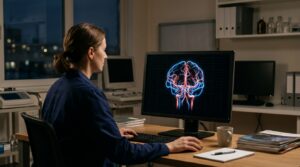
Treatment starts not with prescriptions but with checking the diagnosis: a German doctor first wants the whole picture. MRI and CT show the structure of the brain and spine, ultrasound and angiography the vessels feeding the brain. Assessment in Germany not infrequently refines or changes a diagnosis made at home, and the whole plan changes with it.
Where nerves and muscles are affected, functional methods are added: electroencephalography (EEG), which records the brain’s electrical activity and matters in epilepsy, and electroneuromyography, which measures how well a nerve carries its signal to the muscle. Where inflammation or multiple sclerosis is suspected, the cerebrospinal fluid is examined. The set is matched to the question rather than ordered all at once.
So that the assessment does not start from nothing, the documents are sent in advance: MRI and CT images as files on a disc rather than printouts, the radiology reports, discharge letters and all current medication with doses. Without the MRI files a remote review is impossible: a printout or photo shows a few selected slices, while the specialist needs the whole series to scroll through and compare with new images.
The main disease groups and where each path leads
The patient’s path depends on which of four broad groups the disease belongs to. The first is vascular emergencies: stroke and its after-effects. Acute help cannot wait, so it is given in the nearest stroke unit. A trip to Germany comes later, to find the cause, choose prevention of a second stroke and begin the long work of recovery; see stroke treatment in Germany.
The second group is demyelinating and degenerative disease. In multiple sclerosis the immune system damages the myelin sheath of the nerve fibres; in Parkinson’s disease the dopamine-producing brain cells are gradually lost. No single course cures these conditions, so the task is not to “cure it during the trip” but to find a therapy that keeps the disease under control and preserves quality of life, then set up monitoring at home. An honest clinic puts the goal that way, without promising a complete cure. See multiple sclerosis treatment and Parkinson’s disease treatment.
The third group is epilepsy. According to WHO estimates, up to 70% of people with epilepsy could live seizure-free if properly diagnosed and treated, so the diagnosis and the type of seizures are checked first. Video-EEG monitoring records brain activity for hours or days alongside video, showing what happens during a seizure. The second question is drug resistance: if well-chosen medicines fail to control the seizures, surgery is discussed. More on epilepsy treatment in Germany.
The fourth group is neuromuscular and rare disease, such as myasthenia gravis or amyotrophic lateral sclerosis (ALS). Here the whole value of the trip lies in the accuracy of the diagnosis: symptoms are often vague, and confirmation needs electroneuromyography, antibody tests, sometimes genetic testing, and doctors who see these conditions regularly. Each group has its own pages in this section, linked at the end of this page.
How the treatment is chosen
Treatment is chosen by the diagnosis, how long the symptoms have lasted and whether the process is reversible; there is no single formula in neurology, and saying so is an honest sign. In a vascular emergency the count is in hours, in chronic disease months and years of careful management. So treatment is almost always combined: drug therapy alongside rehabilitation, exercise therapy and work on speech and movement, without which recovery after a stroke or an injury simply does not happen.
Surgery comes in where conservative methods are exhausted or inappropriate: for a disc herniation compressing a nerve, say, or for a tumour. The German approach here is restrained — operations follow indications rather than being done “just in case”, and follow approved protocols in which every step is justified. Brain and spine operations are done by neurosurgeons, and neurosurgery has its own section on this site.
The hospital puts the result in writing: the diagnosis and its basis, the proposed treatment, the timing and the next steps, from follow-up tests to rehabilitation. A good plan names the alternatives, not just one option, with the benefits, risks and burden of each. This is no formality: the German Civil Code requires a doctor to point out alternatives where several equally indicated, standard methods carry substantially different burdens, risks or chances of recovery. The family can then decide, and the doctor at home has clear instructions.
Rehabilitation is part of the treatment, not an extra
In Germany rehabilitation is planned together with treatment, not after it: this is where movement, speech and independence are rebuilt as far as possible. What people rarely expect is that German neurological rehabilitation runs in stages: the phase model of the Federal Rehabilitation Council (BAR) leads from acute treatment and early rehabilitation, still under hospital conditions, to continued rehabilitation in a specialist house and further support. The place is booked before discharge, not after it, and for a patient from abroad preferably before the trip.
Some real addresses. At Kliniken Schmieder, neurorehabilitation in Allensbach is led by Professor Joachim Liepert. The Godeshöhe neurological rehabilitation centre in Bonn and the m&i specialist hospital in Bad Heilbrunn also take severely affected patients for early rehabilitation. The choice of house depends on how independent the patient is: someone bedbound who needs constant care requires early rehabilitation under medical and nursing supervision, while someone who walks unaided needs training and a return to everyday life. More addresses are on the page on neurology and neurorehabilitation clinics in Germany.
What rehabilitation does not promise: recovery is uneven, periods of fast progress alternate with long plateaus, and the exact result cannot be predicted. An honest hospital states the goal as preserving function and independence, not as a full return to how things were. The cost is set by the rehabilitation hospital’s estimate.
Frequently asked questions
How much do a neurology consultation and tests cost in Germany?
The consultation and the tests are paid separately, and the total depends on what is needed. As a guide: a consultation with a doctor on the results costs from €130, MRI of the head around €800, with contrast €900–1,000, MRI of the whole spine around €950, and CT around €500. EEG, the hospital stay and treatment are charged according to the hospital’s cost estimate (Kostenvoranschlag), which the patient receives before the trip.
Do I need to be admitted to hospital for a neurological assessment?
Usually not: MRI, CT, vascular ultrasound, EEG and electroneuromyography are done as outpatient tests over several visits. Admission is needed for longer observation, such as video-EEG monitoring in epilepsy, or when many tests are easier to fit into a short hospital stay. The hospital proposes the format after reviewing the documents, and the estimate depends on it.
Can a therapy that has stopped working be changed in Germany?
Yes, it is a common reason for the trip. But the starting point is a review, not a new regimen: whether the diagnosis holds, whether the doses are right and how the medicines are actually taken. Sometimes the problem lies in the diagnosis, not the drug. The hospital therefore needs reports listing every previous regimen, how long it was taken and why it was stopped. The new plan is issued in writing so that treatment can continue at home.
A second opinion, and how AlenMed arranges treatment
If the diagnosis has already been made at home but doubts remain, it makes sense to start with a second opinion. A German neurologist studies your images and reports and says whether they agree with the diagnosis and the plan. Sometimes that changes the treatment; sometimes it spares an intervention that is not in fact needed.
AlenMed then takes over the organisation: remote review of the documents, matching the hospital to the diagnosis, the request, the official cost estimate (Kostenvoranschlag), the visa invitation and a medical interpreter at consultations. With neurological complaints the interpreter is needed during testing too: memory, speech and attention tests rely on exact wording, and a question passed on inaccurately can distort the result.
The patient takes home a written treatment plan, the reports on every test, and instructions on rehabilitation and on when to repeat the follow-up tests, so that their own doctor can carry the treatment on.
This material is for information only and is not an offer. Whether treatment is possible and what it involves is determined only after an examination at the hospital in person, and the treatment approach is decided by the doctor at a face-to-face consultation.
Individual conditions
News on this topic
PIRATE Project Refines Individual Brain Aneurysm Risk Assessment
German researchers launch the PIRATE project to personalize brain aneurysm rupture risk analysis using 4D flow MRI, hydrodynamics, and machine learning.