EN
Fracture treatment in Germany usually means surgery for one of two problems: a fresh, severe injury that needs help now, or an old fracture that healed crookedly or never healed, causing months of pain and a limp. The second can almost always be addressed, though it is harder than a first operation.
This page covers planning, implants, treatment of a non-union and of infection after earlier surgery, and recovery time. For an overview, see trauma surgery in Germany.
A fresh injury and an old problem are two different requests
With a fresh injury the clock matters more than the country: help is given where the person is. Germany has a network of certified trauma centres at three levels — local, regional and supra-regional — which the German Trauma Society (DGU) links with the rescue services into trauma networks.
If the injury happens during a trip to Germany, the order is different: emergency department, urgent surgery if needed, and only then transfer or continued treatment. See emergency treatment in Germany.
Most requests from abroad concern the aftermath: a non-union (Pseudarthrose in German), a fracture healed with displacement or shortening, a stiff neighbouring joint, or hardware that is in the way or infected. In a non-union, or false joint, scar tissue fills the gap instead of bone, so the bone moves and hurts under load.
What is examined before surgery
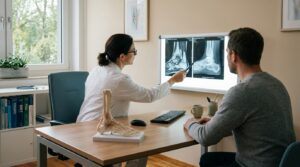
Before surgery the surgeon reviews X-rays in standard views and a CT scan; for an old problem, a CT with three-dimensional reconstruction shows displacement and rotation, and where and by how much the bone must be turned. The operation is planned by a trauma surgeon in Germany.
If the bone was operated on and infection is suspected, blood tests for inflammation and cultures are added; under the German guideline, the samples are deep tissue taken during the operation itself. Treating a non-union without ruling out infection is pointless, as infection often blocks healing, and German surgeons insist on the check.
Blood supply and nerves around the fracture, skin and soft tissue, vitamin D and calcium metabolism are checked too, and smoking, which impairs blood flow and healing, is discussed. These findings decide whether one operation is enough or two stages are needed.
Fixation and bone reconstruction
Bone is held with plates, screws, intramedullary nails, wires or an external fixator, chosen so that the person starts moving as early as possible instead of spending months in a cast.
An angular stable plate, with screws locked into it, grips even fragile bone near joints or in older people. Single screws fix small fragments, say at the ankle. An intramedullary nail runs inside a broken thigh, shin or upper arm shaft. In children, thin wires hold the fragments and spare the growth plates. Open or contaminated fractures may first get an external fixator, pins joined by an outside frame, before final surgery.
For a non-union the surgeon removes dead tissue, restores the axis and fixes the bone more stably. Missing bone is replaced with iliac crest graft or by the two-stage Masquelet technique: a temporary cement spacer, around which a membrane forms over weeks, then the patient’s own bone. Heidelberg University Hospital treats non-unions this way; its Department of Trauma and Reconstructive Surgery is headed by Professor Gerhard Schmidmaier.
A fracture that healed out of position is corrected by osteotomy: the bone is deliberately divided where the CT plan shows, realigned and fixed again. If it was operated on before, hidden infection is ruled out first; the German medical societies’ guideline on infection after fracture fixation describes how.
Timing, loading and rehabilitation
Recovery starts within days: pain is controlled, and a physiotherapist teaches the patient to move within the load the surgeon allows, given as a percentage of body weight or in kilograms. A control X-ray follows before discharge.
The stay depends on the operation; the surgeon sets the flight date after the control X-ray, weighing the thrombosis risk. The written loading plan, also meant for the doctor at home, must not be run ahead of: bone loaded too early can shift. For older people with a hip fracture, walking again quickly matters as much as the bone, so a new joint is often fitted instead (see joint replacement in Germany). Geriatric trauma units care for them: at Nuremberg Hospital’s geriatric trauma centre, trauma surgeons led by Professor Hermann Josef Bail work with geriatricians, and patients are moved in bed straight after surgery.
Treatment then usually continues in a rehabilitation clinic with daily therapy, gait training and, after arm fractures, work on hand function; see orthopaedic rehabilitation in Germany. The result depends on age, the fracture and discipline with loading, and no one can guarantee it.
Frequently asked questions
Can an old fracture that healed crookedly still be corrected?
Often, yes: time alone does not rule out a corrective osteotomy. What matters more is the state of the bone, the neighbouring joint and soft tissue, and general health. If the nearby joint is badly worn, a joint replacement may be better. The surgeon decides in person.
Does the plate or nail have to come out after healing?
Not always. Hardware is removed if it causes pain or irritation, if it is infected, and in younger people often at their own request. In older people it is usually left in place, since removal is a separate operation with its own risks. Children’s wires are generally removed after healing.
How much does fracture treatment in Germany cost?
Only the hospital’s cost estimate gives an exact figure, drawn up after the images and reports are reviewed. It covers examinations, the operation, the implant and the hospital stay; rehabilitation is usually costed separately. Revision surgery for a non-union or malunion is usually more complex than a first operation.
How AlenMed arranges treatment
AlenMed has 86 partner hospitals in 38 cities and 345 doctors; the company office is in Munich. Partners include the Berlin trauma centre, opened in 1997, with more than 730 beds: it takes severely injured patients from all over Germany and has a centre for severe burns. Hospitals are chosen for the nature of the problem, not the loudness of a name.
The company translates discharge summaries and operation reports, sends images to a surgeon for a remote opinion, requests the cost estimate, arranges the visa invitation, meeting, transfer and a medical interpreter, and passes the loading plan and discharge summary to the doctor at home.
This material is for information only and is not an offer. The surgeon decides the extent of surgery after an in-person examination and the hospital’s own imaging.
News on this topic
Modern Ankle Fracture Care: Early Mobility and Individualized Strategies in Germany
A comprehensive review in Deutsches Ärzteblatt International reveals that ankle fractures do not always require surgery or six weeks of strict immobilization.