 EN
ENA comprehensive study of real-world clinical care conducted by the Deutscher Krebsregister e.V. and published in the journal ESMO Real World Data and Digital Oncology demonstrates high treatment efficacy for early breast cancer in Germany. Analyzing routine clinical data from 43,214 patients with hormone receptor-positive, HER2-negative tumors, researchers determined that the probability of living five years post-surgery without a cancer recurrence or new invasive malignancy reaches 82.9 percent. These findings reflect everyday medical outcomes across German healthcare institutions, offering international patients and their families evidence-based insights into long-term prognoses.
Understanding Early HR-Positive, HER2-Negative Breast Cancer

Hormone receptor-positive, HER2-negative breast cancer represents the most prevalent molecular subtype of the disease, accounting for approximately 73 percent of all primary breast malignancy diagnoses. In this subtype, tumor cell growth is primarily fueled by the female sex hormones estrogen and progesterone, while the HER2 protein is not overexpressed on the cell surface. In clinical oncology, this subtype is generally characterized by a relatively favorable prognosis compared to other biological variants.
Despite generally positive treatment outcomes, the biological characteristics of malignant tissue mean that a risk of disease recurrence persists over time. Even following successful surgical resection and initial systemic therapy, some patients experience local recurrence, regional lymph node involvement, or distant metastatic spread. The probability of such events is influenced by individual tumor biology, baseline disease extent, and specific patient risk factors.
While early breast cancer predominantly affects female patients across various age groups, it can also develop in male patients. Although men constitute a small proportion of the total patient population, their clinical presentation and disease course require specialized attention. Understanding these baseline risk profiles enables oncologists to tailor long-term treatment strategies appropriately for every individual.
Current Diagnostic and Therapeutic Pathways in German Clinics
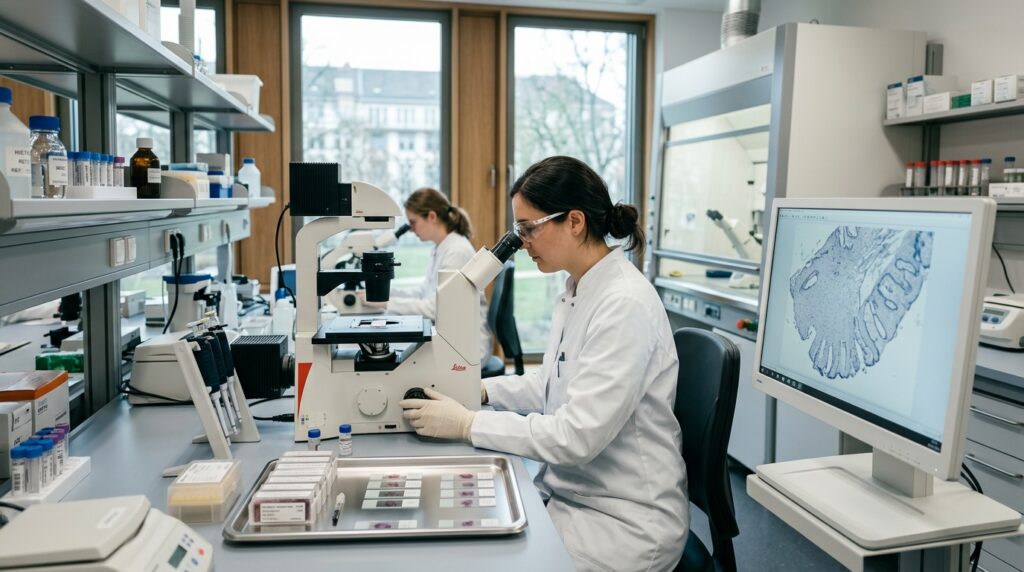
Breast cancer management in German medical centers relies on multidisciplinary care pathways and strict adherence to evidence-based clinical guidelines. Initial diagnostic evaluations encompass digital mammography, high-resolution ultrasound, magnetic resonance imaging, and mandatory core needle biopsy for histological and immunohistochemical assessment. These diagnostic steps precisely determine hormone receptor status, HER2 expression, and tumor cell proliferation markers to guide individualized treatment planning.
Surgical intervention remains the primary therapeutic modality for early-stage disease, with breast-conserving surgery and sentinel lymph node dissection performed whenever clinically feasible. In German routine care, surgical procedures are typically executed shortly after initial diagnosis. Depending on individual pathological findings, surgery is followed by adjuvant radiation therapy, extended endocrine therapy to block hormonal stimulation, and systemic chemotherapy or targeted agents in higher-risk scenarios.
Long-term post-treatment surveillance in Germany is structured to detect potential disease recurrence or treatment-related side effects at the earliest possible stage. Follow-up protocols include regular physical examinations, imaging studies, and monitoring of treatment compliance during extended endocrine therapy. This systematic approach aims to preserve quality of life while maintaining robust disease control over many years.
Large-Scale German Registry Findings and Specific Survival Outcomes

The newly published registry study analyzed real-world data from 42,830 women and 384 men diagnosed with stage I to III hormone receptor-positive, HER2-negative early breast cancer between 2017 and 2021. The investigation pooled patient information from eight regional clinical cancer registries spanning Bavaria, Brandenburg-Berlin, Bremen, Hamburg, Hesse, North Rhine-Westphalia, Saarland, and Schleswig-Holstein. Together, these registries cover approximately 45 million residents, representing about 54 percent of the German population. Inclusion criteria required surgery within four months of diagnosis and a minimum follow-up window of two years.
The primary outcome measured was invasive disease-free survival (iDFS), defined as the time to the first occurrence of local or regional breast cancer recurrence, distant metastasis, a second primary invasive cancer, or death from any cause. Over a median follow-up period of 47 months, an iDFS event occurred in 5,635 of the 43,214 analyzed patients. Among these events, 2,142 represented a breast cancer recurrence as the first documented event, 1,415 involved a second primary invasive malignancy, and 2,078 deaths occurred without a prior recorded recurrence or second tumor.
Statistical survival analysis revealed an estimated three-year iDFS probability of 90.1 percent and a five-year iDFS probability of 82.9 percent. Prognosis varied markedly according to anatomical stage and nodal status. Patients with stage I disease achieved a five-year iDFS rate of 89.4 percent, compared to 61.9 percent for those with stage III disease. Patients without lymph node involvement showed a five-year iDFS of 86.1 percent, whereas those with extensive nodal involvement categorized as N2 or higher had a five-year iDFS rate of 59.7 percent.
Multivariable analysis confirmed that larger tumor size, advanced lymph node involvement, and higher histological grading were independently associated with lower iDFS rates. An elevated risk of iDFS events was also identified in patients aged 75 years and older, as well as in male patients. The study was funded by IQVIA Commercial GmbH & Co. OHG, with research led by Paula Grieger and Prof. Dr. Alexander Katalinic from the Institut für Sozialmedizin und Epidemiologie der Universität zu Lübeck.
Practical Significance for International Patients Seeking Care in Germany

The major strength of this registry evaluation lies in its reflection of everyday health care outcomes across a broad, unselected patient population. As highlighted by Prof. Dr. Alexander Katalinic of the Deutscher Krebsregister e.V. and the University of Lübeck, real-world registry data complement randomized clinical trials by demonstrating how medical treatments perform in routine practice. For international patients seeking treatment in Germany, these findings offer reliable reassurance regarding the quality and consistency of standard oncological care.
The study also underlines the critical importance of extended follow-up and comprehensive risk assessment. Lead author Paula Grieger noted that while overall five-year outcomes are highly favorable, hormone receptor-positive breast cancer requires sustained vigilance because recurrences can occur beyond the initial five-year window. This highlights the necessity of strictly adhering to prescribed long-term endocrine therapies and maintaining regular oncology consultations.
For individuals planning medical travel to Germany, these real-world data provide concrete reference points for consultations with attending specialists. Patients are encouraged to discuss their specific tumor stage, histological grade, and lymph node status with their medical team. Understanding these parameters helps physicians design tailored treatment plans that optimize long-term disease control while minimizing unnecessary therapeutic toxicity.
Source: Deutsche Krebsregister e.V.