 EN
ENA newly approved photovoltaic retinal implant offers restored visual function to patients suffering from central vision loss due to advanced dry age-related macular degeneration. Announced by Professor Dr. med. Lars-Olof Hattenbach, President of the Deutsche Ophthalmologische Gesellschaft, at the DOG 2026 congress press conference, the tiny subretinal chip known as PRIMA converts invisible light into electrical impulses that stimulate remaining optic nerve cells. Following positive results from an international multicenter trial published in the New England Journal of Medicine, the device received European CE marking in July 2026. This technological breakthrough marks a fundamental shift in ophthalmic medicine, enabling individuals who had lost central sight to regain letter and word recognition through specialized treatment and structured rehabilitation in ophthalmic centers in Germany.
A Photovoltaic Microchip to Replace Damaged Photoreceptors in Geographic Atrophy
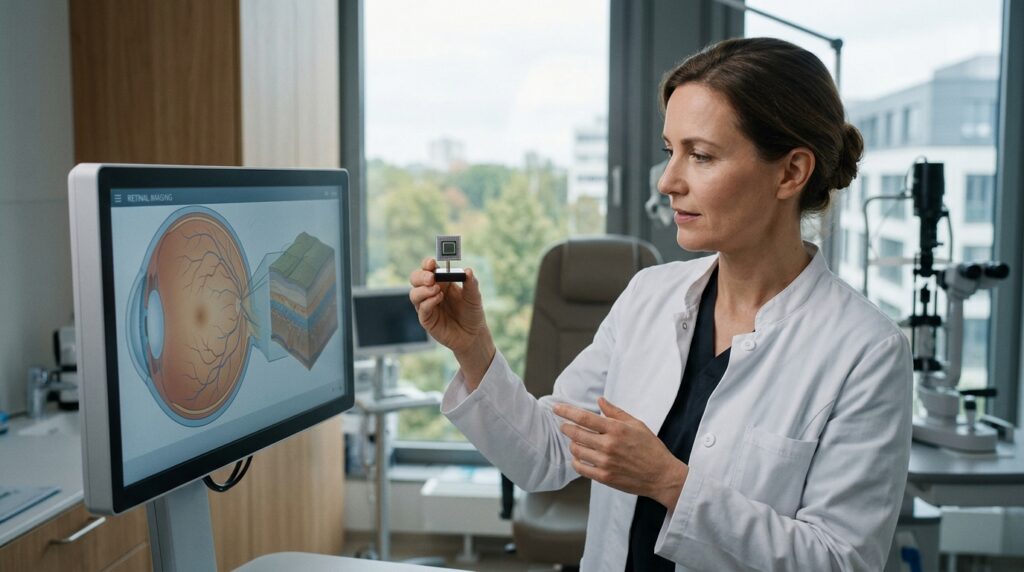
Age-related macular degeneration represents one of the primary causes of severe visual impairment among older adults worldwide. In Germany alone, approximately one million individuals live with a diagnosed form of AMD, and roughly 400,000 of them suffer from geographic atrophy, the advanced dry stage of the disease. In geographic atrophy, the light-sensitive photoreceptor cells located in the macula—the central region of the retina responsible for sharp vision—gradually degenerate and die. As a consequence, affected individuals progressively lose their central field of vision, which severely compromises their ability to read, recognize faces, navigate everyday surroundings, or perform routine independent tasks.
While recently developed medications can help slow down the progression of geographic atrophy, medical science previously lacked any therapeutic option to reverse functional losses that had already occurred. The PRIMA retinal chip system was specifically designed to bridge this critical gap by taking over the functional role of destroyed photoreceptor cells. At the core of the system is a miniature photovoltaic implant measuring just two by two millimeters in size and approximately 30 micrometers in thickness. Containing 378 individual photovoltaic pixels, this ultra-thin microchip is surgically placed directly beneath the retina in the area affected by geographic atrophy.
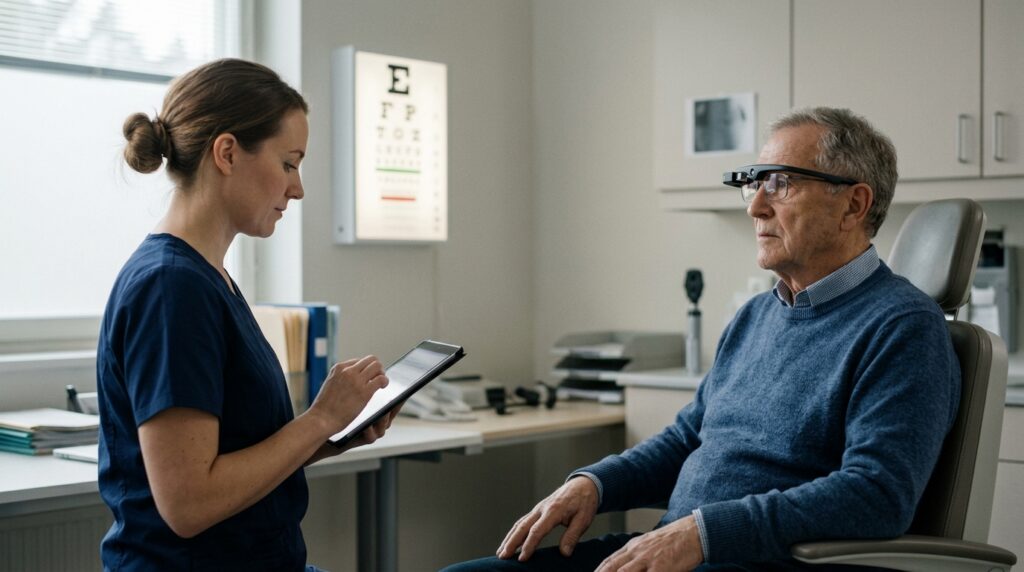
The technological operation of the PRIMA implant relies on an external pair of specialized glasses fitted with an integrated camera system. The camera captures images of the patient’s immediate environment and projects this visual information onto the subretinal chip using invisible near-infrared light. The photovoltaic elements on the microchip automatically absorb the light beams and convert them into precise electrical signals. These signals directly stimulate the remaining functional nerve cells of the retina, transmitting visual information further along the optic pathway to the brain without requiring any internal batteries or physical wire connections.
Professor Dr. med. Lars-Olof Hattenbach, who personally implanted the PRIMA chip in four patients as part of the pivotal clinical trial, highlighted the significance of this wireless photovoltaic design. By eliminating external power cables, the implant reduces surgical complexity and lowers long-term mechanical stress on delicate ocular tissues. For patients coming to Germany for specialized ophthalmic consultation, understanding how the chip bypasses destroyed light receptors provides essential clarity on whether their specific stage of retinal degeneration makes them suitable candidates for this microelectronic therapy.
Clinical Evidence from the PRIMAvera Trial and European Regulatory Approval
The clinical efficacy and safety of the subretinal photovoltaic implant were rigorously evaluated in the prospective multicenter PRIMAvera study, registered on ClinicalTrials.gov under NCT04676854. In this pivotal trial, 38 patients with advanced geographic atrophy secondary to dry age-related macular degeneration underwent surgical implantation of the PRIMA microchip. The scientific results of the international study were subsequently published in the prestigious medical publication, the New England Journal of Medicine, in an article authored by FG Holz, Y Le Mer, MMK Muqit, LO Hattenbach, and colleagues.
Out of 32 patients whose visual outcomes were comprehensively evaluated at twelve months post-surgery, 26 individuals achieved a clinically meaningful improvement in visual acuity. Specifically, 81 percent of these evaluated participants demonstrated an increase of at least ten ETDRS letters on standard eye testing charts, which corresponds to gaining approximately two additional lines of visual resolution. Following the intervention and subsequent training, many patients who had previously lost central sight regained the ability to perceive distinct patterns, identify individual numbers and letters, and read full words.
Crucially, the trial demonstrated that while the chip successfully restored functional perception in the central retinal area affected by geographic atrophy, the patients’ remaining natural peripheral vision outside the treated area remained stable on average. Maintaining peripheral visual fields is essential for spatial orientation and general mobility, ensuring that the artificial central input complements rather than displaces intact peripheral sight. Building upon these clinical outcomes, the PRIMA system officially received European CE marking approval in July 2026.
For international patients seeking advanced care in German university eye centers, the publication of these trial results offers verified scientific evidence regarding expected visual gains. The combination of documented visual chart improvement and maintained peripheral field stability provides a clear clinical benchmark for ophthalmologists evaluating prospective candidates. During initial medical assessments in Germany, diagnostic imaging of the macular center and peripheral retinal integrity allows specialists to determine whether the patient’s visual status matches the parameters demonstrated in the PRIMAvera trial.
Treatment Reality, Rehabilitation Requirements, and Access in German Eye Centers

Despite the encouraging clinical results, medical experts emphasize that the PRIMA retinal chip does not restore natural, full-resolution vision. Present technological generations offer limited spatial resolution and a restricted visual field, and the artificial signals do not convey color vision. Furthermore, surgical implantation is a highly delicate procedure that demands advanced vitreoretinal surgical experience and precise intraoperative technique. Following successful surgery, patients must undergo several months of structured visual rehabilitation to train their brains to interpret the novel electrical signals generated by the subretinal chip.
Professor Hattenbach noted that the true scientific breakthrough lies in successfully uniting microelectronics with delicate neural tissue after decades of research, thereby recreating visual function within a previously blind area of the retina. This achievement represents a fundamental paradigm shift in ophthalmology, moving from merely preserving existing sight to actively replacing lost retinal function. However, obtaining the device is not an automatic process, as access currently remains concentrated in specialized university clinics and designated retinal care centers across Germany, with formal reimbursement pathways still being established.
Ongoing research aims to further enhance future generations of photovoltaic implants by increasing pixel density for higher image resolution and expanding the usable visual field. Investigators are also exploring whether this microelectronic approach can be extended to other degenerative retinal conditions beyond geographic atrophy. For international patients interested in evaluating this option, initial consultations in Germany focus on detailed diagnostic mapping, vitreoretinal surgical clearance, and establishing a structured long-term rehabilitation plan prior to scheduling surgery.
Patients considering consultation in Germany should discuss with their attending specialists whether their disease stage aligns with current inclusion criteria and what realistic outcomes can be expected. Questions should focus on the exact state of central photoreceptor loss, the condition of peripheral nerve layers, the availability of post-operative training programs, and the practical steps required for long-term clinical follow-up. While artificial vision technology is still in its initial clinical implementation phase, the PRIMA chip establishes a foundation for microelectronic vision restoration in patients with advanced macular degeneration.