 EN
Physicians at the Klinik für Orthopädie und Unfallchirurgie at LMU Klinikum München, in partnership with the Deutsches Diabetes-Zentrum Düsseldorf, have launched a comprehensive clinical trial designed to prevent lower limb amputations in patients suffering from severe diabetic foot ulcers. The investigation focuses on a specialized surgical technique known as tibiale transversale Kallusdistraktion, or tibial transverse callus distraction. Widely practiced in China and previously utilized on a sporadic basis at the Munich university hospital, this intervention is now being systematically evaluated under modern evidence-based research standards. Crucially, the trial design was developed through extensive co-creation with affected patients to ensure that practical and psychosocial healthcare needs are thoroughly addressed.
Understanding Diabetic Foot Ulcers and Vascular Complications

Diabetes mellitus, whether type 1 or type 2, is a chronic metabolic condition that can lead to widespread vascular and neurological complications over time. Among the most critical sequelae are cardiovascular disorders, impaired renal function, diabetic retinopathy, and persistent tissue breakdown in the lower extremities. When chronic hyperglycemia causes damage to peripheral blood vessels and nerves, microcirculation to the legs and feet becomes severely compromised. This persistent lack of oxygen and essential nutrients paves the way for chronic skin lesions, medically referred to as foot ulcers, which exhibit a notoriously low tendency to heal spontaneously without specialized interdisciplinary intervention.
In contemporary clinical practice, the management of diabetic foot ulcers encompasses meticulous wound debridement, targeted antibiotic treatment, specialized pressure-offloading orthotics, and open or endovascular revascularization procedures. However, when small distal blood vessels are occlusion-prone or diffusely diseased, conventional vascular surgery and angioplasty may reach their physical limits. Under such challenging circumstances, progressive tissue necrosis and intractable infection remain constant threats, frequently leaving surgical amputation of toes, partial foot structures, or the lower leg as the final resort to contain systemic risks.
Preventing major limb loss is paramount for maintaining patient autonomy, functional mobility, and overall quality of life. Patients who have lived with diabetes for decades often suffer from reduced pain perception due to peripheral neuropathy, meaning initial tissue trauma can pass unnoticed until deep ulcers form. Because conservative therapies alone are often insufficient to restore microvascular blood flow in end-stage arterial disease, academic centers continue to explore innovative surgical modalities capable of stimulating endogenous tissue regeneration.
The Surgical Principle of Tibial Transverse Callus Distraction
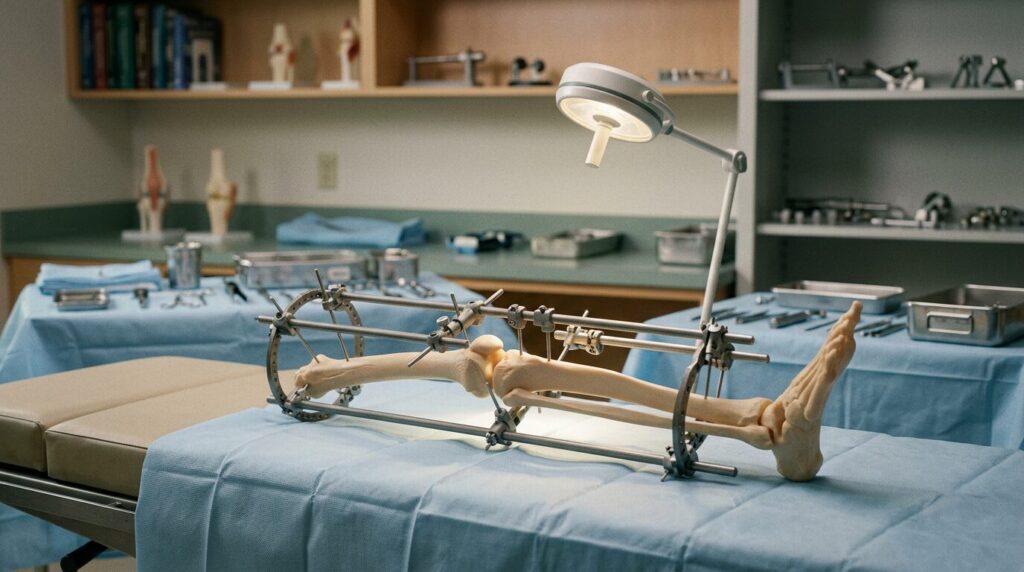
The technique under investigation, tibiale transversale Kallusdistraktion, involves a minor surgical procedure performed on the tibia bone of the lower leg. The operating surgeon creates a small, controlled bone segment and attaches an external structural frame known as a Fixateur extern. Over a period lasting between four and eight weeks, this external device applies controlled mechanical distraction forces to the bone segment. Prior experimental investigations postulate that this mechanical tension triggers a robust biological response, sparking neovascularization and significantly improving localized microcirculation and tissue regeneration throughout the lower leg and foot.
The clinical study is coordinated by Dr. Markus Laubach, assistant physician and project coordinator at the Klinik für Orthopädie und Unfallchirurgie at LMU Klinikum München. The primary objective of this prospective trial is to determine, through rigorous scientific parameters, precisely how many patients benefit from this procedure and to what extent limb loss can be reliably averted. By quantifying microvascular improvements and wound healing metrics, the research team aims to establish a clear evidence base for integrating callus distraction into standard diabetic foot treatment protocols.
A key collaborator in shaping the study design is Norbert Kuster, a patient who has lived with type 1 diabetes for many years. Drawing from extensive dialogues with fellow patients, Kuster emphasized that individuals facing complex medical conditions often experience anxiety regarding clinical trials, largely due to unclear communication regarding procedures and potential physical burdens. In response, the Munich research team prioritized creating a patient-friendly environment that explicitly addresses procedural clarity and individual home care requirements.
Patient Empowerment and Considerations for International Care in Germany

The collaborative effort between clinicians at LMU Klinikum München, researchers at the Deutsches Diabetes-Zentrum Düsseldorf, and patient representatives extended over a year of structured workshops. This close partnership led to the development of patient educational materials written in accessible everyday language, demystifying the trial process. Simultaneously, the medical team expanded their clinical evaluation protocols to incorporate essential real-world factors, including domestic care environments, family support structures, and psychosocial well-being, ensuring a holistic treatment perspective.
A major outcome of this initiative was the establishment of a nationwide patient organization named PRO-LIMB-NET e. V., accessible at www.ttt-surgery.de. Operating as an independent advocacy voice for individuals facing potential or existing limb loss, the association seeks to heighten public awareness, enhance health literacy, and promote self-efficacy among patients with diabetic foot complications. The organization advocates for placing quality of life, personal independence, and social participation at the center of both clinical management and future academic research.
For international patients considering specialized orthopedic and vascular evaluation in Germany, this project highlights the country’s commitment to rigorous, patient-centered medical innovation. High-volume German university hospitals offer comprehensive diagnostic evaluations to determine whether advanced limb-preservation techniques are appropriate. Patients traveling to Germany for diabetic foot care are encouraged to discuss all available revascularization and regenerative options with their medical team, including the logistics of managing external fixation systems like the Fixateur extern during post-operative recovery.
Source: LMU Klinikum München