EN
EN
People with a painful joint or back rarely think of treatment in Germany straight away. By then there has usually been a course of painkillers, an X-ray that every doctor reads differently, and the advice to “wait and see”. They come not for a miracle but for a clear answer to two questions: is an operation really needed — and if so, which one?
The answer comes from a sequence of steps, and at each one the patient may find that it is enough. Below is how orthopedics in Germany is organized: how the diagnosis is rechecked, what is treated without surgery, when and how a worn-out joint is replaced, and what happens in spine units and children’s orthopedic departments.
Why patients travel to Germany for joints
Patients travel to Germany for joint care mainly because the result depends not only on the surgeon’s hands but on the whole chain: diagnosis, the implant itself, the operating room and rehabilitation. A weak link can undo a flawless operation, so in Germany the chain is checked from outside instead of resting on one doctor’s reputation.
Hospitals that implant artificial joints go through the voluntary EndoCert certification introduced by the German orthopedic society, and more than six hundred joint replacement centers in the country have passed it. A certified center has to show that its surgeons perform enough of these operations each year to stay in practice, that complex cases are handled by an experienced surgeon rather than whoever is on duty, and that results are followed up after discharge: the hospital records complications and reports its implants to the German Arthroplasty Registry. In short, the patient is not simply seeing one good specialist but entering a system whose quality is checked regularly by outside experts.
Treatment itself follows clinical guidelines written by the medical societies of each specialty — documents that set out which tests a complaint calls for, what to try first and under which conditions surgery is indicated. They are published in the AWMF guideline register, run by the umbrella association of Germany’s scientific medical societies; it includes, for example, a separate guideline on when a knee replacement is indicated. So a German doctor can explain what each step is based on, and the patient is entitled to ask.
The diagnosis comes before the scalpel
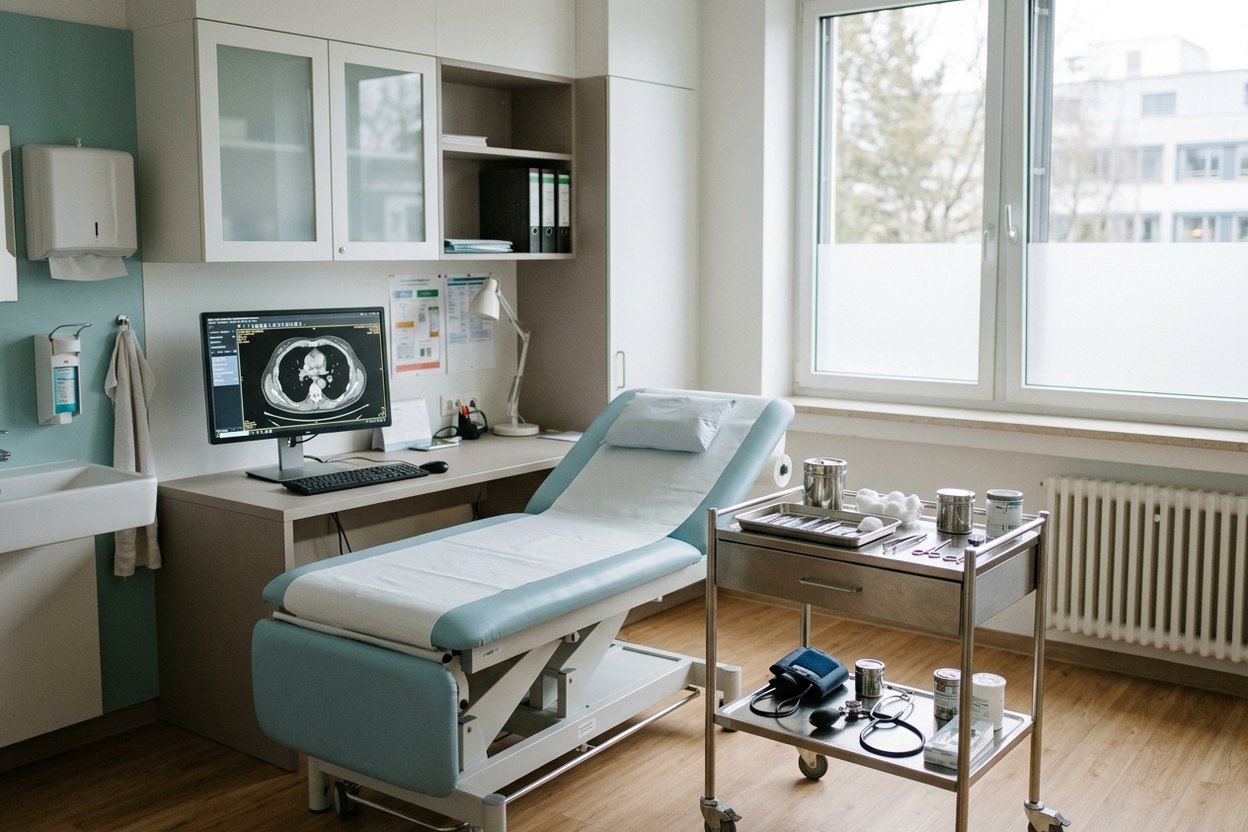
A German orthopedist starts not with an operation but by working out afresh where the pain really comes from. The source is often not where it hurts: a knee aches because of the hip, numbness in the leg comes from the spine. So the doctor asks in detail when and with which movement the pain appears, checks joint mobility, muscle strength and gait, and reviews the images the patient brings rather than relying only on someone else’s report.
The examination is supported by tests, each with its own job. An X-ray shows bone and joint space, ultrasound shows muscles, tendons and fluid in the joint, CT shows complex fractures and the shape of the bone, and MRI shows cartilage, ligaments, menisci, intervertebral discs and nerves; when osteoporosis is suspected, bone density is measured. Nothing is ordered for show; the set is matched to the complaint.
This is often the stage at which it turns out that surgery is still far off. Early osteoarthritis, joint inflammation and the after-effects of an old injury can frequently be managed without an operation, and an honest clinic says so plainly, even if the patient arrived ready for surgery.
Treatment without surgery, and minimally invasive options
What comes first is everything short of surgery: tailored exercise therapy, physiotherapy, pain control and medication. The exact mix depends on the diagnosis, age, physical demands and general health. Exercises are built around the specific joint — strengthening the muscles that offload it, restoring range of motion, teaching movement without overload — and a brace, insoles or joint injections may be added. For many patients this is enough for a long time.
If it is not, arthroscopy is discussed: an operation through a few small ports instead of an open cut, with a camera and fine instruments inside the joint, so that the surgeon sees the damage on a screen and treats it at once. There is less tissue trauma, and recovery is faster than after open surgery. It is offered when the pain has a specific mechanical cause, such as a torn meniscus, a damaged patch of cartilage, a locked joint or a ligament injury. For ordinary wear of the knee, arthroscopic “washing out” and “cleaning” of the joint showed no benefit in studies, and in Germany these procedures were removed from the services paid for by statutory health insurance.
As long as a joint can be preserved, it is preserved. If osteoarthritis affects one half of the knee and the leg is bowed, for example, the surgeon may correct the axis of the bone: the load shifts to the healthy part of the joint, and replacement can often be postponed. But a small operation is not right for everyone. With advanced wear it only adds another operation, and the orthopedist will then say plainly that a replacement makes more sense.
Joint replacement
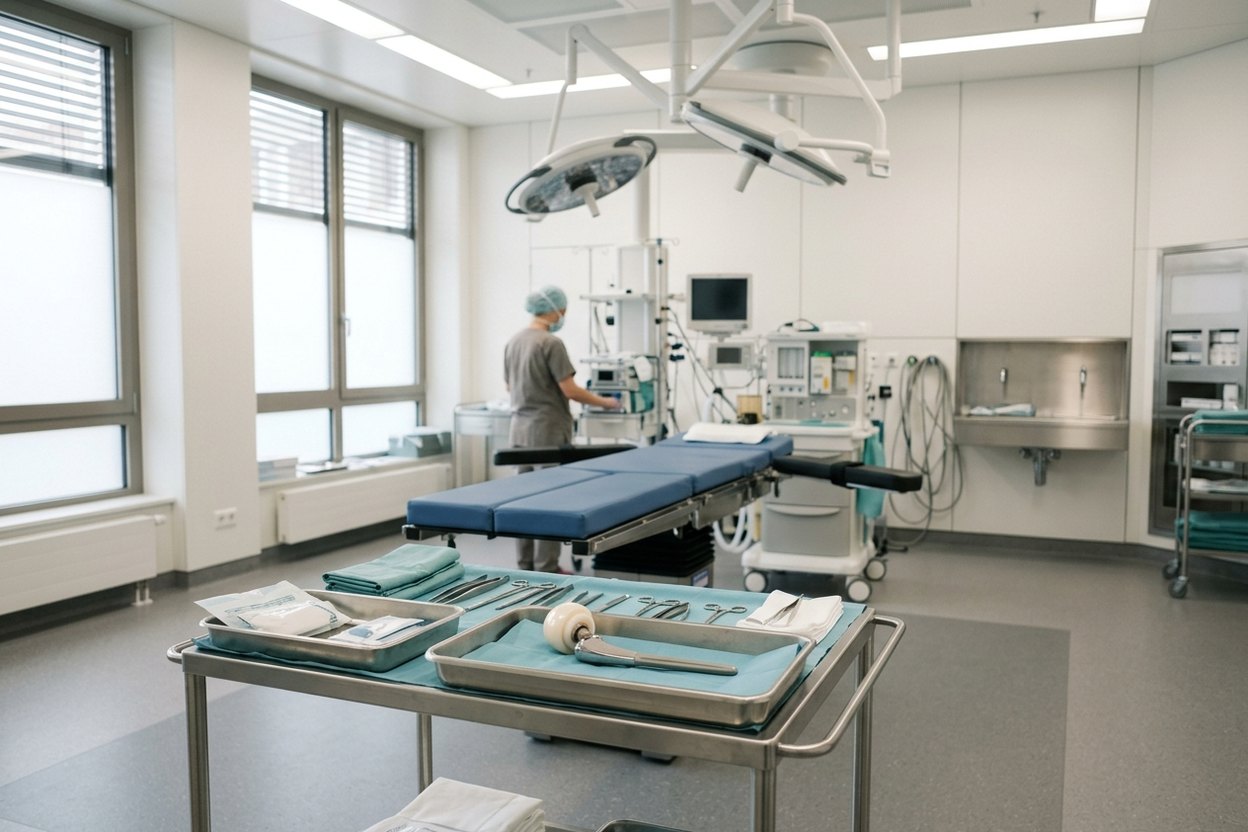
When a joint is worn beyond what treatment can help, it is replaced with an artificial one. Hips and knees are replaced most often, shoulders less so. The implant is matched to the patient’s anatomy, and the operation is planned in advance from the images so that size and position can be calculated precisely. Before surgery, sources of infection such as bad teeth are treated, because any infection in the body threatens a new joint. Indications, types of implant and preparation are covered on the joint replacement page.
Such operations are done in large numbers at the Helios ENDO-Klinik in Hamburg, for example. It has been open since 1976, it is the largest specialist clinic in Europe for joint replacement, sports orthopedics and spine surgery, and it has a separate focus on infections around an implanted prosthesis. In Munich, orthopedics and sports orthopedics at the Klinikum rechts der Isar of the Technical University of Munich are led by Prof. Rüdiger von Eisenhart-Rothe, head of the EndoTUM joint replacement center. The Markgröningen Orthopedic Clinic has a joint replacement center of its own, and both centers hold the highest EndoCert level, as centers of maximum care that also take on difficult revision operations. Patients often ask us for the “best orthopedic surgeon in Germany”; the honest answer is that what matters is how often the surgeon and the unit perform your particular operation, not a place in a list. The page on choosing an orthopedic surgeon explains which surgeons work with AlenMed and how to pick one for your problem.
What happens after the operation matters just as much. In certified centers rehabilitation starts the next day, not “once it has healed”: the patient is helped up, a physiotherapist works with them, and early, careful loading helps the joint settle in and movement return. The result depends on how this recovery is organized — in the hospital, then in a rehabilitation center or at home — no less than on the operation itself.
Spine, trauma and paediatric orthopaedics
The spine, injuries and children’s orthopedics each have their own departments and hospitals in Germany. Spinal surgery for herniated discs, spinal canal stenosis or curvature is done through small access where possible and is taken on when conservative treatment is exhausted; it is done without delay only when nerves are compressed, with growing leg weakness or bladder problems. Hospitals in this field include the Asklepios Orthopedic Hospital in Bad Abbach with its spine and scoliosis center and the Werner Wicker Clinic in Bad Wildungen with its spine center and the German Scoliosis Center. How this treatment is organized is described on the spine treatment page.
Injuries and their after-effects are treated by the same specialists: in Germany orthopedics and trauma surgery form one medical specialty, and doctors train for it in a single program. Sports injuries such as torn ligaments and menisci or cartilage damage are most often treated arthroscopically, through small ports. With badly healed fractures there is no rush: precision matters more than speed, and the corrective operation is planned in detail from the images. Details are on the trauma surgery in Germany page.
Pediatric orthopedics deals with problems that should be caught while the skeleton is still growing: hip dysplasia in infants, posture problems and scoliosis in schoolchildren and teenagers, foot deformities. Caught early, a problem can often be corrected without surgery, with a splint, a brace or exercises, while a missed one more often ends in an operation. In Hamburg, for example, the Altona Children’s Hospital treats such children in its pediatric and adolescent orthopedics unit.
Frequently asked questions
What does an orthopedist treat in Germany?
An orthopedist in Germany treats diseases and injuries of the musculoskeletal system: joints, spine, bones, muscles, ligaments and tendons. That covers osteoarthritis, herniated discs and spinal curvature, sports injuries, the after-effects of fractures and joint replacement, and in children hip dysplasia, scoliosis and foot deformities. Orthopedics and trauma surgery are one specialty in Germany, so the same doctor can treat a painful joint and an old injury.
Where can I find an English-speaking orthopedist in Germany?
Some German orthopedists speak English well enough to discuss an operation, but you cannot count on it in every department, and language alone is a poor reason to choose a surgeon. Choose by diagnosis and experience with your operation, and bridge the language gap with a medical interpreter: AlenMed translates reports and arranges an interpreter for appointments and before surgery.
Do I have to agree to surgery if an orthopedist recommends it?
No: the doctor proposes an operation, but the decision is the patient’s. Under German law, before consent the doctor must explain what the procedure involves, how necessary and urgent it is, its risks, prospects and alternatives, early enough for the patient to decide calmly; copies of the signed documents go to the patient. If doubts remain, ask what would happen if the operation were postponed.
Which images and documents should I prepare for a German orthopedist?
You need the images that relate to the complaint — X-ray, MRI or CT on a disc in the original files rather than photos of a screen — plus the radiologist’s reports. Add discharge summaries, reports of earlier operations, details of any implants and a list of current medication. Older images help too, because they show how the joint has changed. Without images a hospital can neither assess the case nor estimate the cost.
How AlenMed arranges treatment
AlenMed chooses the hospital from the diagnosis and the expected operation, not from the loudness of a name: orthopedic hospitals in Germany differ in their strengths, some in joint replacement and revisions, others in spine surgery or sports injuries. The company works with 86 partner hospitals in 38 cities and 345 doctors, and its office is in Munich. From the images and reports the patient sends, a request goes to the specialist department, so that an orthopedic surgeon in Germany is matched to the case rather than to a famous name.
AlenMed then handles the organization: it translates records, books appointments, arranges the invitation for the visa, meets the patient on arrival and provides a medical interpreter at appointments. The cost estimate and the invoice are issued by the hospital itself, directly to the patient. How the bill for a joint replacement is put together is explained on the joint replacement costs in Germany page.
This material is for information only and does not replace a consultation with a doctor. Whether treatment is possible, what it will involve and what it will achieve can be determined only after an examination at the clinic in person.
Individual operations
News on this topic
Consensus Guideline for Bacteriophage Therapy in Bone and Implant Infections
An international consensus guideline published in Nature Medicine establishes standards for personalized bacteriophage therapy in complex orthopedic infections.
Ultrasound Regional Anesthesia Replaces General Anesthesia for Surgery
German specialists from DEGUM emphasize how ultrasound-guided regional nerve blocks improve surgical safety, lower medication doses, and protect high-risk patients.
Obesity and Rheumatism: Inflammatory Immune Changes Are Reversible
Leipzig researchers have revealed that obesity-induced immune system inflammation mirrors rheumatoid arthritis and can be reversed through substantial weight loss.