EN
A pacemaker does not treat the heart; it insures it against a rhythm that is too slow. People often arrive here after a blackout, dizzy spells or a doctor’s first mention of a «block». That insurance role explains the rest: who needs one and why the operation is small.
Below: who needs one, the types, implantation in a German hospital, what is allowed afterwards and what to collect before writing. For the wider picture, see heart treatment in Germany.
When a pacemaker is genuinely needed
A pacemaker is needed when a slow or pausing heart causes symptoms and the cause cannot be removed; in high-degree block, even without symptoms. In sick sinus syndrome the heart’s natural pacemaker fires too rarely: slow pulse, pauses, vision fading. In high-degree atrioventricular block, atrial signals fail to reach the ventricles, and fainting is possible.
One ECG is not a diagnosis: it may miss the problem. Doctors use monitoring over one or more days and, for rare episodes, an implantable loop recorder worn for months. The German Cardiac Society guidance on cardiac pacing links the indication to symptoms matching a recorded pause, so German departments almost always want the episode itself on record.
A pacemaker is not indicated when the cause is reversible: doctors then adjust pulse-slowing drugs or treat the underlying disease. Fast arrhythmias need other treatment, often catheter ablation (see arrhythmia treatment in Germany). Nor is it a defibrillator, which guards against dangerously fast rhythms.
The types of device
Pacemakers come as single-chamber, dual-chamber, resynchronisation and leadless devices. A single-chamber device has one lead; a dual-chamber device has two, in atrium and ventricle, keeping their natural sequence. Dual-chamber pacing is preferred in sick sinus syndrome but not for everyone: in permanent atrial fibrillation, pacing the atrium is pointless, and the second lead adds complication risk.
Resynchronisation adds a left-ventricular lead to put the ventricles back in step in heart failure with weak pumping and a wide QRS complex. Conduction system pacing uses the heart’s own wiring; guidelines still give it a limited role. A leadless capsule sits entirely inside the heart and is an option when the veins below the collarbone are difficult or infection risk is high.
A battery lasts about 6 to 15 years, depending on use; depletion shows up early at routine checks, and then the generator is replaced while the leads usually stay. Ask about MRI beforehand: it is simplest when the whole system, generator and leads, is MR-conditional. Many devices also send data from home.
How the implantation is done
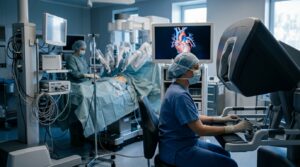
Pacemaker implantation in Germany uses local anaesthesia, often with light sedation; it usually takes about an hour, with the patient awake. Through a cut below the collarbone, X-ray-guided leads pass along a vein into the heart and are fixed; after threshold tests the generator goes into a pocket under the skin.
Most go home the next day after a device check; the wound is checked in the first days. For several weeks the device-side arm stays below shoulder height so the leads stay put. Stitches often dissolve; otherwise they come out on a set day. Flying is best after the wound heals, though it is possible 2 days after an uncomplicated implantation once pneumothorax is excluded. Consent forms list the early complications: haematoma, lead displacement, pneumothorax and infection, all uncommon.
Examples from the heart centres in Germany, not a ranking: at the Heart and Diabetes Centre NRW in Bad Oeynhausen, the electrophysiology and rhythmology department under Professor Philipp Sommer covers pacemakers, defibrillators and leadless capsules. At Rotkreuzklinikum in Munich, Professor Christian von Bary heads internal medicine I and the arrhythmia centre and lists pacemaker, defibrillator and leadless implants among his fields. At Helios München West, where Professor Sebastian Kufner heads cardiology and intensive care, rhythmology is led by Professor Christopher Reithmann, whose focus includes pacemaker and defibrillator therapy.
Living with the device
Life is close to normal: phones and household appliances are safe, but the phone stays out of the breast pocket and at the opposite ear. Induction hobs, welding equipment and strong magnets call for distance. Airport metal detectors are safe; show the device card. Your doctor says when to drive and work again. Sport is fine except contact sports and, early on, shoulder strain.
Routine checks read the memory with a programmer and adjust the settings. The memory is like a long ECG: pacing frequency, battery and lead status, rhythm episodes, including unnoticed atrial fibrillation that may call for stroke prevention. An MRI is possible if the system is MR-conditional; it then follows a protocol.
What to collect before you write
For a written assessment, collect an ECG showing the rhythm disturbance, monitoring results, echocardiography, discharge letters and a medication list with doses. If a device is already in place, add the device card and the latest check reports.
The sequence: a written assessment, then a face-to-face appointment with a cardiologist in Germany, usually an electrophysiologist, and only then a decision on implantation. Without a recording of the disturbance itself, any written answer stays preliminary.
Frequently asked questions
Does pacemaker implantation hurt?
Usually not: the site is numbed and light sedation calms you. You may notice a skipped beat or the lead entering a vein near the shoulder, not the leads inside the heart. Redness, swelling or pain over the device needs a doctor.
Where are checks done back home?
At a cardiologist where you live who has a programmer from your device’s manufacturer, so take the device card and the discharge letter with the settings. The first check is done before discharge; if the device supports remote monitoring, the clinic may set it up.
What if dizziness returns after implantation?
Contact a doctor straight away: dizziness, breathlessness or fainting can mean the device is not working properly. An unscheduled check reads the memory and measures the leads, showing whether the device, its settings or another cause is behind it. Sometimes new settings are enough.
How AlenMed organises treatment
A medical translator prepares the documents for cardiology departments. The answer says whether the patient is accepted, which device is discussed and how many days the stay takes, plus an estimate (see cost of heart surgery in Germany). Medical visa papers are prepared in parallel.
AlenMed works with 86 partner hospitals in 38 cities and 345 doctors, with its office in Munich. A coordinator books appointments, interprets at consultations and on the ward, and collects the discharge letter and device card.
For information only, not an offer; the treatment plan is set by a doctor at an in-person consultation.
News on this topic
European CE Mark Approval Granted for da Vinci 5 in Cardiac Surgery
The da Vinci 5 system has received CE marking in Europe for adult cardiac interventions, expanding minimally invasive coronary bypass and thoracoscopic procedures in Germany.
ACS Pathfinder approved as a medical device to support heart attack diagnosis
Developed at UKE with support from DZHK, the ACS Pathfinder algorithm has received CE certification and a European patent for rapid, precise heart attack rule-out.
Inhaled mosliciguat shows clinical promise in pulmonary hypertension
Phase 2 PHocus trial results demonstrate significant hemodynamic and functional progress with inhaled mosliciguat in patients with PH-ILD.