EN
ENArrhythmia treatment in Germany ranges from medication to catheter ablation and implanted devices, depending on the rhythm disorder found. The heart may stumble, race for no reason or pause; or there are no symptoms, and atrial fibrillation turns up on an ECG by chance. Some rhythm disorders are harmless; others raise the risk of stroke or are dangerous in themselves.
Treatment starts with a precise answer: what kind of disorder is it, and where does it come from? Below we cover diagnosis, medication, ablation, devices, specialist departments and travel. The wider picture is on the page about cardiology and heart treatment in Germany.
Types of Rhythm Disorder and Why They Matter
Rhythm disorders fall into three groups: too fast (tachycardia), too slow (bradycardia) and irregular. In atrial fibrillation, the commonest irregular rhythm, the upper chambers (atria) quiver chaotically; in atrial flutter they beat very fast but more regularly. Supraventricular tachycardias are sudden bouts of racing heart starting above the ventricles. Extra beats feel like a thump and are often harmless. Ventricular tachycardias arise in the lower chambers, often in diseased heart muscle, and need prompt investigation. In bradycardia and heart block, impulses are too rare or delayed, causing weakness, dizziness or fainting.
Atrial fibrillation needs attention even without symptoms: blood pools in the quivering atria, clots can form, and a clot that breaks loose can cause a stroke. So a doctor assesses the stroke risk and decides on blood thinners, as the European guidelines on atrial fibrillation describe. A separate article covers alcohol and heart rhythm disorders.
Diagnosis: Finding the Cause of Palpitations
The cause is found step by step. A resting ECG shows the rhythm at that moment; 24-hour or multi-day Holter monitoring catches episodes that come and go. For rare episodes, a small recorder implanted under the skin tracks the rhythm for a long time. Echocardiography (heart ultrasound) shows the chambers and valves, which shapes treatment. Blood tests check for an overactive thyroid or a potassium imbalance, either of which can upset the rhythm.
If the source stays unclear, an electrophysiological (EP) study follows: thin electrodes passed through a groin vein to the heart locate where the faulty impulse arises or travels. Ablation is often done in the same session. Bring ECGs recorded during an episode, monitoring data, hospital reports and a list of your medicines.
Medication or Ablation: How the Method Is Chosen
The method depends on the arrhythmia type, symptoms, heart condition and drug tolerance. Medication either slows a fast pulse (rate control) or helps keep a normal rhythm (rhythm control); in atrial fibrillation, anti-clotting drugs are often added. For some patients, this is enough.
Catheter ablation needs no incision: a thin catheter is passed through a vein in the groin to the heart, where a small patch of tissue that triggers or conducts faulty impulses is heated or frozen into a tiny scar. In atrial fibrillation, a ring of such scars isolates the pulmonary vein openings, where the triggers usually arise. It is done under sedation or general anaesthesia, followed by monitoring.
Results are not guaranteed: the arrhythmia returns in some patients, and the electrophysiologist decides on a repeat procedure. If ablation was proposed at home and you have doubts, a second opinion based on your ECGs and reports can help.
Pacemakers, Defibrillators and Other Devices
A pacemaker is fitted for a slow heartbeat or heart block, where impulses stall on their way to the ventricles; it fires whenever the heart’s own beat is late. A standard pacemaker sits under the collarbone with leads through a vein; a capsule-sized leadless one is placed inside the heart by catheter. An implantable cardioverter-defibrillator (ICD), for people at risk of dangerous ventricular arrhythmias, stops such episodes with pulses or a shock. See who is at risk of sudden cardiac arrest.
For some patients with atrial fibrillation who cannot take anti-clotting drugs long term, a catheter-delivered plug can seal the left atrial appendage, a small pouch where clots most often form. Pacemakers and ICDs need regular checks with the manufacturer’s programmer, so ask before discharge where this can be done at home.
Frequently asked questions
How much does arrhythmia treatment in Germany cost?
The cost depends on what is needed: tests, medication, ablation or a device implant. The ablation method, the device price and the hospital stay all affect the total. The hospital gives the exact amount in a cost estimate once an electrophysiologist has reviewed your ECGs and reports, and invoices you directly.
Does ablation help with atrial fibrillation?
For many patients, yes: according to the European guidelines, pulmonary vein isolation reduces the risk of atrial fibrillation returning and improves quality of life. Even so, episodes come back in some patients, and a repeat procedure may be discussed. Whether ablation suits you is for an electrophysiologist to decide.
Do I need blood thinners after ablation?
Often, yes: the decision depends on the risk of stroke, not only on whether the normal rhythm is back. The European guidelines advise continuing anticoagulation after ablation in patients at increased risk of clots, however well the procedure went. The cardiologist chooses the drug and duration based on age, other conditions and bleeding risk; never stop it on your own.
How AlenMed Arranges Arrhythmia Treatment in Germany
AlenMed arranges treatment in partner hospitals’ rhythm departments, from reviewing your records to follow-up. At München Klinik Schwabing, the department of internal medicine and cardiology is headed by Prof. Florian Straube, whose field is rhythmology and electrophysiology, including ablation for supraventricular and ventricular tachycardias, atrial fibrillation and frequent ventricular extra beats. At the Red Cross Hospital Munich, Prof. Christian von Bary heads the centre for heart rhythm disorders: ablation, pacemakers, ICDs, leadless pacing and left atrial appendage closure. At Helios Klinikum München West, rhythmology is led by Prof. Christopher Reithmann, an interventional electrophysiologist; according to the hospital, more than 700 catheter ablations are performed there each year. The Heart and Diabetes Center NRW in Bad Oeynhausen and Rhön-Klinikum Campus Bad Neustadt each have a separate department of rhythmology and electrophysiology. AlenMed’s office is in Munich; partner hospitals are all over Germany.
We pass your ECGs and reports to an electrophysiologist, obtain an assessment and cost estimate, and arrange the visa, pickup, accommodation and an interpreter. The hospital invoices you directly. Back home, we help with follow-up questions to the treating doctor, and a local cardiologist can check the device using the German discharge letter.
This material is for reference only and is not an offer. The method of arrhythmia treatment is decided by a cardiac electrophysiologist after an in-person examination.
News on this topic
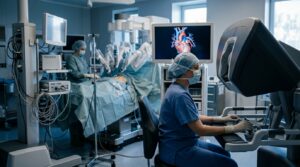
European CE Mark Approval Granted for da Vinci 5 in Cardiac Surgery
The da Vinci 5 system has received CE marking in Europe for adult cardiac interventions, expanding minimally invasive coronary bypass and thoracoscopic procedures in Germany.
ACS Pathfinder approved as a medical device to support heart attack diagnosis
Developed at UKE with support from DZHK, the ACS Pathfinder algorithm has received CE certification and a European patent for rapid, precise heart attack rule-out.
Inhaled mosliciguat shows clinical promise in pulmonary hypertension
Phase 2 PHocus trial results demonstrate significant hemodynamic and functional progress with inhaled mosliciguat in patients with PH-ILD.