 EN
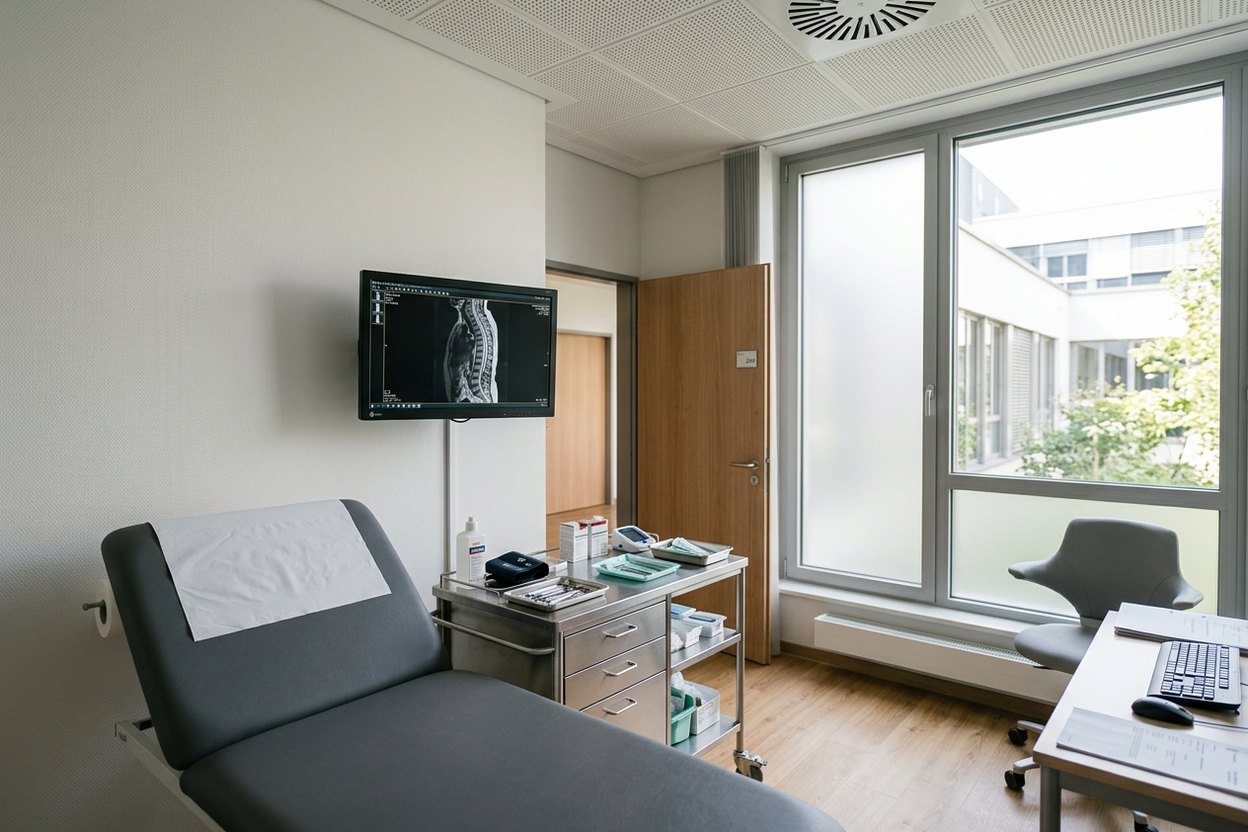
Medical care in Germany rests on rules rather than on individual famous doctors: who pays for what, at which tariff each service is billed, who checks the result of treatment and what a hospital must publish about itself.
For a visitor, these rules bring predictability: an estimate before the trip, a clear route to an appointment and mandatory quality reports. A foreign patient, however, sits outside the German insurance system and pays directly, so this page explains how the money is then calculated. Our guide to medical tourism in Germany covers such trips as a whole.
Insurance and tariffs: where the sums come from
The sums come from two insurance circuits, statutory GKV and private PKV, and from official tariffs. A foreigner should know about both: insurance sets the equipment standard and the administrative discipline of hospitals, yet neither GKV nor PKV pays for a visitor’s treatment.
Health insurance is compulsory for everyone living in Germany. The GKV contribution depends on income, not on health — the solidarity principle — and employees share it equally with their employer. A GKV patient does not pay the doctor: practices, hospitals and pharmacies bill the insurance fund. A private patient pays first and is reimbursed by the insurer. An uninsured foreigner pays like a private patient, but without reimbursement.
Billing follows official tariffs. Inpatient stays are paid through DRG (Diagnosis Related Groups): each group of diagnoses and procedures carries a fixed coefficient, nursing is paid separately per day (Pflegeentgelt), and by law general hospital services cost the same for every patient of a hospital. Outpatient consultations and imaging are billed under the GOÄ physician tariff, dentistry under GOZ. For a visitor, all this becomes an official Kostenvoranschlag, the hospital’s estimate before the trip; see typical prices for treatment in Germany.
Outpatient or inpatient: who does what
Outpatient and hospital care are separate worlds in Germany: routine examinations, diagnostics and minor procedures happen in doctors’ practices (Praxen) and medical care centres (MVZ), while surgery, intensive care and serious cases belong to hospitals. For an insured resident the route usually starts with the family doctor (Hausarzt), who treats patients or refers them to a specialist (Facharzt) or to hospital. At present most specialists can also be seen without a referral — details in the FAQ section.
For a visitor, part of the work-up can be done as an outpatient, usually at lower cost, and admission is arranged by a doctor when needed; waiting times follow from the same structure. Prescription medicines are sold only in pharmacies (Apotheke), against a doctor’s prescription. If treatment continues at home, get a dosing plan with the international drug names from the doctor before leaving.
Strengths and weak spots of the German system
The strength of medical care in Germany lies in binding quality rules rather than in famous names. The Gemeinsamer Bundesausschuss, the Federal Joint Committee at the top of the system’s self-government, sets binding requirements on treatment methods and patient safety, down to surgical checklists. Hospitals publish annual quality reports, and results for a range of procedures, complications included, are compared across hospitals yearly; outliers must explain their figures.
Minimum volumes and certification add to this. For certain complex planned procedures, such as liver transplants or breast cancer surgery, the committee sets a minimum number of cases per year, and a hospital below it may not perform them. Cancer centres certified by the German Cancer Society are inspected on site every year, and a certified joint replacement centre needs minimum numbers both overall and per senior surgeon. These are requirements on process, not a guarantee of outcome.
The weak spots are debated openly in Germany itself. GKV patients often wait long for planned specialist appointments, rural areas lack doctors, paperwork is heavy and digitalisation is slow. Insurance fund spending is rising faster than contribution income, and a hospital reform that will take several years is concentrating complex procedures in hospitals that meet equipment and staffing requirements. For a visitor this means one thing: the hospital gives the dates during planning, and they are built into the trip.
University hospitals, specialist centres and private hospitals
University hospitals combine research, teaching and treatment, so complex and rare programmes are more often available there. They develop and test new methods and treat rare and severe diseases to current standards. Examples include LMU University Hospital in Munich, Charité in Berlin and Heidelberg University Hospital.
Alongside them work single-speciality centres, such as heart or orthopaedic centres, and private hospitals for planned treatment. «University» does not automatically mean «better»: for a routine operation, the department’s volume of that procedure matters more, and the figure appears in the hospital’s quality report. Our guide to university hospitals in Germany explains how to choose between them.
What this means for medical care for foreigners in Germany
Medical care for foreigners in Germany follows one route, because a visitor has neither GKV nor PKV: documents, estimate, deposit, appointment. Healthcare in Germany for tourists and other short-term visitors means emergency cover through travel insurance, not planned treatment; see our guide to health insurance in Germany. In a sudden emergency, call 112 or go to a hospital emergency department (Notaufnahme), which must help every patient; an uninsured foreigner is invoiced later. Read more about ambulance and emergency care in Germany.
Next comes the visa: the hospital issues the invitation once the deposit against the estimate is paid, so the order is estimate, deposit, invitation, consulate. The documents for a medical visa for Germany are listed separately.
Finally, language. Some German doctors speak English, but ward rounds, surgical consent and medication instructions are safer with an interpreter, as every detail counts.
Frequently asked questions
Why is medicine in Germany considered among the best?
Its reputation rests on the system rather than on names: university hospitals combine research and care, specialist societies publish clinical guidelines, and hospitals must publish quality reports. The weaknesses are known too: long waits for specialists, heavy paperwork and slow digitalisation. Look for a hospital experienced in your condition rather than for the «best country».
Where does Germany rank in medical care?
There is no single official rank: each comparison uses its own criteria. The Country Health Profile 2025 for Germany, from the State of Health in the EU series by the OECD and the European Observatory on Health Systems and Policies, covers population health, financing, accessibility, effectiveness and resilience. Germany spends more on health than any other EU country, but spending alone does not guarantee better results.
Is medicine better in Germany or in Russia?
There is no general answer: compare specific treatment, not countries. Both have compulsory insurance for residents (in Russia it is called OMS), but a visiting patient in Germany is not covered and pays according to the estimate. What matters is whether the method you need is available, how often the hospital uses it, which guidelines it follows and how soon you can see a specialist.
Does Germany have better healthcare than the USA?
Neither can be declared the winner: the systems are built differently. In Germany insurance is compulsory for all residents, and GKV patients do not pay the doctor directly. In the USA coverage mostly comes through employers or public programmes such as Medicare and Medicaid, and some people have none. Visitors pay in both countries, so compare estimates, hospital experience and waiting times.
Is healthcare free in Germany?
For insured residents it is nearly free at the point of use: doctors, hospitals and pharmacies bill the insurance fund, and patients pay only statutory co-payments, for example for medicines and hospital days. Insurance is compulsory for residents and financed by contributions. A foreigner without German insurance pays according to the hospital’s estimate.
Which doctors in Germany can you see without a referral?
Insured residents can see the family doctor (Hausarzt) and most specialists without a referral, as patients choose their doctor freely. A referral (Überweisung) is required for radiologists, laboratory physicians, pathologists and radiation oncologists, and it eases booking through the 116117 service. A self-paying foreign patient needs no referral: the hospital sets the appointment after reviewing the documents remotely.
How AlenMed arranges treatment
AlenMed, with its office in Munich, arranges treatment in Germany for patients from abroad through 86 partner clinics in 38 cities. We review the documents remotely, send a request to a specialist hospital, obtain its official estimate, arrange the visa invitation after the deposit, and on arrival meet the patient and provide an interpreter.
The patient receives the estimate, the visa invitation and confirmed dates, and after treatment the discharge letter and the final invoice. Payments go directly to the hospital at official tariffs, DRG for inpatient care and GOÄ for outpatient and chief-physician services, so patients pay the hospital’s own prices and can check every item against the estimate.
This article is general information, not an offer. The examination and treatment plan is decided by the doctor at an in-person consultation; the exact cost is set out in the hospital’s estimate.