 EN

Hospital care in Tübingen, a small university town in Baden-Württemberg, comes down mostly to one institution: the university hospital, both the maximum-care hospital for the most complex cases and the district hospital for the town and county of Tübingen. Choosing a hospital here usually means choosing a department.
This page covers the hospital’s own facts, the eye clinic with its own history, the journey via Stuttgart, and when a larger city nearby is the better choice. Other cities: see hospitals in Germany.
What the town is and what that means for a patient
Tübingen is a quiet old university town on the Neckar, which for a patient means a calm setting and short distances. The university dates from 1477, the medical faculty was one of its four founding faculties, and the hospital is the region’s largest employer. Buses from the main station reach the university hospitals in 5–15 minutes.
The flip side: fewer hotels and restaurants than in a big city, so relatives book accommodation once the date is known. And compare departments, not towns: how many cases with your diagnosis each treats a year. For league tables, see hospital rankings in Germany.
The town’s main hospital: size, departments and directors
The main Tübingen hospital is the university hospital, Universitätsklinikum Tübingen: by its own figures it opened in 1805 and has 1,658 beds. It comprises 17 clinics with numerous departments, including anaesthesiology and intensive care, the women’s clinic, ENT, dermatology, paediatrics, neurosurgery, neurology, orthopaedics and psychiatry, plus a centre for personalised medicine.
The hospital itself names the directors: Prof. Meinrad Gawaz (cardiology and angiology, i.e. vascular medicine), Prof. Lars Zender (medical oncology and pneumology), Prof. André Mihaljevic (general, visceral, meaning abdominal, and transplant surgery), Prof. Igor Tsaur (urology), Prof. Marcos Tatagiba (neurosurgery), Prof. Sara Brucker (gynaecology and obstetrics) and Prof. Ulf Ziemann (neurology with a focus on neurovascular disease).
With oncology, surgery, neurology and imaging in one institution, the path from scan to decision is shorter. The buildings stand mainly on two sites, Kliniken Tal near the town centre and Kliniken Berg on the Schnarrenberg hill in the north; the invitation names the site. The hospital also runs clinical studies, listing open ones online with contacts, but their criteria, not the wish to join, decide who takes part. Details: University Hospital Tübingen.
The eye clinic and other specialist strengths
The eye clinic has its own history and page, University Eye Hospital Tübingen. Prof. Bogomil Voykov is its acting director. The first university eye clinic opened in 1875; since 2016 it has had a new building at Kliniken Berg. The ophthalmology department that includes the clinic is one of thirteen medical centres of excellence in Baden-Württemberg and the only one for eye disease. Specialist clinics cover the retina, glaucoma, cornea, squint with eyelid and orbital surgery, inherited retinal disease and uveitis (eye inflammation).
Also worth a look: neurosurgery, neurovascular neurology, medical oncology, urology and visceral surgery, each with its own department and director. Still, a certified centre for your condition matters more than the town. Check the certificates on the hospital’s website and, for cancer, the German Cancer Society (Deutsche Krebsgesellschaft), which explains what its certificate means and how to find centres. The Comprehensive Cancer Center Tübingen-Stuttgart holds the society’s certificate as an oncology centre.
Getting there and staying
For a Tuebingen hospital (the web-address spelling), the gateway is Stuttgart: regional trains from Stuttgart to Tübingen take about an hour, the drive from Stuttgart Airport about half an hour, the direct Airport Sprinter bus about an hour. Settled before admission: the date, a written estimate, which patients from abroad pay in advance, the visa invitation and an interpreter. Without good German or English, patients are asked to arrange one themselves where possible, helped by the International Patient Unit.
For relatives, the hospital points to a guest house with apartments; some hotels offer special terms to hospital visitors. General wards usually allow visits daily from 10:00 to 20:30; intensive care visits must be announced. A comfort room, single or double, is an elective service billed separately. Almost all rooms have their own bathroom; bring toiletries, nightwear, a dressing gown, slippers and all regular medicines with the dosage plan.
Tübingen or a larger city nearby?
Look wider when Tübingen’s date is too late or the department treats few cases like yours. Stuttgart is about an hour away by train, Ulm further, and an earlier date or more such cases a year outweigh the address. The nearest option: hospitals in Stuttgart.
German university hospitals combine treatment, teaching and research, but differ in strong departments and certified centres; see university hospitals in Germany. So instead of «which town?» ask which department takes on my diagnosis, how many such cases it treats a year and how soon it can admit me.
Frequently asked questions
How much does treatment at a Tübingen hospital cost?
There is no general price list: the hospital’s estimate sets the amount from the patient’s documents and treatment plan. Patients from abroad pay it into the university hospital’s account before admission. If treatment proves more complex, for example through complications, the hospital asks for more, and after the final invoice it refunds any overpayment.
Do I need my own interpreter in Tübingen?
Yes, if your German or English is not good enough: the hospital asks such patients to arrange, where possible, an interpreter who knows medical terms. Its International Patient Unit and the ward staff help to find one. AlenMed provides a medical interpreter for the consent talk, the ward rounds and discharge.
Can a relative stay in the room at a Tübingen hospital?
Yes, the hospital can admit one relative as a companion: they get a fold-out bed in the patient’s room and meals. Whether there is a medical reason for this is decided by the doctors case by case. Anyone else stays at the guest house or a hotel.
How AlenMed arranges treatment in Tübingen
AlenMed handles the preparation: papers and scans are reviewed remotely, the request goes to the department matching the diagnosis, and the hospital’s written estimate arrives before the trip. Then come the visa invitation, the admission date, a meeting on arrival and a medical interpreter for the consent talk and ward rounds.
After discharge, AlenMed translates the discharge letter, keeps in touch with the treating doctor in Tübingen and helps arrange follow-up. Prices are explained before any payment.
This material is for information only and is not an offer. The choice of hospital and treatment is made by a doctor after examining the patient.

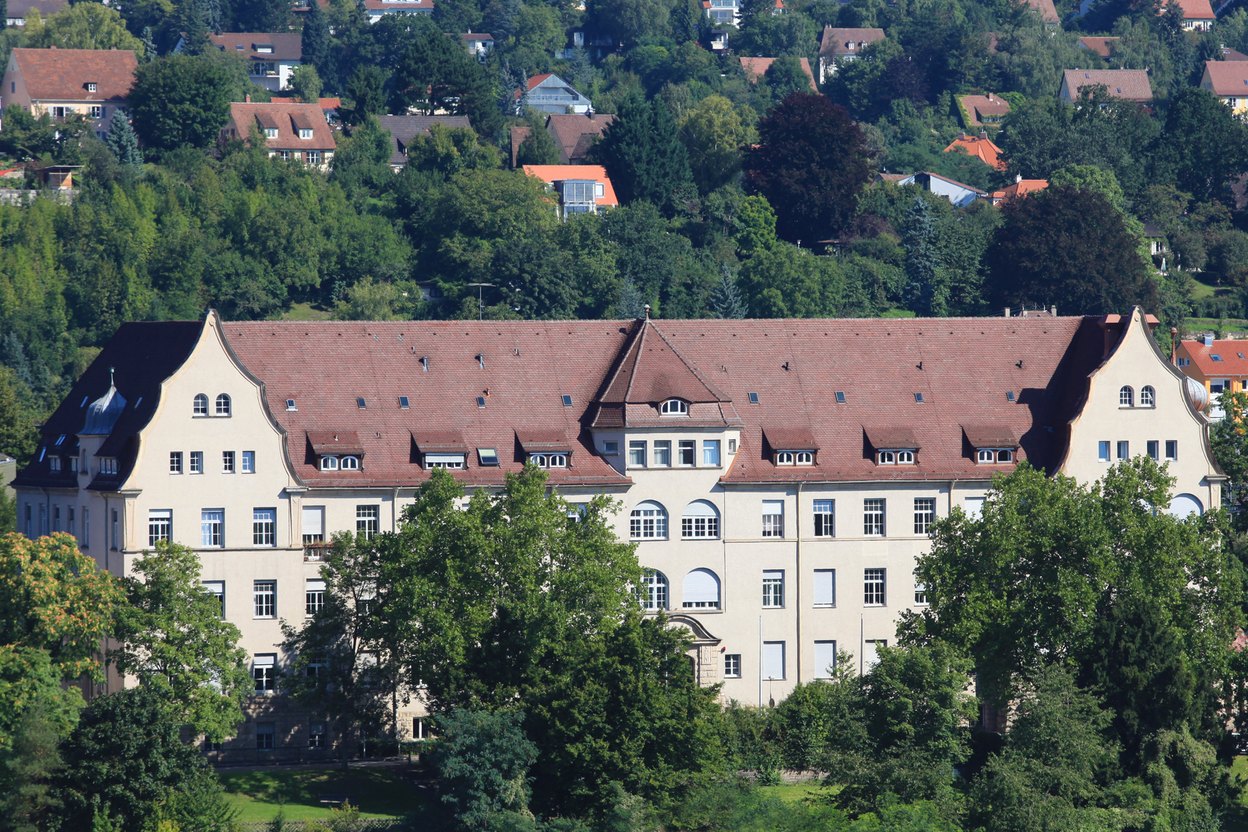
Tuebingen University Eye Hospital
Part of the Eberhard Karls University Medical Centre in Baden-Württemberg, with its own eye clinic building since 1909. Care focuses on retinal disease, glaucoma and hereditary disorders of vision, closely tied to university research.
Tuebingen University Hospital
An academic centre of Eberhard Karls University, opened in 1805, with 1,650 beds and more than 420,000 outpatient visits a year. It takes on complex and rare conditions, worked through by interdisciplinary teams alongside clinical research.