 EN
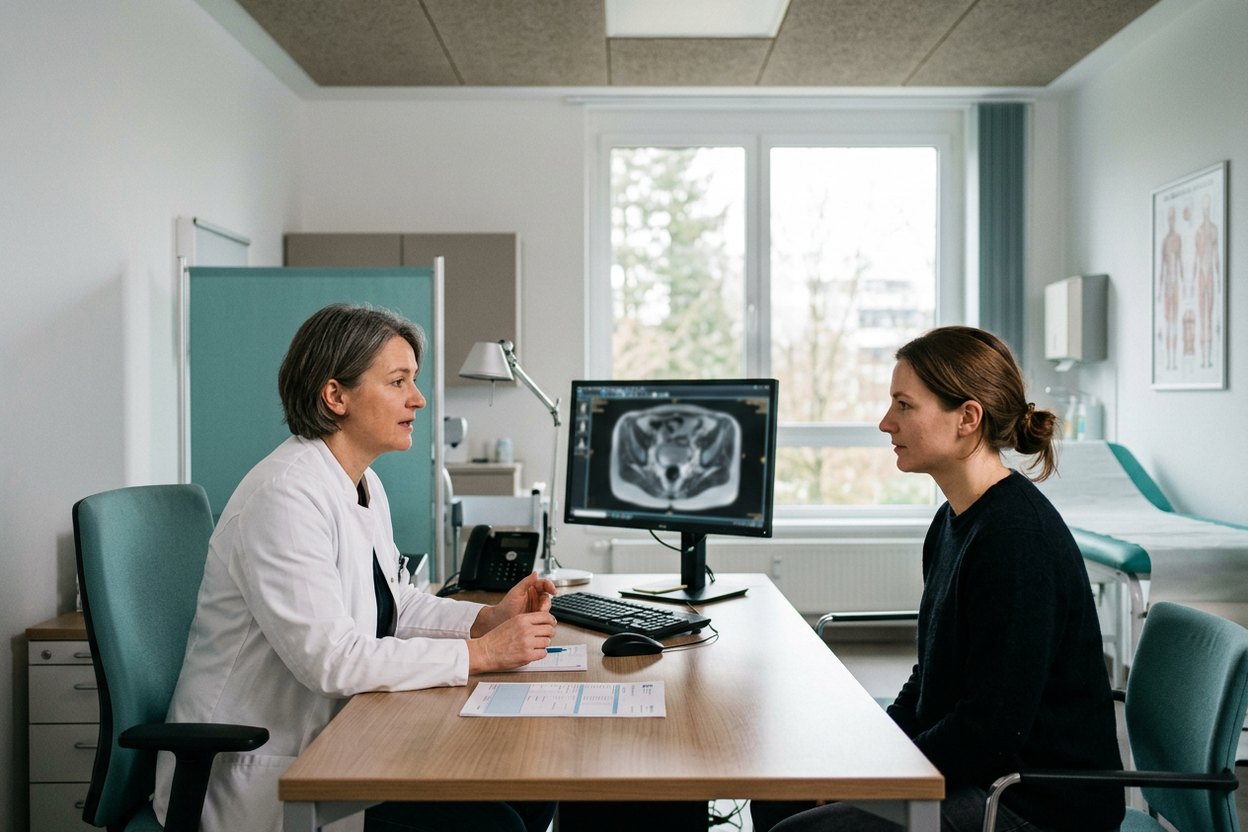
A woman who reaches «her» doctor, an endometriosis specialist, is rarely seeing her first one. Behind her are years of painful periods put down to «how her body is» and several reports saying nothing is wrong. This is not about carelessness: endometriosis is hard to see on a routine examination and a routine scan, which is why the road to a diagnosis takes years on average, between 4 and 12 years according to WHO.
This page explains what «endometriosis specialist» means, how such an appointment differs from an ordinary gynaecological one, what the work-up looks like and what AlenMed does when you need an endometriosis specialist in Berlin.
Who counts as an endometriosis specialist
An endometriosis specialist is a gynaecologist for whom endometriosis is everyday work rather than a rare case; there is no medical specialty called «endometriologist». Such a doctor operates on the disease regularly, works with a colorectal surgeon and a urologist when lesions reach the bowel or ureter, and has a pain specialist and a physiotherapist on hand.
The German-speaking countries run a certification scheme for endometriosis centres, with steps from an outpatient practice up to a hospital that takes on complex surgery. Under the criteria of the Stiftung Endometriose-Forschung (Endometriosis Research Foundation) there are three steps: Endometriosepraxis, a practice; Endometrioseklinik, a clinic that operates; and Endometriosezentrum, a centre for complex interdisciplinary operations. Certification means a minimum number of patients treated per year (for clinics and centres, of operations too), work in a team and an outside audit. The disease itself is described in the WHO fact sheet on endometriosis.
A patient can also check a doctor herself: ask how many endometriosis operations he does a year, whether he operates on deep disease involving the bowel, and who discusses the case with him. The general page explains how to choose a doctor anywhere in Germany and what lies behind the phrase «best endometriosis specialists«.
What the work-up looks like
The main instrument is the conversation. A specialist asks about more than period pain: pain on opening the bowels or passing urine during the period, pain during sex, cyclical blood in stool or urine, exhaustion, difficulty conceiving. That account tells the doctor where to look, so a pain diary kept over one or two cycles before the appointment helps.
Next come examination and ultrasound in experienced hands. Transvaginal ultrasound, with the probe in the vagina, shows ovarian endometriomas, cysts that endometriosis forms on the ovary, and the signs of deep nodules if the examiner knows how to look for them. Where deep disease is suspected, pelvic MRI is added; if the bowel or urinary tract is involved, the hospital orders further tests.
Laparoscopy, an operation through small incisions, is diagnosis and treatment in one, which is exactly why it is not done «just to look». It is planned so that lesions found can be removed in the same sitting and histology, examination of the tissue under a microscope, can confirm the diagnosis. No blood test diagnoses endometriosis. Treatment is covered on the page on endometriosis treatment in Germany.
Whom patients see in Berlin
Among AlenMed’s partner hospitals, patients looking for an endometriosis specialist in Berlin go to the gynaecology departments of Charité and Helios Klinikum Berlin-Buch. At Charité in Berlin, the university hospital, this is the Clinic for Gynaecology with Breast Centre, whose director is Prof. Jens-Uwe Blohmer. At Helios Klinikum Berlin-Buch, gynaecology and obstetrics have been headed since 1 October 2026 by Dr. Sebastian Hentsch, who according to the hospital specialises in endometriosis and urogynaecology.
Berlin suits this kind of trip: several large hospitals in one city, direct flights, and a second opinion available without travelling on. Other hospitals are covered in the overview of hospitals in Berlin.
The first appointment and the surgery question
For the first appointment, bring discharge summaries, previous operation reports and histology, imaging on a disc, a list of medicines with doses and the pain diary. Without the earlier histology, any discussion of how much to operate is blind.
Surgery is not the only route. Pain control, hormonal treatment that suppresses the cycle, physiotherapy and pain management are used on their own and around an operation; the choice depends on what matters most to the patient now — pain, pregnancy, or both. Neither the end of pain nor a pregnancy after surgery can be promised.
Where surgery is on the table, its extent has to be clear in advance: removing lesions while keeping the organs, work on the bowel or ureter, which means the right surgeon has to be in the theatre, or the uncommon situations in which removal of the uterus is discussed. If the proposed extent raises doubts, a second opinion from a German doctor can be obtained beforehand.
Frequently asked questions
How is an endometriosis specialist different from an ordinary gynaecologist?
An endometriosis specialist is also a gynaecologist, but one for whom the disease is daily work. The specialist asks in detail about pain with bowel movements, urination and sex, looks for deep nodules on ultrasound and operates on such cases regularly, together with a colorectal surgeon, a urologist, a pain specialist and a physiotherapist.
Can a blood test diagnose endometriosis?
No, there is no blood test that diagnoses endometriosis. Suspicion rests on the patient’s account, the examination and transvaginal ultrasound, plus pelvic MRI for deep disease. The diagnosis is confirmed by histology of tissue removed at laparoscopy, so the operation is planned to remove any lesions found straight away.
How should I prepare for the first appointment?
Start a pain diary one or two cycles before the appointment: when it hurts, where, how badly, and whether the pain is linked to the period, the bowel or passing urine. Also gather discharge summaries, earlier operation reports with histology, imaging on a disc and a list of medicines with doses.
How AlenMed arranges an appointment with an endometriosis specialist in Berlin
AlenMed sends the summaries and images to the gynaecology department of a Berlin partner hospital, and the hospital answers with an appointment date and a written cost estimate. The company works with 86 partner hospitals in 38 German cities and 345 doctors, with its office in Munich; it arranges an interpreter at the appointment and helps with the visa and accommodation.
Before travelling, ask who will operate, whether the hospital is equipped for bowel surgery, how many days the work-up takes and whether a follow-up appointment after the operation is needed.
This material is for information only and is not an offer. The treatment plan is decided by a doctor at an in-person consultation.