 EN
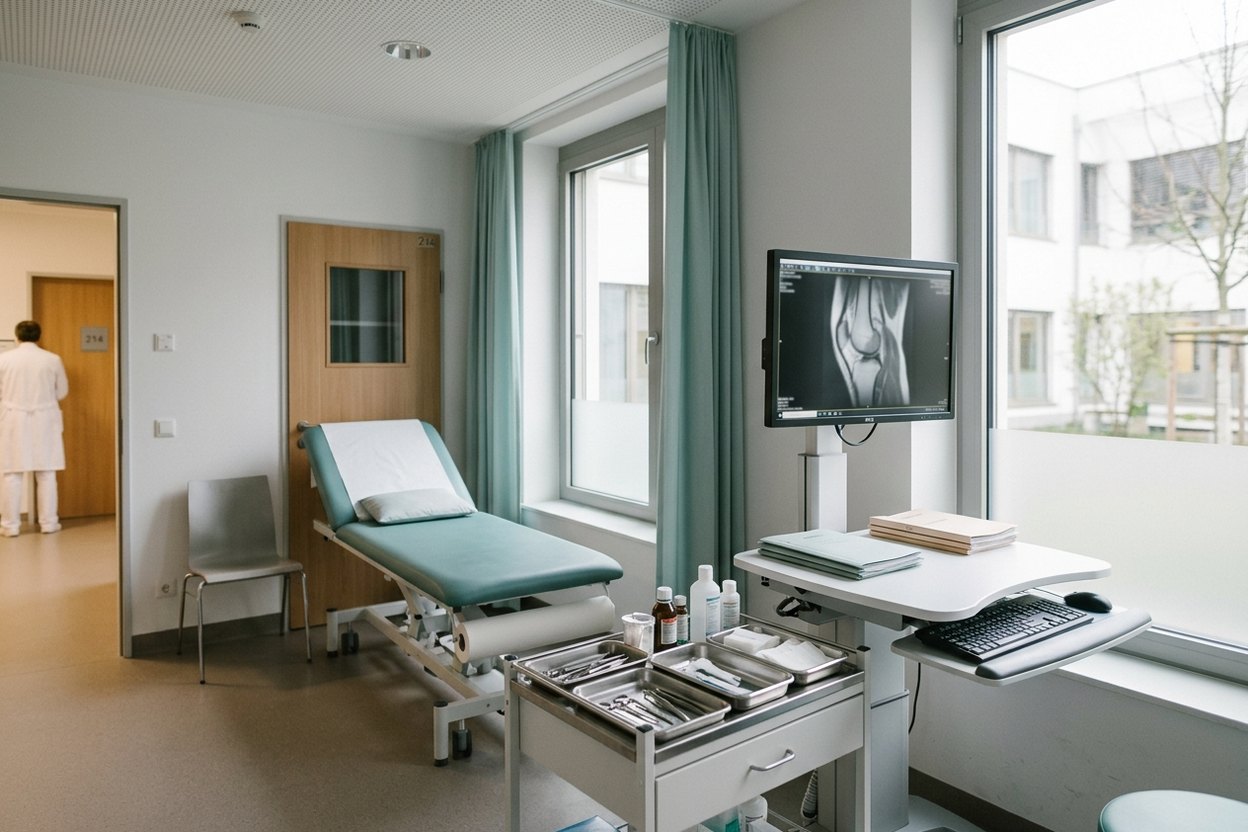
Psoriasis treatment in Germany takes place in hospital dermatology departments, which first score the disease’s severity and then treat it step by step, from creams and light therapy to tablets and biologics. Psoriasis is a chronic, non-contagious immune disease: skin cells renew too fast and form red plaques with silvery scales. It cannot be cured for good, but modern treatment keeps the skin almost clear for long periods in many patients.
This page covers the types of psoriasis, how severity is scored, treatment at each step, phototherapy and planning the trip. For other skin conditions, see dermatology in Germany.
Psoriasis Symptoms and Types
Psoriasis has several forms. The most common, plaque psoriasis, affects the elbows, knees, scalp and lower back and often the nails, which may pit or thicken. Guttate psoriasis, a shower of small drop-like spots, often follows a sore throat; pustular psoriasis, with pus-filled blisters, is rare but severe. The disease arises from an inherited tendency and a misdirected immune system; flares are triggered by infections, stress, skin injuries, some medicines, smoking, alcohol and excess weight. Patients can influence some of these factors, which will not cure psoriasis but may mean fewer flares.
In some people the inflammation spreads to the joints: this psoriatic arthritis causes pain, swelling and morning stiffness, and studies suggest it affects up to 30% of people with psoriasis. The dermatologist therefore asks about the joints and refers you to a rheumatologist if needed, and both then share the care. Look-alikes such as atopic or seborrhoeic dermatitis, lichen planus or fungal infection are ruled out by close examination and, if necessary, a skin scraping.
How Severity Is Assessed Before Treatment
Severity is judged from a full skin examination and two scores. Plaques are viewed through a dermatoscope, a lit magnifier; a punch biopsy, a tiny core of skin, is taken only in doubtful cases. PASI measures how much skin is affected and how red, thick and scaly it is; the DLQI questionnaire shows how much the disease disrupts daily life. An unusual spot among the plaques is checked as in skin cancer screening.
Before medicines that act on the whole body, blood tests check inflammation (CRP and ESR), blood count, liver and kidneys and screen for hepatitis, HIV and tuberculosis, since some of these drugs weaken the immune defence.
From Creams to Biologics: Treatment Step by Step
Treatment moves up in steps, from creams for mild psoriasis to tablets, injections or light for moderate to severe disease. Mild cases need corticosteroid and vitamin D creams, alone or combined, salicylic acid to lift scales, scalp solutions and daily moisturisers. There is no special “German ointment”: Germany uses the same groups of active ingredients as other countries, and the dermatologist chooses product and regimen by the site and extent of the plaques.
Moderate to severe psoriasis calls for systemic medicines: methotrexate, acitretin, ciclosporin and fumaric acid esters, long used in Germany. Newer tablets include PDE4 inhibitors and a JAK-family drug that blocks the enzyme TYK2. If these fail, are not tolerated or do not suit, biologics against IL-17, IL-23 or TNF-alpha follow: antibodies that intercept the body’s inflammation “signals”, given as injections or infusions. The choice follows the German guideline on treating psoriasis vulgaris (ordinary plaque psoriasis) in the AWMF register.
Systemic treatment needs regular blood, liver and kidney checks. The response is reviewed after 10–12 weeks, or after 16–24 weeks for slower-acting drugs; if the skin has not cleared enough or the effect fades, the drug is switched. Flares can still return.
Phototherapy for Psoriasis
Phototherapy with measured ultraviolet light mainly suits widespread psoriasis when creams are not enough. The usual form is narrowband UVB at 311 nm, typically given three times a week for one to three months. Stubborn cases may get PUVA: UVA light after psoralen, a plant substance that sensitises the skin to light, taken as a tablet, cream or bath. PUVA can cause nausea, needs eye protection and, if repeated often, raises the skin cancer risk, so lifetime sessions are limited.
Balneophototherapy adds a salt-water bath, modelled on the Dead Sea, before the ultraviolet light: the salt softens the scales. Any phototherapy means weeks of sessions, so before travel it is agreed whether to finish the course in Germany or continue at home.
Frequently asked questions
Where in the world is psoriasis treated best?
No single country leads: good care is found wherever strong dermatology centres offer modern biologics and phototherapy. When choosing, ask whether the department treats severe cases and psoriatic arthritis and works with rheumatologists. Climate therapy, for example at the Dead Sea, helps some patients but does not replace medical treatment.
Can psoriasis be cured in Germany?
No, psoriasis cannot be cured completely, in Germany or anywhere else: the tendency stays for life. Modern treatment, however, keeps the skin almost clear for long periods in many patients. Dermatologists agree a treatment goal with the patient and change the medicine if it is not reached, though flares can still occur.
What works best for psoriasis?
No single treatment works best for everyone; it depends on the type and severity of the disease. Mild psoriasis often responds to corticosteroid and vitamin D creams, widespread disease to phototherapy, and moderate to severe forms to tablets or biologics. The dermatologist decides, considering joints, other illnesses, pregnancy plans and earlier treatments.
How AlenMed Arranges Psoriasis Treatment in Germany
To start psoriasis treatment in Germany, send photos of your plaques, reports and a list of previous medicines; AlenMed has them translated for a hospital dermatology department, which replies with a plan and a cost estimate (Kostenvoranschlag). The bill covers consultations and tests under the GOÄ fee schedule, phototherapy by the number of sessions and, in severe cases, an inpatient stay. With biologics, the drug itself, used for months or longer, is a sizeable item, so continuing at home and access to it in your country are discussed before travel. Amounts come only from the estimate; see cost of treatment in Germany. Consultations are possible, for example, with Prof. Ulrike Blume-Peytavi, deputy director of the Department of Dermatology at Charité, or Prof. Esther von Stebut, director of the Department of Dermatology at University Hospital Cologne.
AlenMed issues the visa invitation, arranges medical interpreters and has the final report translated for your doctor at home. Other patients describe their experience in our psoriasis treatment testimonials. The company’s office is in Munich, with partner hospitals across Germany.
This is general information, not an offer; treatment is decided by a doctor at an in-person consultation.