EN
EN
Trauma care in Germany is provided by certified trauma centres and orthopaedic and trauma surgery departments, for fresh injuries and badly healed old ones. A fracture, torn ligaments, a road accident or a sports injury changes plans in a moment, and the question becomes where the bone and joint will heal straight and the arm or leg work again.
People seek trauma surgery in Germany straight after an accident, and also when an injury treated at home has left a crooked bone, a stiff joint or lasting pain. This page explains how German trauma care is organised, what is decided and why timing matters.
How trauma care in Germany is organised
Trauma care in Germany is organised as a network: hospitals treating severe injuries are joined in the TraumaNetzwerk DGU, created by the German trauma surgery society. It covers hospitals in Germany, Austria, Switzerland, Luxembourg and Belgium and grades them as local, regional and supraregional trauma centres. The point is simple: a severely injured patient is taken where everything their case needs is available, and the hospitals in the network share common standards and can quickly transfer a patient between levels.
For a planned patient this means a centre audited against outside requirements rather than one surgeon’s reputation. Requirements for staff and equipment are set out in a German White Paper on the care of the severely injured; independent certification companies check them, and the level must be reconfirmed at intervals. The certificate is about severe injuries, yet it says much about a department. Certified centres appear on the TraumaNetzwerk DGU map, and a hospital can be asked how long its certificate runs.
Trauma surgery has borders: brain injuries are led by neurosurgeons, the fine structures of the hand often by hand surgeons, and worn-out joints belong to orthopaedics — in Germany the same specialty. Multiple severe injuries are managed by a team: trauma surgeon, anaesthetist and radiologist in the resuscitation room, joined if needed by a neurosurgeon and an abdominal surgeon.
Orthopaedics and trauma surgery: one specialty in Germany
In Germany orthopaedics and trauma surgery are a single medical specialty (Orthopädie und Unfallchirurgie): the same training covers the fresh injury and the worn-out joint. The two fields used to be separate, but specialist training was merged, which is why many German departments carry both names.
The patient gains one line of judgement: whether to repair or replace a joint is decided by one doctor, not argued between two through the patient, and it rests on the images, the patient’s age and the demands of their life. Planned joint treatment is covered under orthopaedics in Germany and joint replacement in Germany.
Sometimes an injury does lead to a joint replacement, and that is said plainly from the start. A displaced femoral neck fracture in an older person usually means a new hip at once: the bone heals poorly there, and a prosthesis gets the patient walking sooner. A severe fracture inside a joint can also lead to arthritis and a later replacement. No good surgeon promises the joint as it was.
The first appointment: what exactly is damaged
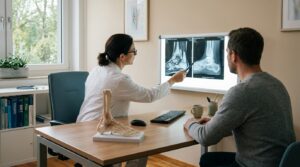
The first appointment starts with the whole picture of the injury, not just the X-ray. A fracture can hide a torn ligament or a damaged vessel or nerve, and a bone that heals out of line will need another operation. So the trauma surgeon asks how the injury happened and checks circulation, sensation and movement.
Each investigation has its own job: an X-ray shows the fracture’s geometry; CT shows complex and joint fractures in three dimensions for planning surgery; MRI shows ligaments, cartilage and soft tissue; ultrasound shows tendons, muscles and joint fluid. Fresh images are taken even if the patient brings their own: fragments may have shifted, healing may have begun, older images may be at the wrong angle.
Then the options are discussed: what happens without surgery, what surgery offers, what each path risks. German law requires the explanation to be oral, timely and understandable, so foreign patients are spoken to through an interpreter; written material only supplements it, and the patient gets copies of whatever they sign. No outcome is promised; the decision is the patient’s.
A fresh injury and the question of time
With a fresh injury some decisions cannot wait and are taken where the injury happened. An open fracture is cleaned surgically at once because of the risk of infection; compromised blood supply, swelling that compresses muscles and vessels, and nerve damage need immediate treatment. Marked displacement cannot wait either, or the bone heals out of line.
Flying with a cast or an external fixator is not always possible, nor at once: the treating doctor decides, and airlines may ask for a fitness-to-fly certificate. A limb in a cast can swell in flight, and after a leg injury a long flight raises the risk of thrombosis. Papers from the local hospital should list the diagnosis, injury date, treatment so far, implants and medicines. Images travel on a disc or USB stick in their original format (DICOM) with the radiologist’s report: a phone photo of a screen cannot be measured.
Sometimes it is better to stabilise the injury locally and come to Germany for the second stage: a temporary external frame holds the fragments until the swelling and soft tissue settle, and the definitive operation follows, as German surgeons also do. Such a pause is not “lost time” but part of treatment. Different fractures are covered under fracture treatment in Germany.
Surgery or conservative treatment
Not every injury needs an operation: many fractures heal well with the right immobilisation and follow-up, and a good surgeon does not operate for the sake of it. Undisplaced fractures, or those reduced and held in a cast or brace, are usually treated without surgery and checked on X-rays.
When surgery is needed, the bone is joined and held with plates, screws or rods — osteosynthesis — so that the fragments sit precisely and the person can move early. Knee, shoulder and elbow operations are largely arthroscopic: a few small ports, a camera and instruments inside the joint instead of a wide incision. Rods and plates can also go in through small incisions, but not when a joint surface must be rebuilt under direct view.
Healing time depends on many factors, so it is given as a range rather than a date. Bones heal faster in the young; smoking and diabetes slow healing and raise the risk that the bone will not knit. The type of fracture, the soft tissue and how strictly weight is kept off the limb matter too.
Old, badly healed injuries and sports injuries
An old or badly healed injury is reassessed from scratch and corrected surgically if needed. These patients are a separate group: the bone has healed out of line or not at all, the joint hurts or is stiff, the axis of the limb has shifted. The deformity is measured on new images, often CT, and the options include an operation that cuts and realigns the bone, revision osteosynthesis, freeing a stiff joint or replacing it.
Sports injuries — torn knee ligaments, meniscus and shoulder damage — are treated with load in mind: the aim is not to stitch but to make the joint work again, so the recovery plan is written together with the operation plan. A torn cruciate ligament is usually replaced with the patient’s own tendon, and rehabilitation decides much of the result.
Before a complex operation — a revision, a correction, a joint replacement — a second opinion is worth far more than after it, because a failed operation is harder to put right. See second opinion from a German doctor; the overview of orthopaedic hospitals in Germany helps to choose a centre.
Recovery after an injury
Recovery starts as soon as it is safe, because the result depends on it as much as on the operation. German hospitals do not put rehabilitation off: on the ward a physiotherapist teaches the patient to stand, walk with support and move the joint. Load rises in steps — none, partial, full — as the X-rays allow.
Intensive rehabilitation usually follows in a rehabilitation clinic, and the transfer is planned while the patient is still in hospital, so that there is no gap. On discharge the patient receives an exercise plan, check-up dates and advice on crutches, braces and other aids. The programmes are described under rehabilitation in Germany.
Frequently asked questions
Can an injury already treated at home be treated in Germany?
Yes: German hospitals also see patients whose injuries were first treated at home. If the bone has healed out of line or not at all, or the joint hurts and moves poorly, the case is reassessed on the images and reports, then in person, and the options are explained, from conservative treatment to corrective surgery.
Is trauma care in Germany separate from orthopaedics?
No: in Germany orthopaedics and trauma surgery are one specialty, and its specialists treat both injuries and joint disease. Departments and individual surgeons differ in focus — some mainly treat injuries, others worn-out joints and their replacement — so experience with your particular problem matters more than the name of a department.
How long does trauma care in Germany take?
The exact time is given only after an examination, as it depends on the injury and the treatment chosen. A stay covers the examination, surgery or conservative treatment, observation on the ward and, if needed, rehabilitation. The bone keeps healing at home, so check X-rays and follow-up visits are planned ahead.
How much does trauma care in Germany cost?
The cost is set by the hospital’s estimate, drawn up after reviewing the images and reports. The bill covers examinations, the operation and implants, the hospital stay and, where needed, intensive care, physiotherapy and rehabilitation, so the same “knee operation” can cost very different amounts for different patients.
How AlenMed arranges trauma treatment in Germany
AlenMed starts with a remote review: the patient’s images and reports are translated and sent to the relevant department, which replies whether and how it can help. The trauma centre is matched to the injury and level of care needed, and urgency and admission date are agreed. The hospital issues a written estimate; AlenMed arranges the visa invitation, meets the patient and provides an interpreter at appointments and ward rounds.
After discharge AlenMed translates the discharge letter, keeps a line open to the operating surgeon for new images and questions, and helps plan review visits and the removal of fixation devices if they need to come out.
This material is for information only, is not an offer and does not replace a consultation with a doctor. The treatment plan is decided by a doctor at an in-person examination.
Individual injuries
News on this topic
Modern Ankle Fracture Care: Early Mobility and Individualized Strategies in Germany
A comprehensive review in Deutsches Ärzteblatt International reveals that ankle fractures do not always require surgery or six weeks of strict immobilization.