 EN
EN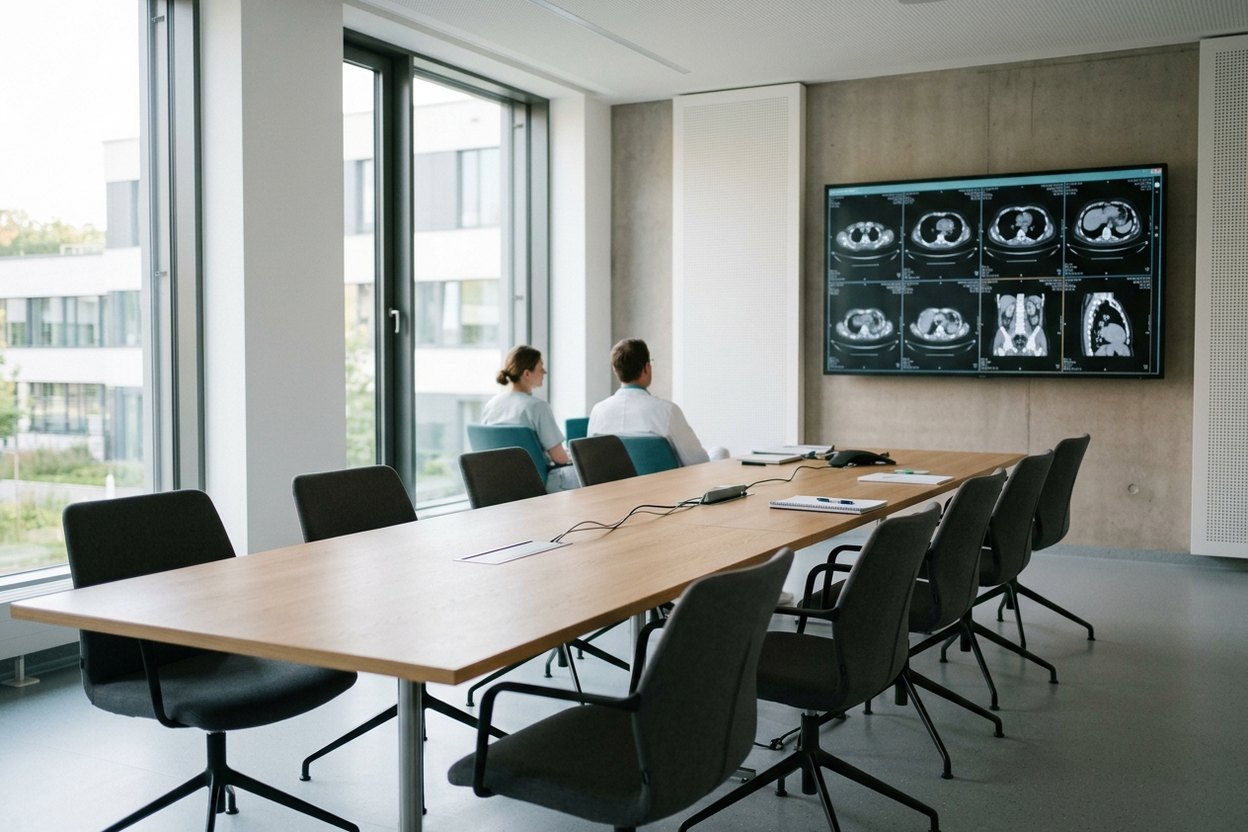
When the word “cancer” appears in a report, or even just a suspicion of it, the hardest part is the uncertainty. You have the images and the test results, but not the main thing: an understanding of what it actually is, how far it has spread and what to do. Cancer diagnosis in Germany answers that request above all. Its task is not to frighten but to give an accurate, complete picture you can build on.
A finding is not yet a diagnosis
A shadow on a scan, a raised tumour marker, a nodule on ultrasound — all of these are reasons to look further, not a finished diagnosis. Many such findings turn out to be benign. The point of a sound assessment is to separate the harmless from what needs attention calmly, step by step, and not to prescribe treatment blind.
The German system is built around coordination. There are thirteen top-level cancer centres (Onkologische Spitzenzentren) in the country, selected and funded by Deutsche Krebshilfe, the German Cancer Aid; one of them is in Munich. What distinguishes them is that difficult cases are reviewed not by one doctor but by a board of different specialists. That reduces the risk of something being missed or read one-sidedly.
How the assessment is built
The initial assessment usually takes a few days and follows a clear logic. First a consultation with an oncologist, with a detailed history, an examination and a study of the documents you already have. Then the doctor orders investigations — exactly those the situation calls for, nothing superfluous.
The tools are familiar ones: blood tests, ultrasound, computed tomography and MRI, endoscopy, mammography. Positron emission tomography (PET) stands apart: it shows not the shape of an organ but the activity of tissue, and helps establish where the process is active and whether it has moved beyond its original borders. It all ends with a second consultation, where the results are brought together and explained in plain language.
The tissue decides: biopsy and molecular profile
The key stage is examining the tissue itself. A biopsy (taking a small sample) and the histology that follows answer the question of what these cells are. The molecular profile goes further: it shows the features of the tumour by which modern medicine chooses a targeted treatment. In effect, diagnosis today answers not only “what is this” but “what should this be treated with in your case”.
So a good assessment is not a race for the number of procedures but a precise choice of the right ones. A good hospital does not order everything “just in case” but moves from question to question until the picture is complete.
When there are doubts — a second opinion
If the diagnosis has already been made at home but questions remain, it makes sense to start with a second opinion. A German specialist studies your images, slides and reports and says whether they confirm the diagnosis and agree with the proposed plan. Sometimes that spares you an unnecessary intervention; sometimes it opens an option that was not offered before. Either way it restores the main thing — the sense that the situation is understood and can be managed.
This material is for information only and does not replace a consultation with a doctor. Which investigations are done, their extent and the interpretation of the results are determined individually after an examination at the clinic in person.