 EN
EN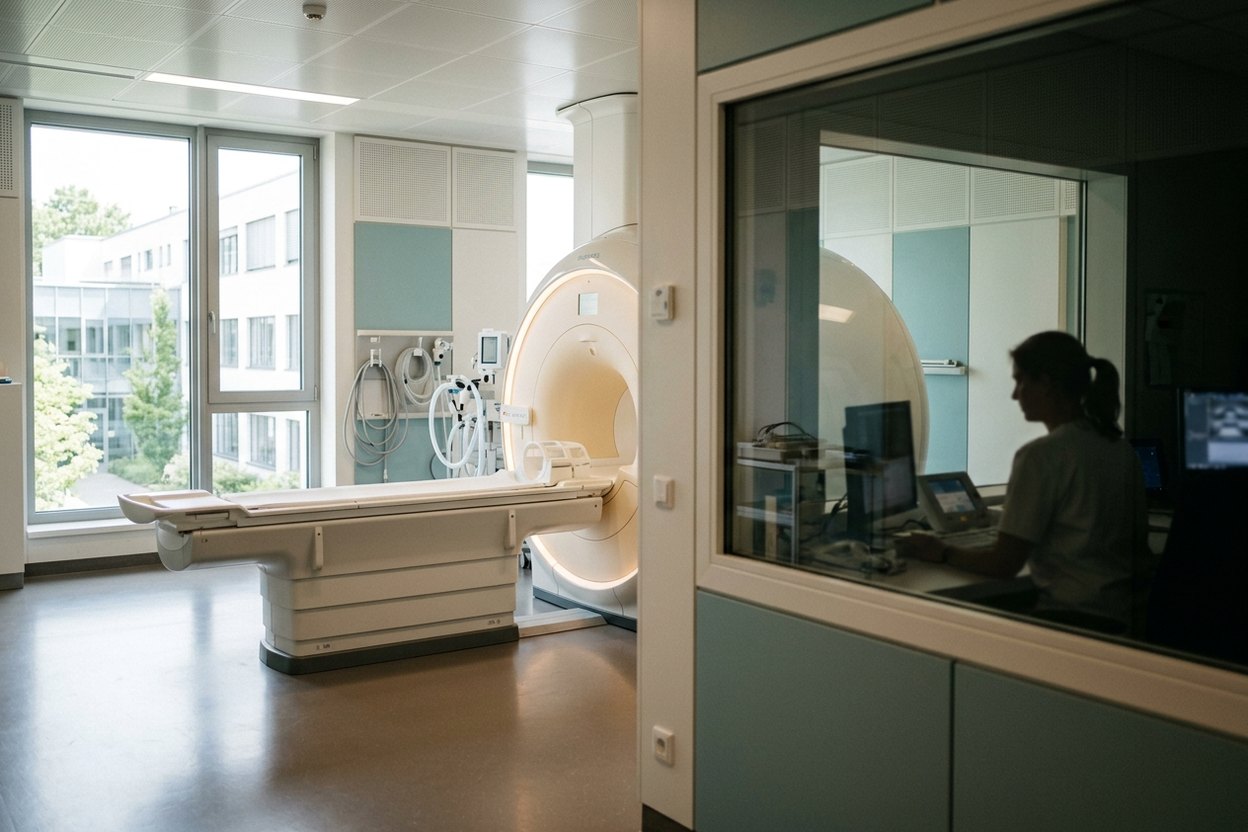
Knowing how to get an MRI scan in Germany takes much of the fear out of being sent for one: a doctor orders the scan, a radiology department with the right scanner carries it out, and patients from abroad get a written estimate first. The order usually means finding out, not confirming the worst; a scan of one region costs around €800.
Below: when an MRI is needed and how it differs from CT, how the scan goes, what it costs and what you take home — images on a disc and a written report.
How MRI Works and How It Differs from CT
MRI builds its pictures with a strong magnetic field and radio waves, so unlike CT and X-rays it involves no radiation. The scanner records the body slice by slice and produces detailed images in several planes.
Soft tissue shows best: brain and spinal cord, joints, muscles, internal organs and blood vessels. CT is faster and usually comes first after accidents, head injuries and fractures, and bone is harder to assess on MRI; the doctor chooses the method. The Krebsinformationsdienst of the German Cancer Research Center explains the examination in detail (in German).
When an MRI Is Ordered
An MRI is ordered when the doctor needs detail that an examination, ultrasound or X-ray has not given. Typical reasons: persistent headaches and neurological symptoms, back and joint pain, ligament and cartilage injuries, the abdomen and pelvis, unclear findings from other tests and, in cancer care, a tumour’s size and borders; the heart has its own examination, cardiac MRI. A spine MRI matters most when back pain comes with numbness or weakness in a leg, which can mean a compressed nerve; back pain treatment has its own page. Without symptoms, a check-up in Germany is the better start.
Sometimes a contrast agent is injected into a vein to make structures and vessels stand out. The doctor decides whether it is needed and asks about kidney function first: if it is severely reduced, contrast may not be given.
What an MRI Costs
A scan of one region costs around €800; the final price depends on the region, the number of sequences (series of images with different settings), contrast and the radiologist’s report. Self-paying patients are billed under the German fee schedule for doctors, the GOÄ, where each body region is a separate MRI item and extra series are charged on top.
Indicative prices for a single examination; the exact amount comes from the hospital:
| Examination | Indicative price |
|---|---|
| MRI of one region: a region of the skeleton, head or chest | around €800 |
| MRI of one region with contrast | €900–1,000 |
| MRI of the whole spine | around €950 |
| Consultation with a doctor on the results | from €130 |
For the spine, one section and the whole spine are separate items, and the doctor decides which is needed. A full body MRI scan in Germany is not a routine check: it is quoted separately and does not replace cancer screening, as for people without symptoms it is not yet considered a meaningful test for targeted early detection of tumours. The exact figure comes in the hospital’s estimate; the cost of an MRI in Germany has its own page.
The Scan Itself: Preparation, Noise, Claustrophobia, Implants
The scan is painless: you lie on a table that slides into the tunnel and keep still for a few minutes to about an hour, as movement blurs the images. Metal stays in the changing room: glasses, jewellery, piercings, watch, keys, belt, clothes with zips or metal buttons, removable dentures, hearing aids. The scanner knocks loudly, so you get headphones or earplugs, and an intercom and call bell connect you with staff.
For claustrophobia there are open scanners and wide, short-bore machines: a standard tunnel is only about 60 cm across. Bürgerhospital Frankfurt, for example, lists an open MRI with a 70 cm opening and a shortened tunnel, and says its team is experienced with patients who fear confined spaces. If anxiety is severe, the doctor may give a mild sedative; then do not drive — take a taxi or have someone collect you.
Mention a pacemaker, defibrillator, implants, clips, hearing aids or metalwork from operations before the scan, and bring your implant or pacemaker card. Using the manufacturer’s data, a specialist decides whether the device is MRI-compatible: some modern devices are, others are not. It is a routine safety check, not an obstacle.
Frequently asked questions
Do I need a referral for an MRI in Germany?
With German statutory health insurance, yes: radiologists see statutory patients only on referral, usually from a GP or specialist. Patients from abroad who pay themselves arrange the scan through the hospital: it reviews their records and previous images, its doctors decide what the question requires, and a written estimate follows before travel.
How long does an MRI scan take?
The scan itself takes from a few minutes to about an hour, depending on the region and the number of sequences. Add time for changing, safety questions and, if contrast is planned, a cannula in a vein. Without a sedative you can resume your day straight afterwards, driving included.
Do I have to repeat an MRI in Germany if I already have images?
Not necessarily. Recent images on a DICOM disc, with their report, go first to a radiologist at the German hospital, who judges whether they answer the treating doctor’s question. A new scan is needed if the images are old or incomplete, the symptoms have changed, or contrast sequences are missing.
How to Get an MRI in Germany with AlenMed
Before you travel, we translate your records, find a hospital with the right equipment — an open scanner or cardiac MRI, for instance — and obtain an estimate. Recent images go to a radiologist first, since repeating a scan without reason makes no sense; this review is in effect a second opinion in Germany. One such specialist is Prof. Christian Habermann, head of the Institute of Diagnostic and Interventional Radiology at Marienkrankenhaus Hamburg: his profile lists CT, MRI and mammography, including cardiac MRI for congenital heart defects in more than 350 patients.
In Germany an interpreter accompanies you. You leave with the images on a DICOM disc, which doctors at home can open, plus the radiologist’s written report and its translation; the treating doctor then goes through the results with you.
This material is for reference only and is not an offer. Figures are indicative; the exact cost is in the hospital’s estimate. A doctor decides in person whether you need the examination and its scope.