 EN
No country holds a monopoly on cancer care, so there is no one place where the best cancer doctors in the world are; the honest question is who treats this tumour, at this stage, often enough to be good at it. People ask it with a diagnosis in hand and no way to judge a name, even among doctors in Germany.
Below: what German oncology measures, where tumour-specific searches such as the best breast biopsy doctors in Germany really lead, and what to ask at the first appointment.
What “best” means in German oncology
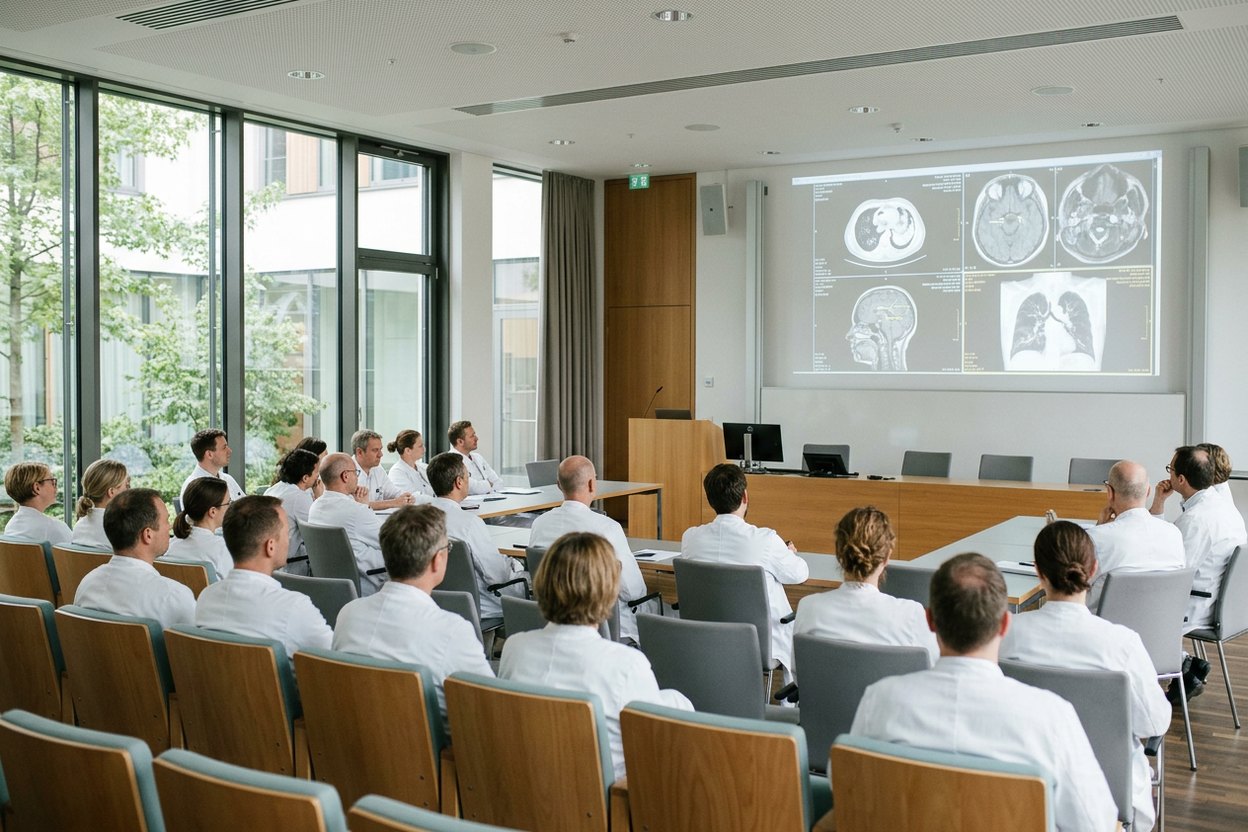
In German oncology, “best” describes a way of working that starts with the tumour board (Tumorkonferenz), a regular meeting where the surgeon, medical oncologist, radiotherapist, radiologist and pathologist review the same case together. The recommendation is the board’s, not one person’s; more on cancer treatment in Germany.
The closest thing to an objective measure is certification. The German Cancer Society (Deutsche Krebsgesellschaft) certifies centres for individual tumours (breast, bowel, prostate and more), each audited every year by the independent institute OnkoZert, and missing the required case numbers puts a certificate at risk. That means a department seeing this tumour weekly, not twice a year. Top-tier Comprehensive Cancer Centers, funded by German Cancer Aid after international review, also run clinical trials; see cancer hospitals in Germany.
On the personal level, Chefarzt is a job title, not a grade; what matters is whether this doctor runs the centre for your tumour and has the matching subspecialty. Ask how many of these operations the department does a year, whether your case goes to a tumour board, and who your contact between appointments is.
Breast cancer: the surgeon, the pathologist and the biopsy
Patients asking “who is the best breast cancer doctor” usually mean the surgeon, but the decision starts earlier, with the pathologist who types the tumour. The report shows the receptor status (receptors for oestrogen and progesterone on the cells) and HER2, a growth-signal protein. Receptor-positive tumours get anti-hormonal therapy and HER2-positive ones can get antibodies against HER2, so the drug plan follows this report.
Searches for the best breast biopsy doctors in Germany belong here. Where possible, a core needle or vacuum biopsy guided by ultrasound or mammography is used; it can be done on an outpatient basis under local anaesthetic. Its quality depends on the radiologist hitting the right spot and the laboratory reading the sample; see biopsy in Germany.
A certified breast centre joins gynaecological oncology, plastic surgery, radiotherapy, pathology and radiology under shared rules, a better filter for the best breast cancer doctors in Germany than any name. An example is Prof. Marc Thill, chief physician of the clinic for gynaecology and gynaecological oncology at the Agaplesion Markus Krankenhaus in Frankfurt and medical director of the Agaplesion Frankfurter Diakonie Kliniken.
Stomach, liver, gallbladder and kidney tumours
Searches for the best stomach cancer doctors and the best liver cancer doctors in Germany lead to the same departments: gastroenterological and medical oncology, working with surgeons. Two are led by Prof. Florian Lordick, director of the clinic for oncology, gastroenterology, hepatology and pneumology at Leipzig University Hospital, and Prof. Lars Zender, medical director of the clinic for medical oncology and pneumology at Tübingen University Hospital.
Gallbladder and bile duct cancers are rare, so case volume matters more here than anywhere: a search for the best gallbladder cancer doctors in Germany should end in a department that has seen this tumour before, such as one experienced with liver or pancreatic cancer, where surgical and drug decisions are made together.
Kidney tumours belong to uro-oncology, not general oncology, so searches for the best kidney cancer doctors in Germany lead to urology, for example to Prof. Boris Hadaschik, director of the urology clinic at Essen University Hospital and head of its uro-oncology centre. The rule: match the subspecialty to the organ, not the reputation to the tumour.
Chemotherapy and drug treatment: who prescribes it
Drug treatment is prescribed by a medical oncologist or haematologist-oncologist; patients looking for the best chemotherapy doctors in Germany usually want this specialty without knowing its name. The job: choosing the regimen, adjusting the dose, managing side effects over months.
Beyond classical chemotherapy, targeted drugs and some immunotherapies are matched to molecular findings in the tumour tissue, since a targeted drug works only if its target is present, as the US National Cancer Institute explains. Examples: Prof. Volker Heinemann, director of the Comprehensive Cancer Center at LMU Munich, and Dr. Benedikt Westphalen, who leads its precision oncology and personalised medicine unit. Prof. Florian Bassermann directs the clinic for internal medicine III (haematology and oncology) at Klinikum rechts der Isar in Munich.
A second opinion on a drug plan reviews the imaging and, if needed, the tumour tissue, not just the letter; patients can request their samples from pathology. The answer may be that the plan is right, which is worth the trip too; see second opinion from a German doctor.
Frequently asked questions
How can I check whether a cancer centre is certified?
OncoMap, the German Cancer Society’s search platform, lists all certified centres by cancer type and postcode. Certification covers a centre for one tumour, not a whole hospital, so look for one matching your diagnosis. For a rare tumour without such centres, ask how many cases the department treats a year.
Does treatment in a certified centre make a difference?
German data suggest it does. In the large WiZen study, initial treatment in a certified hospital was associated with better overall survival than in non-certified hospitals for every cancer type examined. Such a study cannot prove cause and effect, but it is a strong argument for a certified centre.
Can I choose a particular oncologist?
Yes, if agreed in advance: treatment by a doctor of your choice, usually the head of department, is an optional service (Wahlleistung), and German law requires a written agreement beforehand. The tumour board still makes the recommendation, and an experienced senior physician of the same department may treat you.
How AlenMed arranges treatment
AlenMed reviews documents and imaging in advance and sends the case to the department whose profile matches the tumour, not to whoever answers first; the histology report and imaging descriptions are translated, and an interpreter attends the appointment. The network: 86 partner clinics in 38 cities, 345 doctors, an office in Munich.
The practical chain: a request to the clinic, a written cost estimate (Kostenvoranschlag), a visa invitation letter, transfer and accommodation.
This material is for information only and is not an offer. Treatment is decided by a doctor at a face-to-face appointment.