EN
EN
Heart surgery in Germany is available to patients from abroad once the hospital has reviewed their records and issued a cost estimate. Usually a cardiologist at home has said an operation is needed, and three questions follow at once: which one, where, and at what cost.
In Germany, heart surgery is performed by university hospitals and specialised heart centres nationwide. This page covers who decides, the types of operation, less invasive options, where to go, costs and logistics; for the wider picture, see cardiology in Germany.
Who decides whether an operation is needed
The Heart Team decides: a cardiologist and a cardiac surgeon review the angiogram, echocardiogram and CT scan together. Coronary angiography is an X-ray of the heart’s arteries after contrast dye is injected through a thin catheter, showing where and how badly they are narrowed.
Not every narrowing needs surgery: medication or a stent – a small mesh tube placed via a catheter without an incision – may be enough; that is interventional cardiology. Sending all discs and reports lets the team choose the method from the images themselves.
The main types of heart operations
The main operations are coronary bypass, valve surgery and thoracic aortic surgery, plus repair of congenital defects in some adults. Bypass surgery routes blood around a narrowed coronary artery through an artery or vein from the patient’s body, either with a heart-lung machine (on-pump) or on the beating heart (off-pump); see coronary bypass surgery.
In valve surgery the surgeon first tries to repair the patient’s own valve; otherwise it is replaced with a mechanical or biological prosthesis. A mechanical valve lasts very long but means lifelong blood thinners, so the choice depends on age and lifestyle.
Aortic surgery is needed when the thoracic aorta widens (an aneurysm) and may burst, or when its inner layer tears and blood enters the wall (a dissection). Congenital heart defects in adults are a separate field: some are found only in adulthood, others need repeat surgery after a childhood operation.
Less invasive options: small incisions and catheter procedures
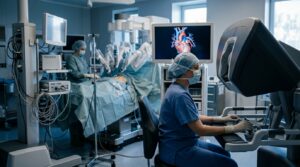
Less invasive techniques spare the breastbone, working through a small incision or a blood vessel. In a mini-thoracotomy the surgeon reaches the heart between the ribs, mostly to repair the mitral or tricuspid valve; blood loss and pain are usually less. It does not suit everyone: if a bypass is needed too, the breastbone is still opened.
In TAVI a new aortic valve is delivered on a catheter through a blood vessel in the groin and expanded inside the old one. MitraClip, a clip also inserted via the groin, holds the mitral valve leaflets together. Both are done in a hybrid operating room – an operating theatre with an X-ray angiography system – mostly for older patients at high risk from open surgery. The US National Heart, Lung, and Blood Institute has a patient guide to heart surgery.
Are there best heart surgery hospitals in Germany?
There is no single best hospital: the right one depends on the operation and how soon it is needed. Cardiac surgery is done at university hospitals and heart centres. The German Heart Centre Munich, a TUM university hospital, performed Germany’s first successful heart transplant in 1981; Prof. Markus Krane heads its Department of Cardiovascular Surgery. In Berlin, cardiac surgeon Prof. Volkmar Falk leads the medical directorate of the Deutsches Herzzentrum der Charité.
Operations are also performed at the Heart and Diabetes Centre North Rhine-Westphalia in Bad Oeynhausen, where Prof. Jan Gummert heads the Department of Thoracic and Cardiovascular Surgery. Another is Herzzentrum Dresden, a university heart hospital with 190 beds. Choose by the operation and its timing, not by fame.
What heart surgery costs in Germany
Bypass surgery costs roughly €30,000–€40,000. Hospitals bill under the DRG system: a fixed amount per case, set by diagnosis, extent of surgery and days in intensive care and on the ward. The chief physician’s fee for private treatment is charged separately under the GOÄ, Germany’s official medical fee schedule. Indicative prices:
- Comprehensive cardiac diagnostics (1–2 days) — approximately €2,000
- Diagnostic coronary angiography — from €3,000
- Coronary artery stenting — from €5,000 (individual stent €1,550–€2,500)
- Coronary artery bypass grafting (CABG) — €30,000–€40,000
- Minimally invasive and valve procedures (TAVI/MitraClip) — calculated in the hospital’s individual cost estimate (Kostenvoranschlag)
Angiography and stenting are catheter procedures, not operations; they are listed for comparison.
The exact amount is in the hospital’s cost estimate (Kostenvoranschlag), issued after review of the records, angiograms and CT scans. It covers the surgical team, prostheses and materials, intensive care and the ward, tests and medication. The sum is paid as a deposit, any unspent balance is refunded, and if complications arise, the bill is recalculated by actual costs. A full breakdown is on the cost of heart surgery in Germany page.
Frequently asked questions
Can I find out which operation I need before the trip?
Provisionally, yes. A cardiac surgeon reviews your reports and angiography or CT discs and proposes a method, which the hospital then prices. The final plan follows the examination on site, which may refine the extent of surgery or show that a stent or medication is enough.
Which is better, a mechanical or a biological valve?
Neither is better for everyone. A mechanical valve lasts very long but requires lifelong blood thinners and regular blood tests. A biological valve usually needs no lifelong blood thinners but wears out and may need replacing. The choice depends on age, lifestyle and other illnesses.
Is heart surgery possible for elderly patients?
Yes, age alone does not rule out treatment. For older patients for whom open surgery is too risky, there are catheter techniques: TAVI for a narrowed aortic valve and MitraClip for a leaking mitral valve. The Heart Team decides after assessing the heart and overall health.
How AlenMed arranges heart surgery in Germany
AlenMed arranges heart surgery in Germany step by step: it translates your discharge summaries, ECGs, echocardiography reports and angiography or CT discs, sends them to cardiac surgeons at partner hospitals and obtains the official estimate and an admission date.
It also arranges the visa invitation letter, an interpreter for consultations and the anaesthesia briefing, and, after discharge, cardiac rehabilitation at a specialist clinic. The AlenMed office is in Munich, partner hospitals are all over Germany, and the hospital invoices the patient directly.
This page is for reference only, not an offer. Prices are indicative; the cardiac surgeon decides the type and extent of surgery at an in-person consultation.
News on this topic
European CE Mark Approval Granted for da Vinci 5 in Cardiac Surgery
The da Vinci 5 system has received CE marking in Europe for adult cardiac interventions, expanding minimally invasive coronary bypass and thoracoscopic procedures in Germany.
ACS Pathfinder approved as a medical device to support heart attack diagnosis
Developed at UKE with support from DZHK, the ACS Pathfinder algorithm has received CE certification and a European patent for rapid, precise heart attack rule-out.
Inhaled mosliciguat shows clinical promise in pulmonary hypertension
Phase 2 PHocus trial results demonstrate significant hemodynamic and functional progress with inhaled mosliciguat in patients with PH-ILD.