EN
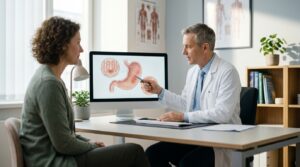
Stomach and digestive treatment in Germany starts with finding the cause: pain, heaviness and heartburn are often kept down with tablets for years while the cause remains. Gastritis, an inflammation of the stomach lining, is only one possible cause.
The German approach is to find what damages the stomach and treat exactly that. Bowel, liver, gallbladder and pancreas diseases have their own pages in the gastroenterology in Germany section; this page covers the stomach: causes, tests, treatment.
What lies behind stomach pain: gastritis, reflux, ulcer
Stomach pain is often caused by gastritis, reflux or an ulcer, which feel alike because they affect the same area. Gastritis is an inflamed stomach lining, mostly due to Helicobacter pylori or regular NSAID painkillers and rarely to bile reflux, according to the German health ministry’s patient portal; an autoimmune form also exists. In reflux, acid rises into the oesophagus, and an ulcer is a sore in the stomach or duodenal wall.
Vomiting blood or coffee-ground material, black stools, unexplained weight loss, difficulty swallowing or repeated vomiting mean that gastroscopy should not wait: they may signal bleeding or a tumour. If a tumour is found, the plan changes; see stomach cancer treatment.
Diagnosis: gastroscopy with biopsy and tests
The diagnosis rests on gastroscopy with biopsy, with tests to clarify the cause. A thin endoscope goes in through the mouth, and light sedation, if wished, lets the patient sleep. A high-definition scope magnifies the image; narrow-band imaging (NBI) highlights the lining and its vessels. Biopsies come from several areas by a standard scheme, as inflammation is patchy, and show bacteria, atrophy (thinning of the lining) or intestinal metaplasia (bowel-type cells replacing stomach cells).
A C13 urea breath test detects Helicobacter pylori. For heartburn, 24-hour pH impedance monitoring records via a thin nasal tube how often stomach contents reach the oesophagus and how acidic they are. Suspected autoimmune gastritis calls for blood tests for pepsinogens I and II, gastrin-17 and antibodies to acid-making parietal cells. More on digestive system diagnostics.
Gastritis treatment by type of inflammation
Gastritis is treated by type, since bacterial, chemical and autoimmune forms differ in cause. Helicobacter gastritis (type B) is treated with an acid-reducing medicine, bismuth and two antibiotics chosen with resistance in mind, followed by a test of cure, because feeling better proves nothing; see Helicobacter pylori treatment.
Bile reflux gastritis (type C) is treated with medicines that speed food out of the stomach and sometimes ursodeoxycholic acid, which makes bile less harsh. Painkiller gastritis is the same type: the prescribing doctor reviews the drug, switches it or adds acid protection.
In autoimmune gastritis (type A), the immune system destroys parietal cells, which also make intrinsic factor, a protein needed to absorb vitamin B12. B12 therefore runs short and is replaced by injections or tablets, usually for life, plus iron if low. Acid reducers are usually unnecessary; the lining is checked by regular gastroscopy.
Some heartburn remedies, such as antacids and low-dose proton pump inhibitors in small packs, are sold without prescription in German pharmacies; antibiotics and most other drugs need one. Self-treatment masks symptoms and can distort tests: acid reducers are stopped before the Helicobacter breath test as the hospital instructs. The gastroenterologist chooses the regimen after the tests.
Diet, follow-up and procedures for complications
Diet helps through a flare-up, follow-up matters when the lining has changed, and complications are often treated endoscopically. In a flare-up, light food such as rusks or oatmeal in small portions is advised, without alcohol, smoking, coffee, fatty or spicy food; the diet is then widened step by step.
For atrophy and intestinal metaplasia, the pathologist assigns a stage on the OLGA (atrophy) and OLGIM (metaplasia) scales by how much lining is affected. Early stages almost never progress; high stages carry a clearly higher cancer risk, so gastroscopy with biopsy is repeated regularly to catch changes while still removable endoscopically.
When tablets are not enough, the endoscope often helps: a bleeding ulcer or polyp found at gastroscopy is frequently treated at once, stopping the bleeding or removing the polyp. Surgery is rarely needed; for proven reflux that medicines cannot control, an anti-reflux operation may be discussed: the surgeon wraps the top of the stomach around the lower oesophagus to reinforce the junction. The gastroenterologist and surgeon decide together.
Frequently asked questions
How many days does a stomach examination take?
A basic examination fits into a two-day programme: a gastroenterologist’s consultation, gastroscopy with biopsy and tests where needed. If gastroscopy finds something best treated at once, such as a polyp or bleeding ulcer, the plan and stay may change. The hospital plans the exact programme from your documents.
Can gastritis turn into stomach cancer?
Rarely, and the main risk factor is Helicobacter pylori. The US National Cancer Institute explains that chronic infection causes long-lasting inflammation, which can lead to atrophic gastritis and certain stomach cancers. People with advanced atrophy or intestinal metaplasia are therefore offered regular follow-up gastroscopy to catch changes early.
What if heartburn tablets stop working?
See a gastroenterologist: German guidelines recommend gastroscopy when a trial of medication has failed. If it finds no explanation, pH impedance monitoring shows whether there is reflux, whether it is acidic, or whether an oversensitive oesophagus causes the symptoms. The result decides between changing the medicines and discussing surgery.
How AlenMed arranges stomach treatment in Germany
AlenMed helps collect and translate documents, sends them to the hospital and agrees the plan and cost estimate. Send medical reports, gastroscopy and histology reports, Helicobacter test results and your medication list.
The Israelite Hospital Hamburg specialises, among other things, in stomach and bowel diseases, including the investigation of unexplained chronic digestive complaints. At Munich Hospital Bogenhausen, gastroenterology is headed by Dr Martin Fuchs, whose work includes endoscopic treatment of oesophageal and gastric motility disorders. At the ISAR Klinikum in Munich, PD Dr Holger Seidl, a director of gastroenterology, focuses on diagnostic and interventional gastroenterology and functional bowel disorders. In Frankfurt am Main, Prof. Axel Dignass heads Medical Department I at the Markus Hospital, which treats digestive and liver diseases. As a guide, comprehensive gastroenterological diagnostics typically span two days, with costs ranging between 700 € and 2,200 € depending on the required procedures; the final amount follows the hospital’s estimate (Kostenvoranschlag), and other diagnostics prices are listed separately. AlenMed arranges the visa invitation and medical interpreters; its office is in Munich, its partner hospitals across Germany.
This page is for information only and is not an offer. Prices are approximate; a doctor decides on treatment at an in-person consultation.
News on this topic
Preventing Stomach Cancer Before It Starts: Breakthrough at Charité
Researchers at Charité have discovered how Helicobacter pylori reprograms stomach tissue, creating new possibilities for early molecular cancer prevention.
Approved Drug Shows Potential in Preventing Severe Pancreatitis
Researchers at Universitätsmedizin Greifswald showed that Anakinra can reduce tissue damage and scarring in acute and chronic pancreatitis.