EN
The first steps out of bed send a sharp pain through the heel; it eases by midday and comes back in the evening. An X-ray shows a bony spike, and the conclusion seems obvious: the spike has to come out.
This page explains the part nobody expects: the spur itself is usually not the source of the pain, which is why German doctors do not treat it. Step by step: what actually hurts, what the examination shows and which methods make up heel spur treatment in Germany.
What actually hurts
What usually hurts is not the spur but the plantar fascia, a dense band that runs from the heel bone to the toes and holds up the arch like a bowstring. When its attachment to the heel bone is overloaded and irritated, morning pain appears. This is what lies behind most cases.
The bony spike is the bone’s reaction to long-standing pull. Such spikes are found in people with no heel pain at all, so a single X-ray settles nothing. The whole logic of treatment rests on this: what needs treating is the fascia and whatever overloads it, not the spike.
The overload comes from excess weight, a flat or a very high arch, stiff shoes with no cushioning, a tight Achilles tendon and calf, and a sudden increase in running or standing. The spur at the Achilles attachment, at the back of the heel, is a separate matter: a different problem with different treatment.
What happens at the appointment
The examination matters most, and the diagnosis is built from it: the point of maximum tenderness under the heel, the mobility of the foot and ankle, how tight the calf is, the gait and the wear pattern of the shoes.
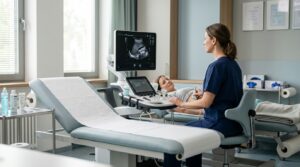
Each scan answers its own question. An X-ray shows the spike and rules out a stress fracture, ultrasound measures the thickness of the fascia and shows inflammation, and an MRI is not always needed: it is used where there is doubt or before surgery.
Conditions that mimic heel spur pain have to be excluded: a trapped nerve under the heel, inflammatory joint disease and, in people with diabetes, neuropathy, meaning nerve damage in the foot. Pain at rest at night and morning pain that walks off are different symptoms with different meanings: the second is typical of an overloaded fascia, the first calls for a search for another cause. How orthopaedics in Germany works is described separately.
Treatment step by step
Treatment always starts with a foundation that works for most people: less load, stretching of the plantar fascia and the calf, custom insoles with arch support and a soft heel, different shoes and weight loss. It is not a delaying tactic but a method that takes weeks of discipline: the key to stretching is doing it every day.
Next come physiotherapy and local measures: supervised exercises, a night splint in stubborn cases and painkillers in short courses. Corticosteroid injections, a hormone-based anti-inflammatory drug, are used sparingly, because repeated injections damage the fascia themselves. Physiotherapy in Germany and painkillers each have a page of their own.
For pain that has lasted months, shockwave therapy is an outpatient option: a device sends short acoustic pulses into the fascia attachment. It takes several sessions, and the effect builds up gradually rather than arriving at once.
What is different about the German approach, and when surgery is needed
What visitors rarely expect is that for stubborn heel pain German medicine uses low-dose radiotherapy of the fascia attachment, keeping surgery as a last resort. This long-standing practice has a recommendation in the guideline of the German Society for Radiation Oncology (DEGRO) and is discussed once ordinary treatment has failed. It is not cancer treatment or “burning off the spur”: low doses act against inflammation. A radiation oncologist prescribes it, and it does not suit everyone: people under 40 are generally not treated this way.
Surgery is the last and a rare step. Partial release of the fascia or removal of the bony spike is considered when months or years of proper treatment have failed. Surgery does not guarantee that the pain will go, and recovery takes time.
A hospital is chosen by its foot and ankle unit, not by the name of the city. The orthopaedic surgeons on the site include Prof. Sebastian Baumbach, head of the orthopaedics and surgery department with a focus on foot and ankle surgery at the ATOS Starmed Klinik in Munich. See also the selection of orthopaedic hospitals in Germany.
Frequently asked questions
Does a heel spur need to be removed?
Usually not. The pain normally comes from an overloaded plantar fascia, and the same spike is found in people with no pain. So treatment targets the fascia: stretching, insoles, less load and, if needed, shockwave therapy or radiotherapy. Removing the spike is rare, comes only after long treatment has failed and does not guarantee relief.
Why does the heel hurt most in the morning?
Because the fascia shortens as it rests overnight, and the first steps stretch it abruptly: the pain is sharp at first, then eases with walking. That is why stubborn cases get a night splint, which holds the foot at a right angle during sleep. Pain at rest during the night is a different symptom, and the doctor looks for another cause.
Does shockwave therapy help a heel spur?
Studies show that it reduces stubborn heel pain, but it is not the first step. It is offered when the pain has lasted months and stretching, insoles and less load have not helped. The procedure is outpatient and takes several sessions, and relief comes gradually.
How AlenMed arranges the treatment
AlenMed sends the images and reports to a foot and ankle unit, which replies in writing with what it would do and whether a trip is needed at all: part of the treatment can be done at home. The company has 86 partner hospitals in 38 German cities, 345 doctors and its own office in Munich, and arranges an interpreter at the appointment, a written cost estimate from the hospital and help with the visa.
Settle in advance how many days the course takes, whether the insoles are made on site and how long they take, whether a second trip is needed and how to continue the treatment at home.
This material is for information only and is not an offer. The treatment plan is decided by a doctor at an in-person appointment.
News on this topic
Consensus Guideline for Bacteriophage Therapy in Bone and Implant Infections
An international consensus guideline published in Nature Medicine establishes standards for personalized bacteriophage therapy in complex orthopedic infections.
Ultrasound Regional Anesthesia Replaces General Anesthesia for Surgery
German specialists from DEGUM emphasize how ultrasound-guided regional nerve blocks improve surgical safety, lower medication doses, and protect high-risk patients.
Obesity and Rheumatism: Inflammatory Immune Changes Are Reversible
Leipzig researchers have revealed that obesity-induced immune system inflammation mirrors rheumatoid arthritis and can be reversed through substantial weight loss.