EN
ENA knee that twinges on the stairs, fingers stiff in the morning, a hip that aches after a walk: joint pain treatment in Germany starts with finding out what is damaging the joint, because the answer decides between exercise, medication and surgery. At home, one doctor may suggest an ointment and another an operation straight away.
This page covers the causes, the examination, step-by-step treatment of knee osteoarthritis, other joints, hospitals and the trip itself. Knee and hip replacement have their own pages.
Why joints hurt: what the first consultation clarifies
Most joint pain has one of three causes: worn cartilage, inflammation, or injury and overload. Worn cartilage is osteoarthritis: the smooth layer on the joint surfaces thins and stops cushioning the load. Inflammation is behind rheumatoid arthritis, gout and psoriatic arthritis. Injuries damage the menisci (the cartilage pads of the knee), ligaments and cartilage; a torn meniscus or ligament is often operated on through small incisions with a camera inside the joint: arthroscopy.
Inflammatory diseases belong to a rheumatologist, and mistaking them for wear costs time, because untreated inflammation keeps damaging the joint. Morning stiffness lasts longer, joints swell, and in rheumatoid arthritis the same joints are usually affected on both sides of the body. Treatment of rheumatoid arthritis has a separate page.
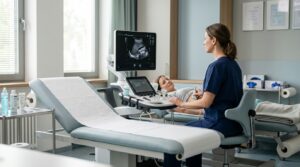
The orthopaedic surgeon examines the joint and checks whether the leg is straight, bowed or knock-kneed. Knee X-rays are taken standing, under body weight, to show how far the joint space has narrowed; ultrasound and, if the picture is unclear, MRI follow. Blood tests look for inflammation and for rheumatic markers, antibodies typical of rheumatoid arthritis. Knee pain without clear osteoarthritis has many possible causes, covered on the knee pain page.
Knee osteoarthritis: steps from exercise to surgery
Knee osteoarthritis is treated in steps: exercise, weight loss and pain relief first, surgery only when they are no longer enough. At first the cartilage thins and the knee hurts after exertion; then the joint space narrows on the X-ray and bone spurs grow; in the end stage little cartilage is left and the pain comes at rest too. Treatment follows the stage and the symptoms, not the X-ray alone.
The German clinical guideline on knee osteoarthritis puts regular exercise and weight loss at the core of non-surgical treatment. Exercise strengthens the thigh muscles, ideally under a physiotherapist’s supervision at first. For overweight patients, every step towards a normal weight means less pain and slower progression. Braces and insoles are reserved for an unstable joint, a misaligned leg or cases where exercise alone fails. Anti-inflammatory gels and tablets are used in short courses at the lowest effective dose. The guideline advises against electrical and laser treatments: their benefit is unproven.
Next come injections. Corticosteroids help during flare-ups when other drugs fail, but only for a while. Studies on hyaluronic acid contradict each other, so the guideline makes no recommendation either way: some patients benefit, others do not, and the doctor decides. German guidelines advise against arthroscopy done only to wash out the joint and smooth the cartilage in confirmed osteoarthritis. No drug rebuilds destroyed cartilage; which new drugs and methods are offered, and which actually help, is covered on the osteoarthritis treatment page.
Which operation fits depends on age and joint damage. Younger patients whose osteoarthritis is not yet advanced and whose leg is misaligned may have a realignment osteotomy: the bone is cut and reset at a new angle to unload the worn part. A limited cartilage defect after an injury in a young patient can be repaired by microfracture, where small holes in the bone beneath the defect let replacement tissue grow, or by transplanting the patient’s own cartilage cells grown in a laboratory. These methods do not suit widespread osteoarthritis. When the cartilage is gone, the answer is a partial or total knee replacement.
Shoulder, hip, hands and feet
Osteoarthritis of the hip and shoulder follows the same principles as in the knee: exercise, less strain and medication first, surgery when these have been exhausted. Shoulder replacement has its own page on this site.
Small joints wear out too: osteoarthritis of the big toe makes every step painful, and in the finger joints it makes buttoning a shirt hard. Orthopaedic shoes, insoles and splints help a great deal; if they are not enough, hand and foot surgeons remove bone spurs, stiffen the joint so that it stops hurting, or replace it.
Where joint pain is treated in Germany
Joint pain in Germany is treated in the orthopaedic departments of university hospitals and in specialist orthopaedic hospitals. With osteoarthritis, the right surgeon neither rushes into an operation nor postpones it endlessly. Prof. Andrea Meurer is chief of orthopaedics and medical director of Medical Park St. Hubertus in Bad Wiessee; until 2022 she led the orthopaedic clinic of University Hospital Frankfurt. She founded the German Osteoarthritis Research Initiative (DIA) and in 2017 was president of the German Society for Orthopaedics and Orthopaedic Surgery.
In Munich, the Department of Orthopaedics and Sports Orthopaedics at Klinikum rechts der Isar, directed by Prof. Rüdiger von Eisenhart-Rothe, works on joint replacement and researches osteoarthritis and joint biomechanics. Sportklinik Stuttgart is also a centre for rheumatic orthopaedics, operating on joints damaged by rheumatic diseases.
Frequently asked questions
Which doctor should I see for joint pain?
Start with an orthopaedic surgeon if the pain comes with strain, injury or wear. If joints swell, stay stiff for long in the morning, hurt on both sides of the body or blood tests show inflammation, see a rheumatologist: these diseases are treated with drugs that suppress inflammation. If a joint destroyed by rheumatoid arthritis needs surgery, both specialists work together.
What if a doctor at home suggests surgery straight away?
Show your X-rays and reports to another orthopaedic surgeon and, unless it is urgent, take your time. The German guideline on knee osteoarthritis advises giving patients enough time to decide and discussing first what the operation can and cannot achieve. Most people with knee osteoarthritis manage without surgery, but when the cartilage is destroyed and pain persists at rest, an operation may be the right step.
How long does joint treatment in Germany take?
It depends on what is needed. An examination with X-rays and blood tests usually fits into one trip, and you go home with a treatment plan to follow there. Surgery adds days in hospital and rehabilitation, which after a joint replacement takes several weeks in a clinic or as an outpatient. The hospital gives the exact timing with its estimate.
How AlenMed arranges joint treatment
AlenMed starts with the documents: weight-bearing X-rays, MRI, blood tests and a note of treatments already tried. We translate them and send them to an orthopaedic surgeon or rheumatologist at partner hospitals across Germany. Sometimes a consultation in person and a conservative plan to continue at home are all that is needed.
If surgery is needed, the hospital sends an estimate before arrival. The amount depends on what is planned: a consultation and conservative plan, arthroscopy or joint replacement, days in hospital and rehabilitation. We arrange the visa invitation, an interpreter and accommodation. After surgery, rehabilitation follows in a clinic or as an outpatient, and after discharge the patient receives an exercise programme in their own language. The AlenMed office is in Munich.
This material is for information only and is not an offer. The treatment plan is decided by a doctor at an in-person consultation.
News on this topic
Consensus Guideline for Bacteriophage Therapy in Bone and Implant Infections
An international consensus guideline published in Nature Medicine establishes standards for personalized bacteriophage therapy in complex orthopedic infections.
Ultrasound Regional Anesthesia Replaces General Anesthesia for Surgery
German specialists from DEGUM emphasize how ultrasound-guided regional nerve blocks improve surgical safety, lower medication doses, and protect high-risk patients.
Obesity and Rheumatism: Inflammatory Immune Changes Are Reversible
Leipzig researchers have revealed that obesity-induced immune system inflammation mirrors rheumatoid arthritis and can be reversed through substantial weight loss.