EN
In Germany, knee pain is treated by an orthopaedic and trauma specialist who first looks for the cause, then chooses exercise, medication or injections, and surgery only when indicated. A familiar story: the knee aches on stairs, after running or at night; at home there was an X-ray, ointments and injections, yet the pain keeps coming back.
Knee pain treatment in Germany starts with the question “why does it hurt”, not with choosing a procedure: front-of-knee pain in a teenage athlete and in an older person with a worn joint are different conditions. Below: causes, tests, treatment without surgery and when surgery is discussed.
Why the knee hurts
Most knee pain comes from worn cartilage, overload or injury, less often from inflammation or a problem elsewhere. With age, knee osteoarthritis takes the lead: the cartilage on the bone ends wears away, and the knee hurts under load and when starting to move after rest. Osteoarthritis and other joint problems are covered under joint treatment.
Injury and overload are typical in younger, active people. A torn meniscus — the cartilage cushion inside the joint — hurts along the joint line and can make the knee lock; a damaged ligament makes the knee give way. Teenagers and people in running and jumping sports often have pain around the kneecap, worse when squatting, on stairs and when running; a 2018 systematic review describes it as one of the most common forms of knee pain.
Less often the cause is inflammation: in rheumatoid arthritis, gout or psoriatic arthritis the joint swells and feels warm. Sometimes the knee itself is healthy and the pain comes from the hip or from the lower back, where spinal problems affect the nerves to the leg.
Which tests are needed
The key test is a careful conversation and examination; scans are added when needed. The doctor finds the painful spot, checks for an effusion — fluid in the joint — for ligament stability and for signs of meniscus damage, looks at leg alignment while standing and always examines the hip.
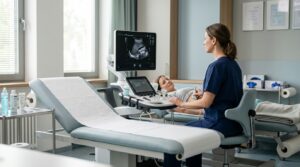
The first scan is usually a standing X-ray: under body weight, the gap between the bones shows how much cartilage is left. MRI in Germany is ordered to see the meniscus, ligaments or cartilage, and ultrasound shows fluid in the joint, an inflamed bursa or a Baker’s cyst.
Blood tests, sometimes with joint fluid analysis, are needed if inflammation is suspected, as with a red, hot knee. An MRI “just in case” is not needed when examination and X-ray give the diagnosis: the German osteoarthritis guideline reserves it for unclear cases. In middle-aged and older people, MRI often finds meniscus tears in knees that do not hurt.
Treatment without surgery
Exercise therapy and physiotherapy are the basis for both worn cartilage and overload: thigh strengthening and mobility exercises, tailored to the person and ideally supervised. For pain around the kneecap, hip muscle exercises are added, and the physiotherapist teaches how to keep the knee in line with the leg when squatting and on stairs.
Avoid what triggers the pain for a while: deep squats, kneeling, jumping. Losing excess weight reduces pain. Braces and insoles are considered only with an unstable knee, clearly misaligned legs or when exercise alone is not enough. Painkillers only as prescribed: in osteoarthritis, anti-inflammatory gels come first, tablets at the lowest effective dose for as short a time as possible.
Joint injections play a supporting role. In osteoarthritis, a corticosteroid — a hormone-based anti-inflammatory — may be used short-term if other medicines fail or are unsuitable, or to make exercise possible; the relief is temporary. The evidence on hyaluronic acid is mixed, any benefit found is small, and the German guideline on knee osteoarthritis makes no recommendation for or against it.
When knee surgery in Germany is discussed
Knee surgery in Germany is discussed when the pain has a mechanical cause or when long non-surgical treatment has not helped enough. If a torn flap of meniscus or a loose piece of cartilage locks the knee so that it will not straighten, arthroscopy through small incisions may help: the surgeon removes the blockage. For osteoarthritis alone, the German guideline advises against washing out and “cleaning up” the joint arthroscopically.
If the wear is linked to a misaligned leg and is not yet advanced, an osteotomy — an operation on the bone near the knee — can correct the alignment. When wear is advanced and the knee hurts even at rest, partial or total knee replacement is discussed. One specialist is Dr Matthias Hoppert, director of orthopaedics and trauma surgery at ISAR Klinikum in Munich and a certified knee surgeon of the German Knee Society (DKG).
The cost of such an operation depends on the implant type, partial or total replacement, the length of stay and the amount of rehabilitation. The hospital states the exact amount in its cost estimate (Kostenvoranschlag); guide figures are on the page on knee replacement cost in Germany.
Frequently asked questions
Why does my knee hurt at night?
Night pain occurs with advanced cartilage wear and with joint inflammation, so have it checked rather than endure it. The German osteoarthritis guideline lists pain at rest and at night among typical complaints. An inflamed knee is usually swollen and warm, and the doctor adds blood tests and sometimes a joint puncture.
Can I do sport if my knee hurts?
Usually yes, if the sport suits the cause of the pain. For osteoarthritis, the German guideline recommends sport without overloading the knee — cycling, front-crawl swimming, water aerobics — and warns that pain may increase at first. After an injury, the doctor decides when to resume sport.
Which doctor treats knee pain in Germany?
A specialist in orthopaedics and trauma surgery, one specialty in Germany: Facharzt für Orthopädie und Unfallchirurgie. This doctor manages treatment with or without surgery. A physiotherapist runs the exercises, and if an inflammatory disease such as rheumatoid arthritis is suspected, a rheumatologist joins in.
How AlenMed arranges knee pain treatment
AlenMed has reports, scans on disc and a description of the symptoms translated and sent to an orthopaedic surgeon at a partner hospital, who says what is missing for a diagnosis — a standing X-ray or an MRI, for example.
AlenMed then arranges the visit for examination and imaging with an interpreter; if no surgery is needed, the patient goes home with a physiotherapy plan. AlenMed’s office is in Munich; partner hospitals are all over Germany.
This material is for reference only and is not an offer. The treatment approach is decided by a doctor after an in-person examination.
News on this topic
Consensus Guideline for Bacteriophage Therapy in Bone and Implant Infections
An international consensus guideline published in Nature Medicine establishes standards for personalized bacteriophage therapy in complex orthopedic infections.
Ultrasound Regional Anesthesia Replaces General Anesthesia for Surgery
German specialists from DEGUM emphasize how ultrasound-guided regional nerve blocks improve surgical safety, lower medication doses, and protect high-risk patients.
Obesity and Rheumatism: Inflammatory Immune Changes Are Reversible
Leipzig researchers have revealed that obesity-induced immune system inflammation mirrors rheumatoid arthritis and can be reversed through substantial weight loss.