EN
ENIf your fingers stay stiff for more than an hour in the morning, the small joints of your hands are swollen and warm, and both hands are affected alike, this looks like arthritis, a matter for a rheumatologist. Many people spend years treating what they take for wear and tear while inflammation damages cartilage and bone: time works against the joint.
Below: how the diagnosis is made in Germany, which medicines are used and when a surgeon becomes involved. Worth knowing from the start: arthritis treatment in Germany is led by a rheumatologist, not an orthopaedic surgeon.
Arthritis and osteoarthritis are not the same thing
Arthritis is inflammation of a joint, osteoarthritis is wear of its cartilage, and this difference governs the whole treatment. An arthritic joint swells and may redden, hurts at rest and in the morning, and eases with movement; osteoarthritis hurts under load and towards evening. Inflammation is mostly treated with drugs that damp down the immune attack, wear with load management, physiotherapy and, in the end, a joint replacement — see osteoarthritis treatment in Germany.
The main forms patients arrive with are rheumatoid, psoriatic and reactive arthritis, ankylosing spondylitis, gout and infectious arthritis. In rheumatoid and psoriatic arthritis and ankylosing spondylitis the immune system itself starts the inflammation; in gout, uric acid crystals settle in the joint; reactive arthritis follows a bowel or urogenital infection; in infectious arthritis bacteria reach the joint. The cause of rheumatoid arthritis is unknown; heredity and smoking raise the risk, and women are affected more often. Each form needs its own treatment, so telling them apart comes first (see rheumatology in Germany).
Rheumatoid arthritis
In rheumatoid arthritis the immune system attacks the synovial lining, the thin tissue inside the joint, and damage to cartilage and bone edges can begin within the first months. That is why German practice insists on treatment as soon as the diagnosis is confirmed. The inflammation also reaches beyond the joints: when the disease stays active for long, heart and blood vessel disease become more likely, the lungs and eyes can suffer and osteoporosis develops faster, so the rheumatologist watches these too.
Disease-modifying antirheumatic drugs (DMARDs) are the foundation: they change the course of the disease rather than just easing pain. Methotrexate usually comes first, another DMARD if it is unsuitable or poorly tolerated. The aim is remission, a state without active inflammation, or at least low disease activity. The effect builds over weeks or months, with regular checks and a change of regimen if the response is weak. DMARDs are taken continuously, not in courses: once they are stopped, the inflammation usually returns. Glucocorticoids (cortisone-type drugs) bridge the gap until the DMARD works and are then quickly tapered off.
If DMARDs fail, biologics or targeted drugs are added. Biologics are mostly antibodies blocking one specific inflammatory signal; targeted drugs are tablets interrupting such a signal inside the cell. As they weaken part of the immune defence, latent tuberculosis and hepatitis are ruled out and vaccinations checked beforehand, and regular blood tests catch side effects early. The German guideline on drug treatment of rheumatoid arthritis sets out these steps; see also rheumatoid arthritis treatment in Germany.
How the diagnosis is made in Germany
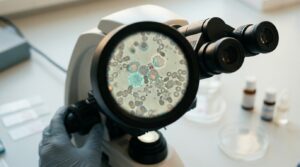
A rheumatologist makes the diagnosis from examination, blood tests and imaging together, since no single finding proves it. The doctor counts tender and swollen joints; the laboratory measures inflammatory markers, rheumatoid factor and anti-CCP antibodies, which are typical of rheumatoid arthritis, plus a blood count and liver and kidney values. Uric acid is checked if gout is suspected, joint fluid if infection is.
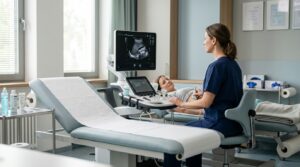
Doppler ultrasound, which displays blood flow, reveals active inflammation of the synovial lining; MRI finds early changes that X-rays cannot yet see; and X-rays of the hands and feet serve as the baseline for judging later whether the damage has been halted.
This is done in the rheumatology departments of university hospitals, several of them AlenMed partners. In Freiburg, the Department of Rheumatology and Clinical Immunology at University Hospital Freiburg is led by its medical director, Prof. Reinhard E. Voll. In Dresden, Prof. Martin Aringer heads rheumatology in Medical Clinic III at University Hospital Dresden and is the clinic’s deputy director. In Hamburg, Prof. Tobias B. Huber directs Medical Clinic III at University Hospital Hamburg-Eppendorf, where nephrology and rheumatology are combined.
Beyond medicines
Besides medicines, treatment includes physiotherapy, occupational therapy and, once a joint is destroyed, surgery. Physiotherapy keeps the range of motion and muscle strength, and exercise is stepped up when disease activity is low. Occupational therapists show how to manage daily tasks without straining fingers and wrists and fit splints and orthoses for the hands. Complete rest harms the joint: the muscles weaken and the joint stiffens.
The surgeon steps in when medicines cannot control inflammation in a single joint or a joint is already damaged: the inflamed lining is removed in an operation called synovectomy, hand and foot deformities are corrected, and a destroyed joint is replaced. Surgery treats the consequences of arthritis, not the disease itself, so drug treatment continues afterwards. See also orthopaedics in Germany.
Children and adolescents
Joint inflammation behaves differently in children, so their care belongs with a paediatric rheumatologist, not an adult one. Drugs and doses are chosen by age and weight, and the doctor watches that growth is not held back. The eyes need separate attention: inflammation inside the eye (uveitis) often causes no symptoms, so an ophthalmologist checks the child regularly. More on juvenile rheumatoid arthritis.
Frequently asked questions
Can arthritis be cured completely?
It depends on the form. Infectious arthritis usually clears up with prompt antibiotic treatment, and reactive arthritis usually settles, though in some people the symptoms return. Gout attacks are prevented by keeping uric acid low over the long term. Rheumatoid arthritis is chronic: the aim is remission, a state without active inflammation, and no doctor can say in advance whether it will be reached and kept.
Which doctor should I see for arthritis?
See a rheumatologist, who makes the diagnosis, chooses the medicines and follows the course of the disease. An orthopaedic surgeon is needed when an operation is considered. In psoriatic arthritis the rheumatologist works with a dermatologist, and with an ophthalmologist or a lung specialist when the eyes or lungs are involved.
Are biologics dangerous?
The main risk of biologics is infection, as they weaken part of the immune defence. So latent tuberculosis and hepatitis are ruled out and vaccinations checked before the start, and blood tests are repeated during treatment. Report any fever to the doctor at once. The rheumatologist and the patient decide together whether the benefit outweighs the risks.
How AlenMed arranges treatment in Germany
AlenMed collects and translates the file, including every earlier blood test and image, without which the rheumatologist cannot judge the course of the illness. We book the rheumatology appointment, obtain the clinic’s official cost estimate (Kostenvoranschlag), help with the visa, meet you and provide a medical interpreter. Our office is in Munich, and partner clinics are across Germany. In chronic arthritis one trip is often enough to set the regimen, with monitoring continued at home, and this should be agreed in advance.
The cost covers the rheumatology consultation, laboratory tests, ultrasound and MRI where needed, an inpatient stay for a severe flare and surgery for a destroyed joint. Yet in chronic arthritis the main cost is not the trip but long-term drug treatment, biologics above all, so before travelling it is clarified how the medicine will be obtained at home. Only the clinic’s estimate gives the sums.
This material is for information only and is not an offer. The regimen and the doses are set by a doctor after an in-person examination and testing.
News on this topic
Consensus Guideline for Bacteriophage Therapy in Bone and Implant Infections
An international consensus guideline published in Nature Medicine establishes standards for personalized bacteriophage therapy in complex orthopedic infections.
Ultrasound Regional Anesthesia Replaces General Anesthesia for Surgery
German specialists from DEGUM emphasize how ultrasound-guided regional nerve blocks improve surgical safety, lower medication doses, and protect high-risk patients.
Obesity and Rheumatism: Inflammatory Immune Changes Are Reversible
Leipzig researchers have revealed that obesity-induced immune system inflammation mirrors rheumatoid arthritis and can be reversed through substantial weight loss.