EN
EN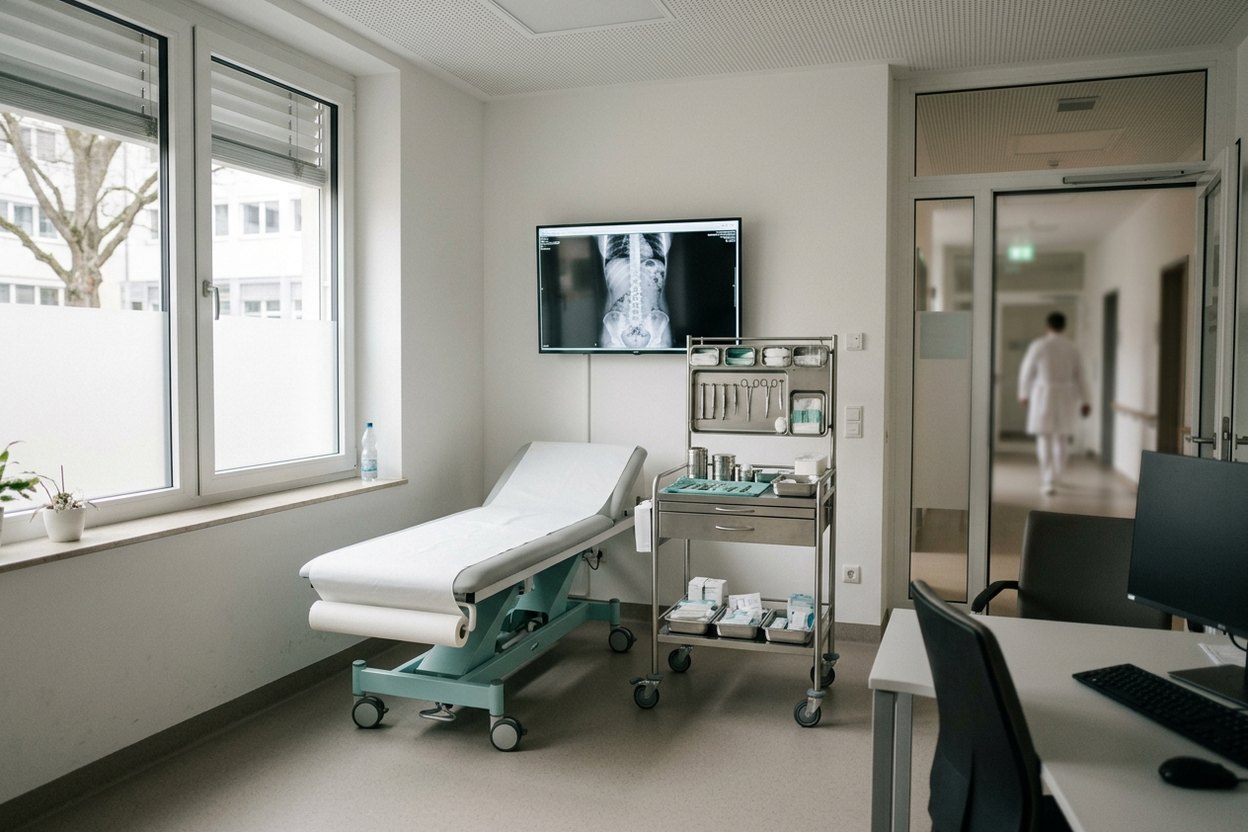
A baby’s ultrasound showing «immature hips», uneven shoulders noticed by a school doctor, legs of different length: in Germany, such problems are treated by paediatric orthopaedists in specialised departments of children’s and orthopaedic hospitals. Parents want to know what to do now, while the skeleton is still growing.
Paediatric orthopaedics in Germany differs from adult care because a child’s bones are still growing. Doctors start with observation and gentle methods, operate only when these fail, and protect the growth plates — the cartilage layers that make bones longer. For an overview, see orthopaedics in Germany; this page covers conditions, examinations, treatment and hospitals.
Conditions children are seen for
Children see a paediatric orthopaedist for hip dysplasia in infancy, scoliosis in adolescence, foot deformities, unequal or bent legs and systemic bone diseases. In hip dysplasia, the hip socket is too shallow to hold the head of the thigh bone securely; in a dislocation, the head slips out. Held in position early, the joint matures; untreated, it develops early osteoarthritis. That is why every baby in Germany has a hip ultrasound.
Scoliosis is a sideways curve of the spine with rotated vertebrae. The most common form, idiopathic scoliosis, has no known cause; it usually appears in adolescence and progresses fastest during growth spurts, so uneven shoulders need a prompt check. Braces and operations are covered on the scoliosis treatment page.
Foot deformities include clubfoot, in which the foot points down and inwards from birth; treatment starts soon after delivery. A marked leg length difference, congenital or after an injury, tilts the pelvis and causes a limp. Bow legs and knock knees overload the knee. Osteogenesis imperfecta is an inherited systemic disease that makes bones as brittle as glass.
Examinations without unnecessary radiation
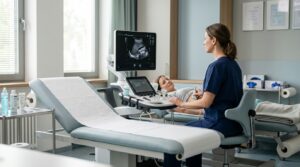
Wherever possible, children are examined without X-rays. Infant hips are checked by ultrasound according to Graf, the German standard for newborns and babies: it shows the still cartilaginous socket and femoral head without radiation, and the measured angles show whether a splint is needed. Optical 3D scanning with light stripes projected onto the skin assesses the back between X-rays but does not fully replace them.
For a full-length standing image, a low-dose X-ray system captures the whole skeleton in two planes in one pass at a markedly lower dose. MRI shows cartilage, ligaments, discs and the spinal cord. Indicative prices:
- joint ultrasound — approximately 130–150 €;
- follow-up consultation with a specialist — from 130 €;
- MRI of a single spinal segment or joint — around 800 €;
- full spine MRI — approximately 950 €;
- the final amount is in the hospital’s estimate; see diagnostics prices.
Treatment: from splint to surgery
Treatment starts with splints, braces, casts and exercises. In a baby with hip dysplasia, a splint or brace keeps the legs bent and apart while the joint matures; a dislocated hip is first put back in place with a Pavlik harness, or by hand followed by a plaster cast. The German guideline on hip dysplasia in the AWMF register sets out Graf ultrasound and splinting. For scoliosis, a Chêneau brace made from a 3D trunk scan (CAD/CAM) is combined with Schroth exercises. Clubfoot is corrected by the Ponseti method: serial plaster casts, a small cut of the Achilles tendon, then a brace.
If surgery is needed, the gentlest option is chosen. While growth plates are open, bow legs and knock knees are corrected by guided growth: a small figure-of-eight plate temporarily slows growth on one side of the bone, and the axis straightens by itself; growth of the longer leg is slowed likewise. Late-detected dysplasia needs reduction and osteotomy: the bone is cut and fixed in the correct position. Young children with severe scoliosis receive growing rods, lengthened as they grow — at Altonaer Kinderkrankenhaus, for example, when early-onset scoliosis progresses rapidly beyond 50–60° Cobb, the curve angle measured on an X-ray.
Rehabilitation is built around play: exercises strengthen muscles and retrain walking and balance, and parents get an exercise plan for home. Complex cases are discussed jointly by orthopaedic surgeons, paediatricians, neurologists and physiotherapists.
Where children are treated
Children are treated in paediatric orthopaedic departments across Germany. In Hamburg, spine surgery is a main focus of the paediatric orthopaedics department at Altonaer Kinderkrankenhaus, headed on an acting basis by PD Dr Kiril Mladenov; its deformity and tumour section is led by Prof. Alexander S. Spiro. In Munich, paediatric orthopaedics is a main field of Schön Klinik München Harlaching, with a dedicated centre for paediatric and neuro-orthopaedics that also treats children with cerebral palsy.
Children with several conditions need a university children’s hospital where paediatricians and paediatric surgeons work together, such as the Dr. von Hauner Children’s Hospital of LMU University Hospital in Munich. Munich’s Klinikum Dritter Orden has a paediatric and adolescent surgery department with a section for paediatric, adolescent and neuro-orthopaedics that offers hip ultrasound consultations. The hospital is chosen by diagnosis, not by city.
Frequently asked questions
From what age does a paediatric orthopaedist see a child?
From birth until growth is complete. In Germany, the first orthopaedic check is the hip ultrasound every baby receives at a routine examination. Later, children come with a specific concern, such as uneven shoulders, a limp or back pain. Teenagers with scoliosis are monitored closely during growth spurts.
Does hip dysplasia always require an operation?
No. In babies, hip dysplasia is usually treated without surgery: a splint or brace holds the legs in position while the joint matures, and ultrasound checks show the result. Reduction and osteotomy are needed when dysplasia is found late or gentle methods fail, which is why the routine hip ultrasound matters.
How much does an examination by a paediatric orthopaedist cost in Germany?
A follow-up consultation with a specialist costs from 130 €, a joint ultrasound approximately 130–150 €, an MRI of a single spinal segment or joint around 800 € and a full spine MRI approximately 950 €. The exact amount is in the hospital’s estimate, issued after a review of the images.
How AlenMed arranges a child’s treatment
AlenMed starts with the documents: reports, X-rays and ultrasound or MRI recordings on disc are translated into German and sent to paediatric orthopaedic surgeons, who say whether a visit is needed now or observation at home is enough.
The hospital then issues an estimate (Kostenvoranschlag), and AlenMed arranges the visa invitation for the child and accompanying parent, an interpreter, accommodation near the hospital and follow-up visits during growth. AlenMed’s office is in Munich; partner hospitals are all over Germany.
This material is for reference only and is not an offer. Prices are indicative; treatment is decided by a doctor after an in-person examination.
News on this topic
Consensus Guideline for Bacteriophage Therapy in Bone and Implant Infections
An international consensus guideline published in Nature Medicine establishes standards for personalized bacteriophage therapy in complex orthopedic infections.
Ultrasound Regional Anesthesia Replaces General Anesthesia for Surgery
German specialists from DEGUM emphasize how ultrasound-guided regional nerve blocks improve surgical safety, lower medication doses, and protect high-risk patients.
Obesity and Rheumatism: Inflammatory Immune Changes Are Reversible
Leipzig researchers have revealed that obesity-induced immune system inflammation mirrors rheumatoid arthritis and can be reversed through substantial weight loss.