EN
EN
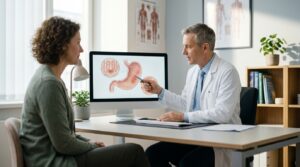
Bowel and digestive treatment in Germany is led by gastroenterologists and starts with an accurate diagnosis, not with pills or surgery. Digestive problems are treacherous because for a long time they seem “not serious”: heaviness, pain, heartburn and disturbed bowels get put down to food and stress until the picture becomes tangled. By the time treatment abroad comes up, a person usually has a set of contradictory reports and one main question — what is really going on here, is it gastritis or something more.
German gastroenterology begins by answering exactly that question, and only then moves on to treatment. The specialty covers the whole digestive system, from the oesophagus and stomach to the bowel, liver, gallbladder, bile ducts and pancreas. Below is an overview of how diagnosis and treatment work and where the specialist departments are; individual conditions have pages of their own, collected below this text.
Why the bowel is treated together with the whole digestive chain
Because the digestive system is a chain of organs, and a symptom in one place often comes from another entirely: pain under the right ribs, for example, may come from the gallbladder rather than the liver. German gastroenterology is strong because it looks at that chain as a whole rather than treating “the stomach” or “the liver” in isolation. Complex cases — inflammatory bowel disease, disease of the liver and pancreas, suspected tumours — are reviewed by a team of gastroenterologist, surgeon and radiologist, and where cancer is involved, an oncologist as well.
The second real difference in German hospitals is the emphasis on early diagnosis. The logic is simple: many serious digestive diseases develop silently for a long time, and finding them before symptoms appear matters far more than heroic treatment of an advanced stage. Bowel polyps and fatty liver disease, for example, can go unnoticed for years.
First, an accurate diagnosis
The diagnosis rests above all on endoscopy: a thin flexible tube with a camera used to examine the oesophagus and stomach (gastroscopy) or the bowel (colonoscopy) from inside. Its value is that it is more than an examination: the doctor can take a biopsy — a tiny piece of tissue for analysis — or remove a suspicious lesion there and then, without resorting to surgery.
The picture is completed by familiar methods — ultrasound, CT and MRI, blood and stool tests. For the bile ducts and the pancreatic duct there is a separate endoscopic procedure, ERCP, in which contrast dye is injected into the ducts through an endoscope passed via the mouth; it is often combined with treatment such as removing a stone. The set of tests is matched to the case, and nothing superfluous is ordered. More about digestive system diagnostics is on a separate page.
Colonoscopy is a rare case where an examination treats and prevents at the same time. Polyps — benign growths — can appear on the bowel wall over time, and some turn into cancer years later; that path may take around ten years. During a colonoscopy such a polyp is found and removed at once, so the potential tumour never has time to develop. That is why the Krebsinformationsdienst of the German Cancer Research Centre calls colonoscopy the most reliable method for the early detection of bowel cancer. In Germany it is part of the national screening programme: since April 2025 both women and men can have a preventive colonoscopy from the age of 50.
What gastroenterologists treat
Gastroenterologists treat diseases of every digestive organ, starting with the stomach and oesophagus: gastritis (inflammation of the stomach lining), stomach and duodenal ulcers, and reflux, in which acidic stomach contents flow back into the oesophagus and cause heartburn. A frequent cause of gastritis and ulcers is the bacterium Helicobacter pylori, which is found with a breath test, a stool test or a biopsy and eradicated with several medicines, including antibiotics. More on the page about gastritis and stomach treatment.
The second group is the bowel. Crohn’s disease and ulcerative colitis are chronic inflammatory bowel diseases: the immune system repeatedly attacks the bowel wall, the illness comes in flare-ups and calmer spells, and treatment is planned for years. Irritable bowel syndrome does not damage the tissue but can spoil daily life with pain, bloating and irregular bowel habits. Diverticulitis, an inflammation of small pouches in the wall of the large bowel, and polyps belong here too. Tumours are treated by oncologists and surgeons together; see colorectal cancer treatment.
Liver diseases rarely hurt, so they are often discovered by chance, in blood tests or on ultrasound. Gastroenterologists treat viral hepatitis B and C, fatty liver disease linked to excess weight, diabetes or alcohol, and rarer autoimmune liver diseases. When damage continues for years, cirrhosis develops and scar tissue replaces healthy liver tissue; in severe cases the way out is a liver transplant at a transplant centre. More on the page about liver treatment.
Gallstones often cause no trouble for years and are then usually left alone. Surgery is advised when attacks of pain (biliary colic) or inflammation of the gallbladder (cholecystitis) occur: the gallbladder is removed laparoscopically, through a few small incisions. Stones that have moved into the bile ducts are retrieved endoscopically during ERCP. More on the page about gallbladder treatment.
The pancreas produces digestive enzymes and insulin, so its diseases affect the whole body. Acute pancreatitis, a sudden inflammation most often caused by a stone in the duct or by alcohol, is treated in hospital. Chronic pancreatitis destroys the gland over years: enzymes then have to be taken as capsules with meals, and diabetes sometimes develops. Pancreatic cysts are often found by chance; some only need monitoring, others are removed. More on the page about pancreas treatment.
How treatment is chosen
Treatment is chosen according to the diagnosis: there is no single formula in gastroenterology, and an ulcer, inflammatory bowel disease, hepatitis and gallstones are treated in completely different ways. Some conditions are kept under control with medication and diet for years, and that is proper treatment, not a half-measure. The German approach favours gentle methods: where open surgery was once needed, endoscopy or laparoscopy — an operation through several small incisions for a camera and instruments — increasingly suffices.
Treatment follows approved protocols: the clinical guidelines of the German Society for Gastroenterology (DGVS) set out how each major disease is investigated and treated, so every step is justified and reproducible. If the diagnosis has already been made at home but doubts remain, it makes sense to start with a second opinion: a German specialist reviews your investigations and says whether they agree with the diagnosis and the plan. Sometimes that spares an unnecessary intervention; sometimes it opens a simpler route.
Which hospitals treat digestive diseases
There is no single best hospital for digestive diseases: the right department depends on the condition. One hospital with a clear focus is the Israelite Hospital Hamburg, whose main field is diseases of the digestive organs, including tumours. In 2018 the Hamburg health authority designated it a visceral medicine centre; visceral medicine means treating diseases of the abdominal organs with gastroenterologists and surgeons working together. Its medical clinic is headed by Prof. Alexander Arlt, and endoscopy is led by Dr Ulrich Rosien.
University hospitals often combine gastroenterology with hepatology and sometimes with transplant medicine. At Essen University Hospital the Department of Gastroenterology, Hepatology and Transplant Medicine is directed by Prof. Hartmut Schmidt, and at Cologne University Hospital the Department of Gastroenterology and Hepatology by Prof. Christoph Neumann-Haefelin. German hospitals often number their internal medicine departments: in Regensburg gastroenterology belongs to Internal Medicine I, directed by Prof. Martina Müller-Schilling, and at the Rechts der Isar university hospital in Munich to Internal Medicine II, directed by Prof. Roland Schmid.
Strong gastroenterology departments also exist in general hospitals. In Frankfurt, at the Markus Hospital (FDK), Medical Clinic I is headed by Prof. Axel Dignass; one of its main fields is chronic inflammatory bowel disease. At München Klinik Bogenhausen the head of gastroenterology, Dr Martin Fuchs, also removes early tumours of the oesophagus, stomach and bowel endoscopically, without an incision. The gastroenterology department of the Albertinen Hospital in Hamburg is headed by Prof. Guntram Lock; at Klinikum Stuttgart the Department of Gastroenterology, Gastrointestinal Oncology, Hepatology and Infectious Diseases is directed by Prof. Jörg Albert; at the Barmherzige Brüder Hospital in Munich the chief physician Prof. Christian Rust is part of the leadership of the liver cancer centre. The hospital decides which doctor sees the patient.
Frequently asked questions
Where does bowel treatment in Germany start?
It starts with documents and a diagnosis. A gastroenterologist reviews your reports, endoscopy protocols, histology results and scans and decides whether some tests need to be done on site. After the in-person consultation, the doctor explains what is going on and proposes a plan: medication and diet, an endoscopic procedure or surgery. If a diagnosis made at home is in doubt, a second opinion can come first.
Do tests done at home have to be repeated?
Partly, yes. German doctors study the results you send carefully, but they repeat tests that are out of date, not detailed enough or do not answer the key question. Sometimes the hospital asks for the histology slides and tissue blocks so that its own pathologist can re-examine the tissue. Older results are not wasted: they show how the disease has developed and help decide what really needs repeating.
How much does bowel treatment in Germany cost?
There is no single price: the amount depends on the diagnosis, the scope of the tests and whether an endoscopic procedure, surgery or a hospital stay is needed. The hospital therefore first reviews the documents and draws up an official cost estimate, the Kostenvoranschlag, listing the tests, the treatment and the amount. If the plan changes, the estimate is updated. Naming a price before a doctor has seen the documents would be guesswork.
How AlenMed arranges treatment in Germany
AlenMed organises the process from the first documents to discharge. To assess the case, the hospital needs your medical reports, endoscopy protocols, histology results, CT and MRI scans on disc, recent blood and stool tests and a list of your current medicines. The documents are translated into German and sent to the specialist department, so that a doctor can assess the case before you travel.
The department is chosen to suit the condition. The hospital then issues an official cost estimate, the Kostenvoranschlag, and AlenMed helps with the visa invitation, meets the patient and provides an interpreter for the consultations. AlenMed’s office is in Munich, and its partner hospitals are located across Germany.
This material is for information only and is not an offer. Whether treatment is possible, its scope and its approach are decided by a doctor after an in-person examination at the hospital.
Individual conditions
News on this topic
Preventing Stomach Cancer Before It Starts: Breakthrough at Charité
Researchers at Charité have discovered how Helicobacter pylori reprograms stomach tissue, creating new possibilities for early molecular cancer prevention.
Approved Drug Shows Potential in Preventing Severe Pancreatitis
Researchers at Universitätsmedizin Greifswald showed that Anakinra can reduce tissue damage and scarring in acute and chronic pancreatitis.