 EN
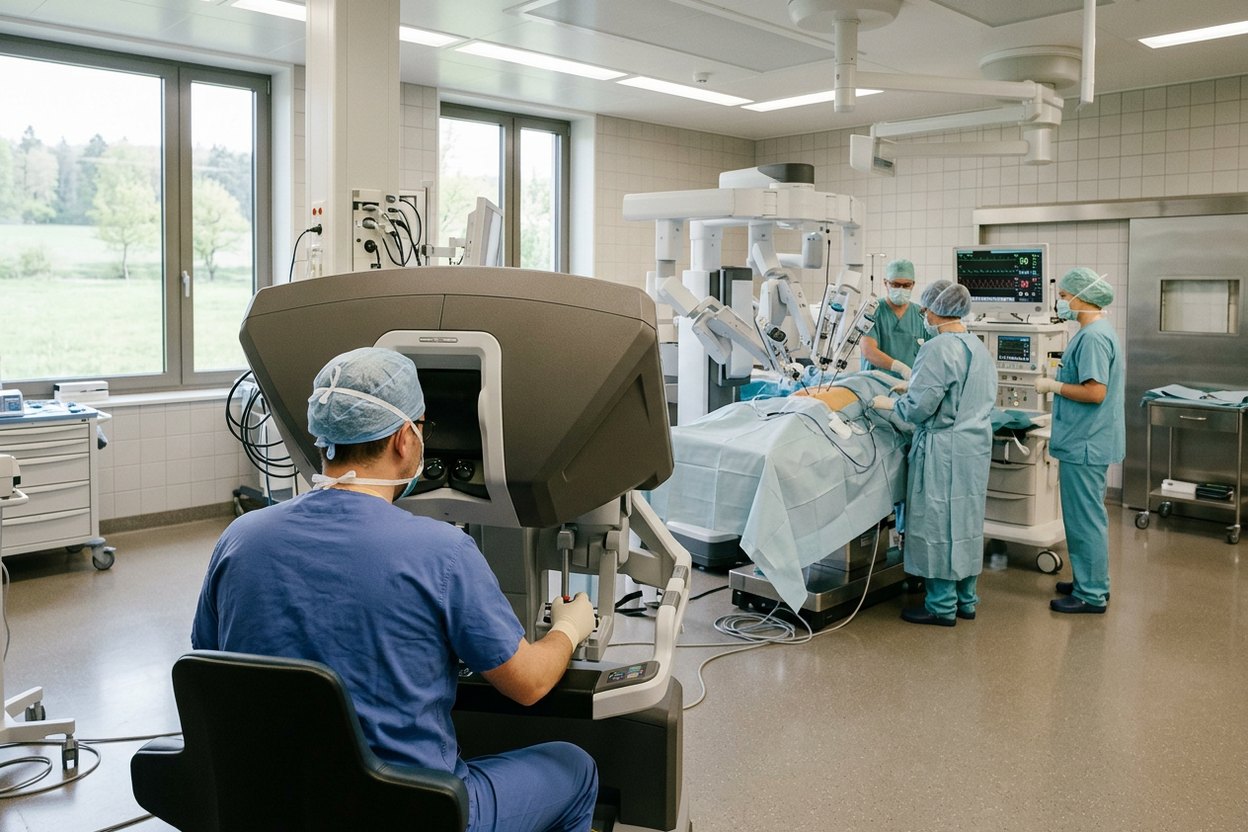
In robotic surgery the robot does not operate by itself, as many assume: the surgeon sits at a console a few metres from the table and controls thin instruments inserted through small punctures. The system transfers the surgeon’s hand movements, filters tremor and gives a magnified three-dimensional image.
This page explains how robotic surgery in Germany is used: for which operations, what the robot can and cannot do, which departments work with it and how to prepare. General advice on choosing a surgeon and preparing is on the surgery in Germany page.
What a Surgical Robot Is and How It Differs from Laparoscopy
A surgical robot lets the surgeon control instruments remotely; the most widely used system is da Vinci, which has three parts. At the surgeon’s console the surgeon views the operating field and guides the instruments with hand controls. The patient-side unit at the table holds the camera and instruments on its arms. The vision tower processes the image and shows it to the rest of the team on a monitor.
Conventional laparoscopy, or keyhole surgery, uses long straight instruments that the surgeon holds directly. The robot’s instruments bend at the tip like a wrist, which helps in narrow spaces such as the pelvis. The image is three-dimensional and magnified.
What the robot does not change: the result depends on the surgeon and team, not the machine, and the operation can be converted to open surgery if needed. Possible benefits, depending on the operation, are smaller incisions and often less blood loss and a shorter hospital stay. A Cochrane systematic review of prostate removal for cancer found that, compared with open surgery, robot-assisted or laparoscopic surgery may shorten the hospital stay and reduce blood transfusions, while urinary and sexual quality of life and complication rates appeared similar.
Which Operations Are Done with a Robot
Robots are used mainly in urology and abdominal surgery. Urology has used them longest: prostate removal for cancer with nerve-sparing where the disease allows, kidney-sparing tumour surgery that removes the tumour rather than the whole kidney, and bladder removal with reconstruction, meaning a new route for urine. The disease itself is covered on the prostate cancer treatment in Germany page.
In abdominal surgery, robots are used on the bowel and rectum, stomach and oesophagus, pancreas and liver, and for hernias, depending on the department. Bowel tumour treatment is described on the colorectal cancer treatment page.
In gynaecology, ENT and heart surgery, individual operations are done robotically in specialised departments. Robot-assisted techniques, for example, are part of the work of the Department of Cardiac and Vascular Surgery, headed by Prof. Markus Krane, at the German Heart Centre Munich. Not every operation is suitable; the surgeon decides.
German Departments That Work with Robotic Surgery
Among AlenMed’s partner hospitals, both urology and surgical departments work with robots. In urology, da Vinci is the main tool at the Urology Clinic Munich-Planegg: according to the clinic’s own figures, it performs more than 600 such procedures a year and has put a second robot into service. At ISAR Clinic Munich (ISAR Klinikum), urology is headed by Prof. David Schilling, and the department performs robot-assisted da Vinci surgery.
In abdominal surgery, Prof. Gero Puhl heads the robotics centre and the department of general and visceral (abdominal) surgery at DRK Hospital Berlin. At Nordwest Hospital Frankfurt, Prof. Thilo Welsch works in surgical oncology and robotic surgery. At University Hospital Tübingen, one field of Prof. André Mihaljevic is robotic and minimally invasive surgery. At the AGAPLESION Markus Hospital in Frankfurt, the department of Prof. Christoph Heidenhain operates on the bowel minimally invasively and robotically, and at Albertinen Hospital in Hamburg, Dr Thies Daniels performs open, laparoscopic and robot-assisted surgery.
The point for the patient is simple: such departments exist across Germany, and what matters is the department’s experience with the specific operation, not the presence of a robot as such.
Who Is Suitable and How to Prepare
The surgeon decides whether a robot-assisted operation suits a patient, considering tumour stage and location, previous abdominal operations, weight, and heart and lung condition. In many such operations the abdomen is inflated with carbon dioxide to make room for the instruments, and the table is often tilted steeply, head down for pelvic surgery. The gas and the tilt push the organs against the diaphragm: the lungs expand less easily and the heart works harder, so in heart or lung disease this load is assessed in advance. Sometimes open or conventional laparoscopic surgery is the better choice.
For the assessment, patients send doctors’ reports, CT, MRI or PET images on disc, biopsy results and a list of medications. A second opinion helps where the operation itself or the choice of method is in doubt.
Frequently asked questions
Is robotic surgery safe?
Robotic surgery carries broadly the same risks as the same operation without a robot: bleeding, infection, injury to nearby organs and complications of anaesthesia. The robot does not remove them by itself. Safety depends above all on the experience of the surgeon and team with this operation and on careful assessment beforehand; if needed, the operation is converted to open surgery.
Is recovery faster after robotic surgery?
Not always and not for everyone. Smaller incisions often allow an earlier discharge, but recovery depends on the operation itself, age, other illnesses and any complications. After a major pelvic or abdominal operation, recovery takes time even with a robot. The surgeon explains before the operation what to expect in your case.
How much does robotic surgery cost in Germany?
There is no single price: the bill depends on the operation, the hospital, the length of stay and the tests before and after surgery. The guide is the hospital’s cost estimate based on the patient’s records. AlenMed requests estimates from several departments that perform the operation robotically and helps you see what each includes.
How AlenMed Arranges Robotic Surgery in Germany
AlenMed sends the records to departments that perform this specific operation robotically, obtains the surgeons’ assessment and cost estimates, and helps compare them. Partner hospitals are located across Germany, and AlenMed’s office is in Munich.
We arrange the visa invitation, airport pickup and accommodation, and provide an interpreter at consultations and on discharge; the hospital invoices directly. After you return, we help you put follow-up questions to the treating surgeon.
This material is for reference only and is not an offer. Whether a robot-assisted operation is possible and advisable is decided by the surgeon after an examination in person.