 EN
EN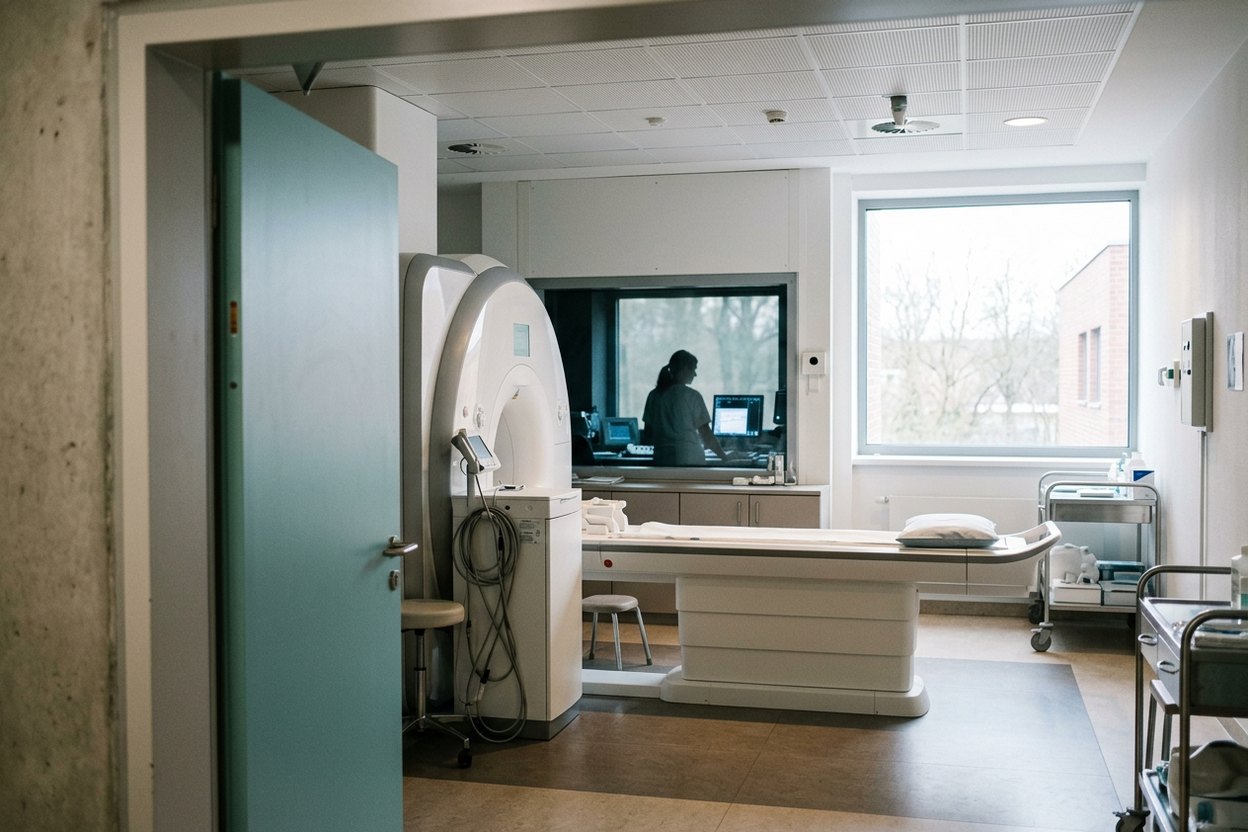
Prostate cancer diagnosis in Germany moves from a PSA test through MRI to a targeted biopsy and centres on a question bigger than the diagnosis: how dangerous this tumour is and whether it needs treating now. Many prostate tumours grow slowly, and needless treatment harms as much as a missed cancer.
Below is the route from blood test to pathology report: why MRI comes before biopsy and what can be done remotely.
PSA: what the number means and what it does not
A raised PSA signals that something is happening in the prostate, not that it is cancer. Made by the gland itself, the protein also rises with inflammation, benign enlargement, pressure on the gland such as a rectal examination, and possibly cycling, so the examination follows the blood draw.
A German urologist first repeats a raised result of 3 ng/ml or more within 3 months, then weighs the trend, a gland examination, age and family history. Statutory insurers pay for a yearly rectal examination for men from 45 as early detection, but not for a PSA test; the German Society of Urology now advises a PSA test from 45 after counselling instead, as the Krebsinformationsdienst explains.
Extra tests, such as free PSA, blood indices or urine tests, only refine the odds and cannot replace tissue, the only place a tumour’s site and aggressiveness show. See tumour markers in Germany.
Prostate MRI before the biopsy, not after
In Germany the MRI comes before the biopsy because it shows whether the gland has suspicious areas and where. Multiparametric MRI combines tissue structure, water movement and contrast uptake, and each lesion is graded on the international PI-RADS scale from 1 to 5: the higher the category, the likelier significant cancer.
The order matters: MRI first either spares the puncture or makes it targeted. Under the German guideline, category 4–5 lesions get 2–3 targeted cores rather than blind template sampling, and the MRI also shows whether the tumour has breached the capsule. More on MRI in Germany.
Quality depends on protocol and reader: the guideline calls for a radiologist certified in prostate MRI by the German Roentgen Society. Scans brought from home can often be re-read from the disc, but an incomplete protocol or poor images mean a repeat.
The biopsy: how the tissue is taken
The tissue is taken with a thin needle, mostly by fusion biopsy: software lays the MRI lesions over the live ultrasound image to guide the needle. A first biopsy usually adds systematic cores from all parts of the gland.
The needle passes through the rectum or the skin of the perineum. The German guideline allows both, but the rectal route needs antibiotic cover; the perineal one can do without and carries less infection risk. The Urology Clinic Munich-Planegg, for example, usually takes the perineal route, on an outpatient basis, under local anaesthesia or brief sedation. More on biopsy in Germany.
LMU University Hospital tells patients to eat breakfast beforehand; most leave an hour after the biopsy. The first drops of urine are usually bloody for 3–7 days, and around 30% of patients see blood in the semen 2–4 weeks on. Complications are rare; fever, chills, inability to pass urine or heavy bleeding mean calling the urologist at once.
What the pathology report says and how the stage is set
The report’s core is the Gleason score and ISUP group, which measure aggressiveness. The Gleason score adds two grades for how far the tumour glands have lost their normal structure, and the ISUP group turns it into a scale from 1, the calmest tumours, to 5, the most aggressive. The group, not the bare diagnosis, decides everything that follows.
Local spread is judged by MRI and rectal examination; at low and favourable intermediate risk no whole-body imaging is needed. PSMA PET, which detects lymph node and bone metastases more accurately than CT and bone scans, is ordered only on indication, such as ISUP group 3 or higher or PSA from 20 ng/ml.
A tumour board of urologist, oncologist, radiotherapist and pathologist then sets out the stage and proposed approach; for low-risk tumours the German guideline recommends active surveillance alone. See prostate cancer treatment in Germany.
A second opinion and a slide review without travelling
Without travelling you can have the histology reviewed by another pathologist, the MRI re-read and a urologist’s written opinion; on review the ISUP group changes more often than people expect. Send the slides and blocks, pathology report, MRI disc with its report, PSA history and translated medical letters. The case can be assessed, for example, by Prof. Christian Stief, urologist at LMU University Hospital.
Such an assessment cannot replace an examination, new tests or a final plan; it shows whether travelling is worthwhile and what to do there.
Frequently asked questions
How much does prostate cancer diagnosis in Germany cost?
As a guide: a urological check-up with consultation, ultrasound and lab tests around 1650 €, ultrasound alone 130–150 €, MRI without contrast approximately 800 €, contrast-enhanced MRI 900–1000 €. Biopsy and PSMA PET are charged separately; the clinic’s cost estimate (Kostenvoranschlag) gives the exact sum.
Is a biopsy needed if the MRI is clear?
Usually not. The German guideline rules out a biopsy for PI-RADS 1 and 2, where cancer is very unlikely, and for category 3 with a low individual risk. The urologist then follows the PSA trend and decides whether a next step is needed.
Can a PSMA PET scan replace the biopsy?
No. PSMA PET shows where a tracer collects and serves to find metastases once cancer is confirmed and the risk is high. Only a pathologist examining tissue makes the diagnosis and sets the ISUP group, so the order is MRI, biopsy if needed, then PET on indication.
How AlenMed arranges the work-up
AlenMed sends reports, MRI discs and tissue blocks to the clinic’s urologist before you travel and plans the MRI, the appointment and, if needed, the biopsy within a few days. We arrange the visa invitation and an interpreter for the appointment and the results discussion.
A biopsy adds the wait for histology: at LMU University Hospital the result usually comes 5 working days later, so plan that margin or have the report sent home. Images come on a disc, reports in German, translated on request. The clinic invoices by its own estimate and is paid directly; for later costs see prostate cancer treatment cost in Germany.
This material is for information only and is not an offer; the extent of the work-up is decided by a doctor in person.