EN
EN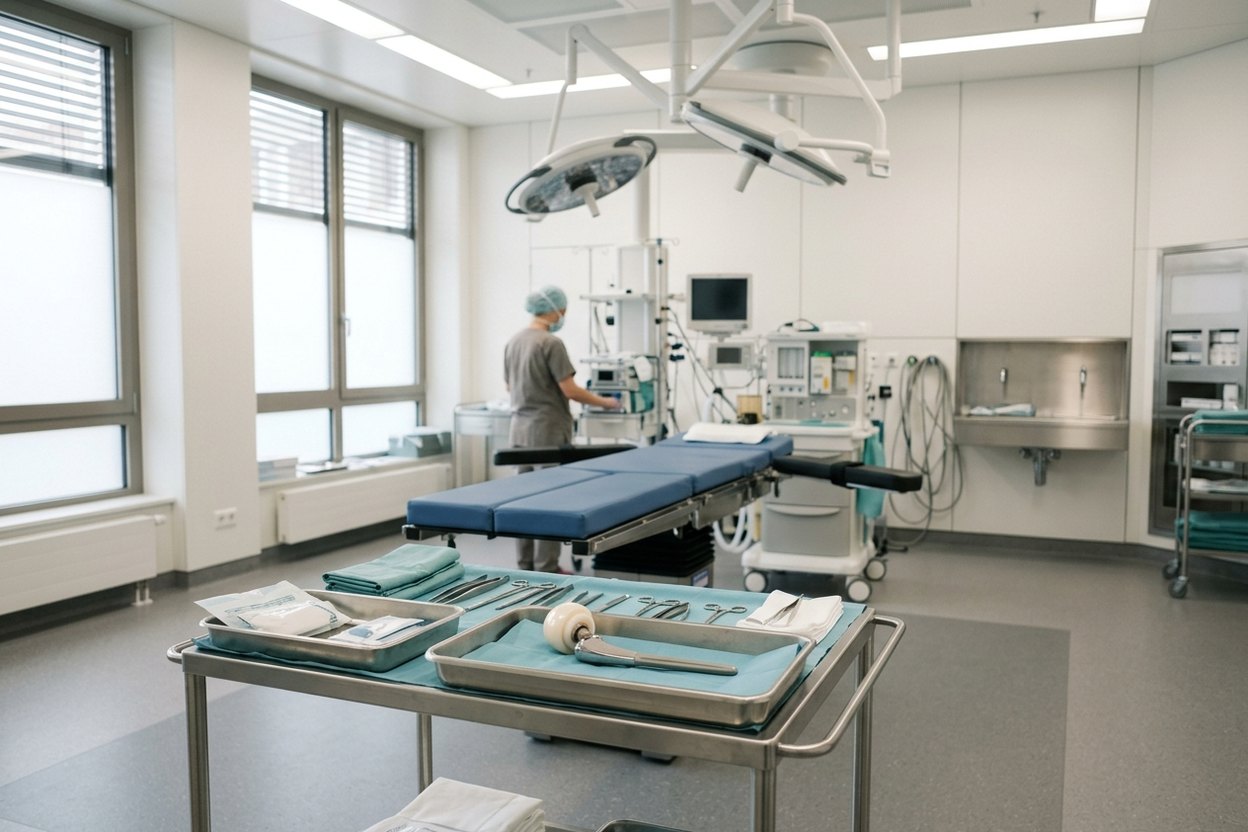
Nobody comes to joint replacement suddenly. It is usually preceded by years of pain — troublesome in the mornings at first, then on walking, and in the end not letting go at night either. Painkillers stop helping, ordinary tasks get harder. The question of a replacement arises precisely when the joint can no longer be restored, and what matters is recognising that moment in time and having the operation done well.
Joint replacement in Germany is a planned operation: patients send images, travel for surgery and recover in Germany or at home. Below: when it is really indicated, how the implant is planned for each person, how surgery and the first days go and what the result depends on six months later. The decision is not made remotely.
Why people come to Germany for this
People come for experience: joint replacement is routine here, with more than four hundred thousand hip and knee procedures in Germany each year. The national joint replacement register (EPRD) tracks how different models perform, and its annual report is public — a rare case of quality checked against data rather than promises.
Modern implants last ten to fifteen years or longer in most patients, and often for the rest of their lives. The span depends on age, weight, activity and the type of joint, so an honest talk with the surgeon beats any average: “how long will it last?” has no answer without age and activity.
Which joints are replaced, and when surgery is not needed
Knees and hips are replaced most often, shoulders less often, elbows and small joints rarely, and surgery is not needed while other treatment still helps. See hip replacement in Germany, knee replacement in Germany and shoulder replacement in Germany.
What decides is not an X-ray alone but a combination: visible wear on the X-ray, pain that limits daily life and exhausted non-surgical treatment, as the current guideline of German orthopaedic surgeons on knee replacement also states. Beforehand, doctors try weight loss, physiotherapy, painkillers and joint injections.
A German surgeon often advises waiting — not a refusal to help: the answer is not always yes. With mild wear, pain and dissatisfaction after replacement are more common; excess weight or high blood sugar raise complication risks and can be improved first. Revision, replacing an existing implant, is harder than a first operation, slower to plan and a focus of certified maximum-care centres.
Planning: what is checked before surgery
Before surgery, the joint and everything affecting the outcome are checked: X-rays, MRI or CT if needed, range of movement, general health. Heart, vessels, blood sugar and infections, including in the teeth, are assessed separately; infections are treated first. Mention any cortisone injection into the joint in the past three months: it raises infection risk.
Type, size and fixation of the implant are planned in advance for the particular joint — for patients from abroad partly from the images sent ahead, with the final plan confirmed face to face.
How the operation goes
The surgeon replaces worn joint surfaces with an artificial joint. Fixation is cemented (bone cement holds the implant at once), uncemented (the patient’s own bone grows into a porous surface) or hybrid. Bearing materials are metal, high-grade polyethylene or ceramic. The choice follows age and activity, not the novelty of the material.
The operation usually takes between one and three hours. Tissue-sparing approaches, parting muscles rather than cutting them where possible, help recovery. Surgeons plan precisely, and some hospitals add navigation or robotic assistance, which help position the implant but do not by themselves guarantee the result.
Knees and hips are operated on under general anaesthesia or a spinal, which numbs only the legs. Pain is controlled with combined medicines; a drain, if used, comes out within days. Thrombosis prevention starts at once with blood thinners and early movement, and patients first stand up with a physiotherapist.
Recovery is half the result
An implant is judged not by the operation but by how the person walks a few months later. First steps under supervision come within the first day, then an exercise programme rebuilds strength and movement, and how conscientiously it is followed matters as much as the implant.
In practice: about five to ten days in hospital after a hip replacement and seven to ten after a knee, then a German rehabilitation clinic, usually for three weeks, or exercises at home to a written plan. When to fly is the surgeon’s call: there is no fixed rule, and long-haul flights usually mean a longer wait. The home stage cannot be shortened: muscles and capsule need about six weeks to hold the joint securely. More on orthopaedic rehabilitation in Germany.
Frequently asked questions
Can the decision on surgery be made remotely?
Not the final one: the surgeon decides after seeing you in person. Remotely, a German orthopaedic surgeon can review recent images and reports and say whether a replacement looks indicated. For a knee, send an X-ray taken standing: it shows wear more clearly.
Is there an age limit for joint replacement?
There is no strict upper limit: very elderly people increasingly receive new joints, helped by gentler surgery and modern anaesthesia. General health matters more than age. For younger people the catch is different: the earlier an implant goes in, the likelier it needs replacing once more.
What if redness or fever appears after returning home?
See a doctor at once: redness, fever and increasing pain can signal infection around the implant. It is rare but needs prompt treatment. Take the discharge report and implant card home — they tell a local doctor which implant is in place and how surgery went.
How AlenMed arranges a joint replacement
AlenMed arranges the process from images to discharge, often starting with a second opinion: if surgery was offered at home but doubts remain, a German orthopaedic surgeon reviews the images and says whether a replacement is indicated, which implant fits and what to realistically expect. That may confirm the plan or buy time.
Step by step: remote review of images, a hospital chosen for the joint and task, a written estimate, admission date, visa invitation, meeting on arrival and an interpreter at the appointment, before surgery and at discharge. See orthopaedic hospitals in Germany and joint replacement cost in Germany.
After discharge the patient keeps the operation report, implant card and a written plan of exercises and contacts. Risks — infection, dislocation, loosening over time — are discussed before the operation, not after.
This material is for information only and is not an offer; treatment is decided by a doctor only after an in-person examination.
News on this topic
Consensus Guideline for Bacteriophage Therapy in Bone and Implant Infections
An international consensus guideline published in Nature Medicine establishes standards for personalized bacteriophage therapy in complex orthopedic infections.
Ultrasound Regional Anesthesia Replaces General Anesthesia for Surgery
German specialists from DEGUM emphasize how ultrasound-guided regional nerve blocks improve surgical safety, lower medication doses, and protect high-risk patients.
Obesity and Rheumatism: Inflammatory Immune Changes Are Reversible
Leipzig researchers have revealed that obesity-induced immune system inflammation mirrors rheumatoid arthritis and can be reversed through substantial weight loss.