 EN
EN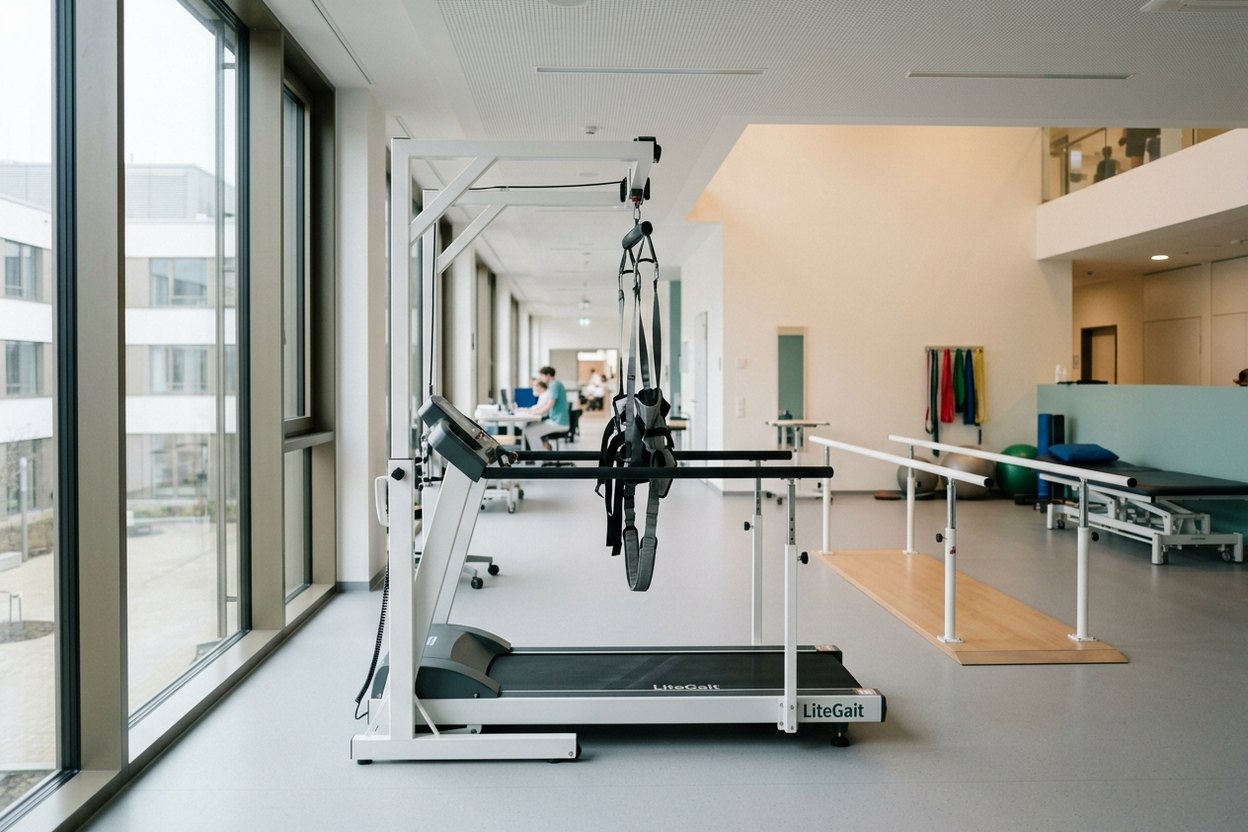
Neurorehabilitation in Germany is step-by-step recovery in a specialist clinic after damage to the nervous system, organised in phases by severity. After a stroke or severe brain injury, families often hear that “from here on it all depends on the rehabilitation”. Recovery is indeed slow, and the nervous system needs not rest but daily, methodical work.
This page covers which conditions call for neurological rehabilitation in Germany, how the phases work, what a programme involves, which clinics offer it and how AlenMed arranges a stay. For recovery treatment in general, see rehabilitation in Germany.
When Neurorehabilitation Is Needed
Neurorehabilitation is needed when illness or injury has taken away movement, speech, swallowing or memory. What a stroke impairs depends on the brain area affected; see rehabilitation after stroke. Head injuries are covered under rehabilitation after traumatic brain injury. Parkinson’s disease destroys the nerve cells that produce dopamine, making movement stiff and slow. In multiple sclerosis the immune system damages the sheath of nerve fibres, disrupting their signals. A spinal cord injury cuts the body below the injury off from the brain. Polyneuropathy damages the peripheral nerves, leaving hands and feet numb and weak, while neuromuscular diseases gradually weaken the muscles.
All of them require rebuilding lost functions, which relies on neuroplasticity, the brain’s capacity to rewire itself: with long, targeted practice, healthy areas partly take over from damaged ones. Spinal cord injury is treated in dedicated centres, such as the Centre for Spinal Cord Injury (Zentrum für Querschnittgelähmte) at Werner Wicker Klinik in Bad Wildungen, headed by Dr Axel Hempfing.
How Neurorehabilitation Works in Germany: Phases A to F
In Germany neurological rehabilitation is divided into phases, labelled with the letters A to F. Phase A is acute treatment in hospital. Phase B is early rehabilitation for severely affected patients who still need intensive monitoring; phase C is when the patient can take part in sessions but with considerable help; phase D is rehabilitation for those who are largely independent. Phase E consolidates the result after discharge, including return to work; phase F is long-term care for those who need it permanently. The model is described by the Federal Rehabilitation Council (BAR).
For the family, the phase decides which clinic fits, how much nursing and monitoring is needed and whether a relative can stay nearby. There is no fixed sequence, and a clinic with departments for several phases can move the patient on without a transfer.
To set the phase, the doctor needs the discharge report, MRI or CT images and a note on what the person can do now (sit, walk, speak, swallow), including any feeding tube or tracheostomy, a breathing tube in the windpipe.
What the Programme Consists Of
The programme consists of daily sessions with a team of neurologists, physiotherapists, occupational therapists (who retrain everyday activities such as dressing and eating), speech and language therapists, neuropsychologists and rehabilitation nurses. It rests on exercise therapy, physiotherapy, occupational therapy, neuropsychology and the restoration of speech and swallowing, in individual and group sessions. The plan is set weekly, and goals are checked with tests and adjusted.
Swallowing is retrained so the person can eat safely, since food in the airways can cause pneumonia. Spasticity, a persistent muscle stiffness that clenches the hand or points the foot down, is eased with exercise and, where indicated, botulinum toxin injections. Memory and attention are trained with the neuropsychologist, speech with the speech therapist.
Relatives learn care, safe transfers from bed to chair and the exercises to continue at home, and the home is prepared before discharge: thresholds and loose rugs removed, grab rails fitted.
Neurorehabilitation Clinics in Germany
Neurorehabilitation in Germany is offered by specialist neurological clinics, each with its own phases and focus. Kliniken Schmieder is a group of neurological specialist and rehabilitation clinics at six sites in Baden-Württemberg: head office in Allensbach, clinics in Gailingen, Konstanz, Heidelberg and Gerlingen, and a day clinic in Stuttgart. It treats neurological conditions of every severity, around 14,000 patients a year. Prof. Michael Jöbges is medical director in Konstanz. In Allensbach, Prof. Joachim Liepert heads neurorehabilitation (stroke rehabilitation, botulinum toxin therapy), and Prof. Anastasios Chatzikonstantinou leads acute neurology and early rehabilitation.
In Bonn, the Godeshöhe Neurological Rehabilitation Center offers neurological intensive care, early rehabilitation and further neurological rehabilitation. The m&i Specialty Clinic Bad Heilbrunn in Bavaria has a neurology department with phase B early rehabilitation and a swallowing disorders centre; Dr Peter Bader is head of neurology.
Medical Park Loipl in Bischofswiesen near Berchtesgaden, Bavaria, works with phases C and D and runs a centre for clinical neuroplasticity, building its programme on the brain’s ability to take over lost functions. The right clinic is chosen by phase, department profile and the patient’s goals, not by reputation.
Frequently asked questions
Can a patient travel to Germany for neurorehabilitation while still severely ill?
Yes, if doctors consider the journey safe: phase B early rehabilitation with intensive monitoring exists for exactly such patients. A doctor at the receiving clinic decides, based on the discharge report, images and a description of the condition. Bedridden patients travel with a medical escort.
How long does neurological rehabilitation take?
There is no standard length: it depends on the phase, the illness and how fast functions return. The treatment plan gives an expected duration, and the team checks the goals regularly with tests. If progress continues, the doctor may extend the stay; if not, discharge and exercises at home are discussed.
Can a relative stay close to the patient?
Yes, accommodation near the clinic can be arranged, while staying in the patient’s room depends on the clinic’s rules and the phase. Family nearby also helps the treatment: therapists teach relatives care, safe transfers and the exercises for home. Clarify the arrangements in advance.
How AlenMed Arranges Neurological Rehabilitation
AlenMed organises the whole stay. We translate reports, forward images, send enquiries to two or three clinics treating the right phase and agree dates; the clinics reply with a treatment plan and cost estimate. For what makes up the bill, see cost of rehabilitation in Germany.
We help with the visa, translation and accompaniment, including for patients with limited mobility, and arrange transport for bedridden patients and accommodation for a relative. The clinic’s invoice is paid directly. Our company office is in Munich, and we arrange neurorehabilitation in Germany wherever there is a department for the right phase.
This material is for information only, not an offer. Whether rehabilitation is needed, which programme and to what extent is decided by a doctor after an in-person examination.