 EN
EN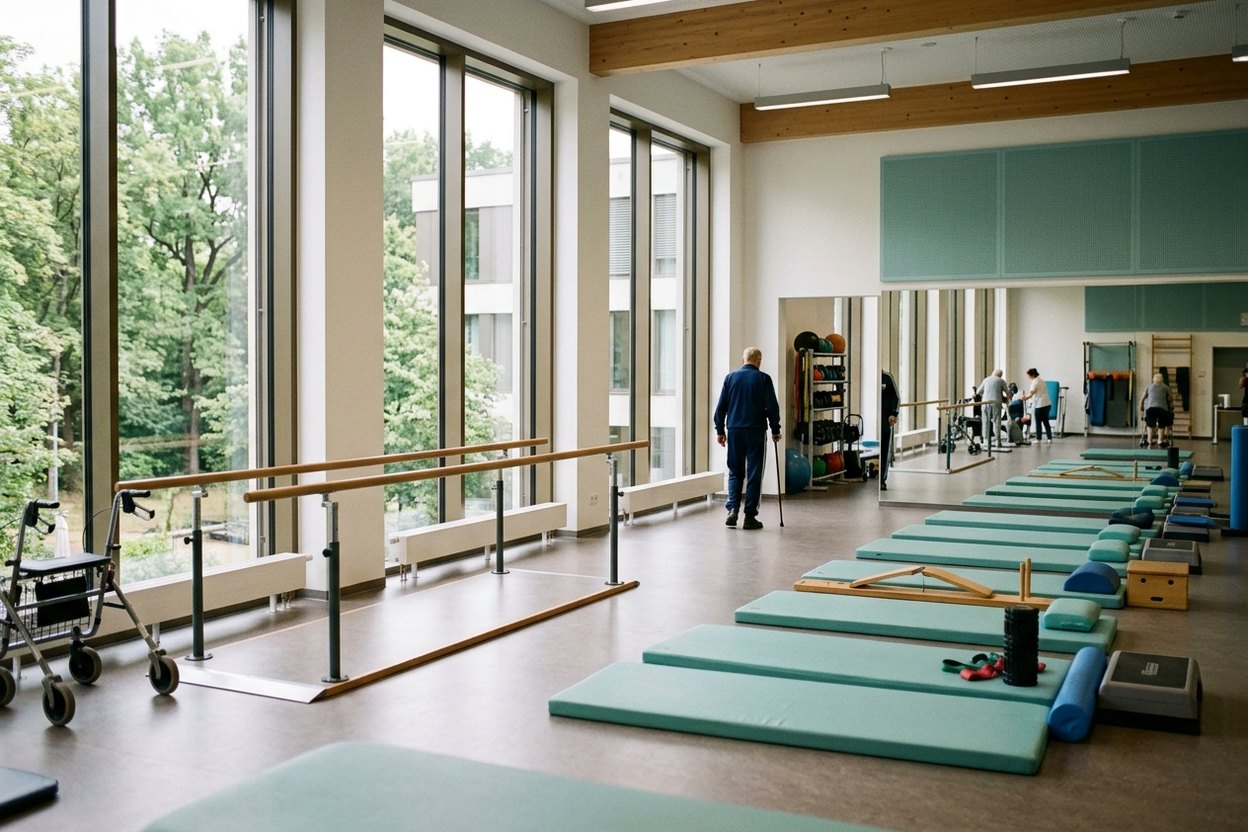
Rehabilitation costs in Germany depend on what has to be restored and how much care the patient needs. After a stroke, an injury or an operation, families want to know the cost of recovery in advance, but there is no single figure: rehabilitation after a hip replacement and after a severe stroke are different programmes with different bills.
Below: what the daily rate covers, why a neurological programme costs more than an orthopaedic one, what related tests cost, and how to get the clinic’s estimate before travelling.
Rehabilitation Costs Depend on the Programme
The type of programme sets the rate first: neurological rehabilitation after a stroke, a brain injury or a disease of the nervous system usually costs more than orthopaedic rehabilitation, because a whole team is involved. A neurologist, physiotherapist, occupational therapist, speech therapist and a neuropsychologist for memory and attention work with the patient; the more specialists and sessions a day, the higher the rate. Paraplegia rehabilitation after a spinal cord injury belongs here too. In Germany, neurological rehabilitation runs in phases A to F, as described by the Federal Rehabilitation Council (BAR): A is acute treatment with the first steps of rehabilitation; B, early rehabilitation with intensive care still on hand; C, therapy the patient joins in while still needing much medical and nursing care; D, rehabilitation in the usual sense, inpatient or outpatient; E, securing the result and returning to work or education; F, long-term support and care. The phases need not follow a fixed order. Within neurology, the patient’s condition raises the rate most: the early phase, with near-hospital nursing and monitoring, usually costs more than later ones, so the clinic reviews the reports and the patient’s condition before naming a rate. For example, m&i Fachklinik Bad Heilbrunn offers early neurological rehabilitation (phase B); phase-by-phase pricing is explained on the page on the cost of neurological rehabilitation.
Orthopaedic rehabilitation is usually cheaper: fewer specialists are involved, and constant nursing is rarely needed. After a joint replacement or ligament surgery, the patient trains with a physiotherapist and an exercise therapist on equipment, in the pool and on walking and balance; the price depends mostly on the length of the programme and the number of one-to-one sessions a day.
Other profiles, from cardiac rehabilitation after a heart attack or heart surgery to oncological rehabilitation after cancer, are priced by the same rules: the clinic’s rate, the format and the length.
What the Daily Rate Includes
An inpatient daily rate usually covers the room, meals, nursing, medical supervision and the planned sessions: exercise therapy, physiotherapy, and occupational or speech therapy if prescribed. Extra procedures, an MRI or a consultation with another specialist appear as separate lines in the estimate and on the invoice.
In an outpatient programme, the patient stays in a hotel or a rented flat and comes only for sessions: the clinic charges for these, while accommodation, meals and transfers are the patient’s own expense. This suits people who are independent and need no nursing; the early neurological phase requires an inpatient stay. Daily amounts for either format are given in the clinic’s estimate.
Related Diagnostics: Indicative Prices
Tests before or during rehabilitation are paid on top of the daily rate: an MRI costs about €800, an ultrasound €130–150 and a specialist consultation from €130. The doctor needs a baseline before the start, such as a spine MRI after spinal surgery or a leg-vein ultrasound if a clot is suspected after a joint replacement, and repeats a test when the condition changes or before the load is increased.
| Test or service | What the price depends on | Indicative price |
|---|---|---|
| MRI | with or without contrast | about €800, with contrast €900–1,000 |
| MRI of the entire spine | cervical, thoracic and lumbar spine in one examination | about €950 |
| Ultrasound | which area is examined and why | €130–150 |
| Specialist consultation on the findings | the doctor’s speciality, the amount of documents and questions | from €130 |
| General medical check-up programme (1–2 days) | what the programme includes: laboratory tests, examinations, consultations | about €1,650 |
Bring recent images and reports with you: a recent test of good quality need not be repeated without a reason. Other tests and check-up programmes are covered on the page on prices for diagnostics in Germany.
Estimate, Payment and Final Settlement
The clinic fixes the exact amount in an estimate, the patient pays in advance on that basis, and the account is settled after the programme. The estimate (Kostenvoranschlag) follows a review of the medical reports and images and lists the therapy hours, that is, how many sessions with which specialists, as well as nursing, laboratory tests, special equipment and, for an inpatient stay, the room and meals.
The prepayment goes directly to the clinic’s account before the start. The doctors regularly test muscle strength and range of motion and adjust the plan to the results, which may change the final amount. Afterwards, the clinic recalculates the invoice for the services provided and refunds any balance. An extension is agreed separately: the clinic states the cost of the extra days, and the patient decides.
Frequently asked questions
How much does a month in a rehabilitation centre cost?
A month costs the clinic’s daily rate times the number of days, plus procedures and tests beyond it; the rate is named in the clinic’s estimate. The early neurological phase, with near-hospital nursing, usually costs more than later phases, and an orthopaedic programme less than a neurological one. Tests are extra: an MRI, for example, costs about €800.
Is outpatient rehabilitation cheaper?
It can be, if the patient’s condition allows it: the clinic charges for sessions, while accommodation, meals and transfers are paid separately. Whether it saves money depends on the hotel and the daily journey, so calculate before deciding. It suits patients who move about independently; the early neurological phase requires an inpatient stay.
Do I pay in advance or after the programme?
Both: before the programme the patient makes a prepayment to the clinic according to the estimate, and the final invoice reflects the services actually provided. Any balance is refunded. If the plan changes along the way, new items are agreed separately, so keep the estimate and compare it with the final invoice.
What happens if the programme needs to be extended?
An extension is agreed separately: the doctors explain why more days are needed, the clinic states their cost, and the patient decides whether to continue. Decide early, not on the last day. A patient who came on a medical visa will also need to extend it before it expires.
How AlenMed Arranges Rehabilitation and Its Estimate
AlenMed translates the medical documents into German and sends them with the images to rehabilitation clinics of the right profile across Germany, for example the neurological hospitals of Kliniken Schmieder in Baden-Württemberg, covering the phases from early rehabilitation to preparing the return to work, or Medical Park St. Hubertus in Bad Wiessee on Lake Tegernsee for orthopaedic and cardiac programmes. Estimates from several clinics can be compared by content, not only by total. Other rehabilitation clinics in Germany and how they differ are covered on a separate page.
Once a clinic has confirmed admission and sent its estimate, we help obtain the medical visa invitation, arrange an interpreter for sessions and ward rounds and the transfer, and help extend the visa if the programme is extended. The company’s office is in Munich.
This material is for reference only and is not an offer. Amounts are indicative, in euros; the exact cost is stated in the clinic’s estimate after a review of the medical documents. The programme and its scope are decided by the doctor at a face-to-face consultation.