 EN
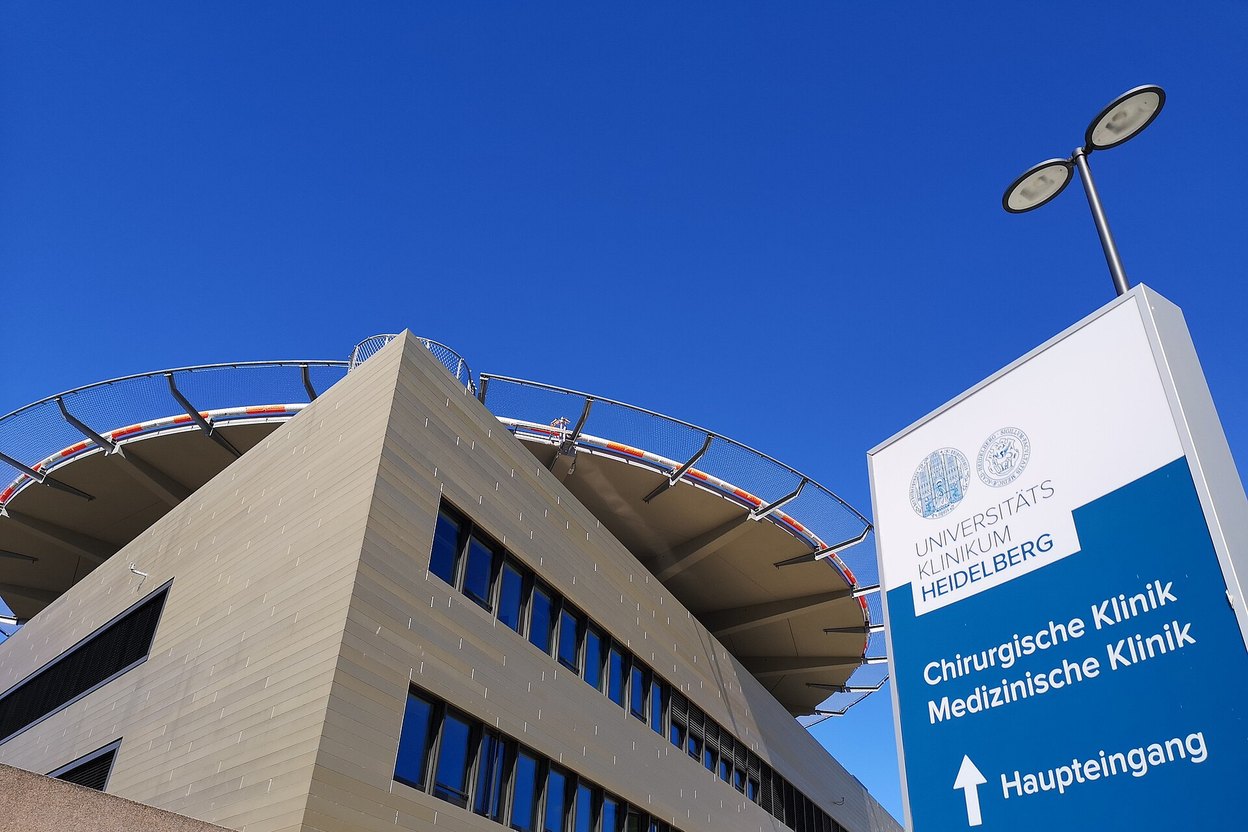
Heidelberg University Hospital, Germany, is one of the country’s largest medical centres, with 2,599 beds across its departments. It stands in Heidelberg on the River Neckar, in the state of Baden-Württemberg, and treats adults and children, including patients from abroad.
Its 50 medical departments and 11 theoretical institutes work with the Faculty of Medicine of Ruprecht-Karls-University. In international sources it also appears as University Hospital Heidelberg, Germany. This page covers its history, centres, doctors and the practicalities of treatment from abroad; for comparison, see our overview of university hospitals in Germany.
Germany’s oldest university hospital
The hospital belongs to the medical faculty of Germany’s oldest university, whose history goes back to 1388. Clinics and research institutes share one campus, so new treatments can reach patients quickly, and suitable patients may be offered a clinical trial.
Most clinics and institutes are on the Neuenheimer Feld campus on the right bank of the Neckar, linked in a ring around a central rest area, so tests in different departments rarely mean crossing the city.
Departments and centres
The hospital in Heidelberg combines specialist departments with interdisciplinary centres, where doctors from several fields work on one complex case. Among them:
- Centre for Child and Adolescent Medicine (Zentrum für Kinder- und Jugendmedizin)
- Centre for Orthopaedics, Trauma Surgery and Paraplegiology (Zentrum für Orthopädie, Unfallchirurgie und Paraplegiologie), including care after spinal cord injury
- Department of Anaesthesiology (Klinik für Anästhesiologie)
- Department of Diagnostic and Interventional Radiology (Klinik für Diagnostische und Interventionelle Radiologie)
- Centre for Infectious Diseases (Zentrum für Infektiologie)
- Centre for Personalised Medicine (Zentrum für Personalisierte Medizin)
- Centre for Rare Diseases (Zentrum für Seltene Erkrankungen)
- Centre for Translational Lung Research (Zentrum für Translationale Lungenforschung)
- Heidelberg Institute for Cardiomyopathies (Institut für Cardiomyopathien Heidelberg)
- Centre for Autoinflammation (Zentrum für Autoinflammation Heidelberg), for rare disorders with recurring bouts of fever
The Centre for Rare Diseases sees children and adults with a confirmed rare disease or after a long search for a diagnosis. The Centre for Personalised Medicine analyses a tumour’s molecular profile when standard treatment is exhausted, looking for a targeted therapy or a suitable trial. The Institute for Cardiomyopathies treats heart muscle diseases, including inherited ones.
Eye conditions, from cataract and glaucoma to corneal transplants and retinal disease, are treated at Heidelberg University Eye Hospital. Children are cared for at the Center for Child and Adolescent Medicine Heidelberg, including paediatric cardiology, oncology and newborn care. The Heidelberg Ion-Beam Therapy Center (HIT) treats selected cancers in adults and children with proton and heavier-ion beams, which can reach tumours lying deep in the body or resisting conventional radiotherapy.
Doctors at Heidelberg University Hospital
Most departments are headed by professors of the Faculty of Medicine. Prof. Markus Weigand is medical director of the Department of Anaesthesiology, covering anaesthesia and intensive care. Prof. Hans-Ulrich Kauczor directs the Department of Diagnostic and Interventional Radiology, where some treatments are also carried out under imaging guidance.
Prof. Benjamin Meder heads the Institute for Cardiomyopathies. Prof. Bernd Alt-Epping is medical director of the Department of Palliative Medicine. According to the World Health Organization, palliative care improves the quality of life of patients and families facing life-threatening illness, relieves pain and other symptoms, and is most effective when considered early.
Prof. Matthias Gorenflo is managing director of the Center for Child and Adolescent Medicine, Prof. Gerd U. Auffarth heads the Eye Hospital, and Prof. Gerhard Schmidmaier is medical director of the Department of Trauma and Reconstructive Surgery. PD Dr. Semi Harrabi is medical head of the Heidelberg Ion-Beam Therapy Center.
Location and your stay
The hospital in Heidelberg, Germany, has almost all its departments on the Neuenheimer Feld campus; the orthopaedic hospital is in the Schlierbach district. From Frankfurt and Stuttgart airports you can reach Heidelberg by train, and trams and buses run from the main station to the campus. The city has other clinics too, so check that the invitation from this Heidelberg hospital in Germany names your department and its building.
Rooms are single or double, all with free WLAN and most with a TV. For an extra charge, a comfort room (Wahlleistung) with a large TV and more meal choices can be booked if available. If your health allows, the hospital suggests walks, for example in the Botanical Garden; tell the ward staff first. Children’s wards have playrooms, and each ward sets its own visiting hours. AlenMed arranges airport pick-up and accommodation for you and your family.
Frequently asked questions
Do I need a referral for the Centre for Rare Diseases?
Yes, if there is no diagnosis yet: the centre reviews such cases only when the treating doctor presents them. The doctor first completes basic tests, judges whether a rare disease is likely and sends the reports, genetic and laboratory results and a written summary. With a confirmed rare disease, you can contact the relevant specialist centre directly.
Can I be treated personally by the head of department?
Yes, as a paid elective service (Wahlleistung) known as chief-physician treatment. You are then treated personally by the department’s medical director, deputised if necessary by an experienced senior physician, or by a specially designated doctor. This is agreed at admission and billed on top of the main invoice, like a single room.
Can a relative stay with the patient?
Sometimes: in exceptional cases the hospital can accommodate an escort in the patient’s room, with the cost added to the total bill. Parents of young patients can stay in parents’ apartments next to the children’s hospital, linked to it by a corridor and through the garden. Other relatives usually stay in a nearby hotel or rented flat.
How AlenMed arranges treatment in Heidelberg
It starts with your documents: discharge summaries, test results and MRI or CT images. AlenMed translates them into German and sends a request to the centre that treats your condition, where a specialist reviews the case and proposes a treatment plan.
The hospital then prepares a preliminary cost estimate (Kostenvoranschlag); the final amount may change, and the final bill follows after treatment. You pay the deposit shown in the estimate directly into the hospital’s account, and the hospital issues an official invitation letter for the German embassy, needed for the visa. Doctors and most nurses speak English; for other languages the hospital recommends an interpreter it has certified, and AlenMed books one in advance. AlenMed’s office is in Munich, with partner hospitals across Germany.
This page is for general information and is not an offer. The treatment plan is set by the doctor in person, and the cost by the hospital’s estimate.