 EN
Pituitary adenoma treatment in Germany starts with two questions: does the tumour make excess hormone, and does it press on the optic nerves? One person notices it through headaches and lost side vision, another through a disrupted cycle; a third by chance on an MRI done for something else.
Worth knowing at once: these tumours are almost always benign, and not every one needs surgery. Some are treated with tablets, others simply watched. Below is how a German department chooses. For the wider field, see neurosurgery in Germany.
What a pituitary adenoma is and how it shows itself
A pituitary adenoma is a tumour of the gland’s own cells that harms in two ways: by pressing on its neighbours or by producing a hormone. The pea-sized pituitary sits at the base of the skull, above the back of the nose, and governs the thyroid, adrenal glands, growth and sex hormones.
Among hormone-producing adenomas, a prolactinoma disturbs the cycle, can cause milk discharge or erection problems, and lowers libido. Growth-hormone tumours cause acromegaly: hands, feet and facial features coarsen, rings and shoes stop fitting. ACTH tumours cause Cushing’s disease: weight on face and trunk with thin limbs, purple stretch marks, raised blood pressure and blood sugar.
Hormone-inactive adenomas grow silently until they press on the optic chiasm above the gland: vision fades at the outer edges, and people walk into door frames. Pressure can also lower the gland’s hormones, causing tiredness and low libido. Headaches occur, but are rarely caused by the tumour, notes the German guideline on hormone-inactive pituitary tumours (in German, now under revision).
The work-up in a German clinic
The work-up in a German clinic rests on pituitary MRI, hormone tests and a vision check. The MRI uses a dedicated protocol with thin slices and contrast, as an ordinary brain scan can miss a small adenoma. See MRI in Germany.
Hormones are measured at set times under strict conditions: baseline tests plus dynamic ones, such as a dexamethasone tablet at night and cortisol next morning. Results from home are considered, but tests are often repeated on site, as laboratories differ in methods and reference ranges.
If the tumour reaches the optic nerves, computerised perimetry maps the visual fields: the yardstick for judging treatment. A multidisciplinary board decides, since the endocrinologist, neurosurgeon, ophthalmologist and radiologist each see part of the picture; long-term care usually stays with the endocrinologist (see endocrinology in Germany).
When tablets are the treatment, and when surgery is
The choice depends on whether the tumour makes a hormone, and which. The prolactinoma is the rare tumour at the base of the brain usually treated with tablets: dopamine agonists, mostly cabergoline, lower prolactin and shrink most tumours. Surgery is for intolerance, drug failure or rapidly worsening sight, though an experienced surgeon may remove a small, well-defined one upfront.
In acromegaly and Cushing’s disease, surgery usually comes first. Medication follows if the disease persists or surgery is impossible, and precedes it only in selected cases, for example to lower operative risk in severe disease.
A small hormone-inactive adenoma sparing the visual pathway is often just watched, with repeat MRI and, if needed, visual field checks. Watching is treatment, not a refusal to treat: it has a schedule and clear triggers for surgery — growth, a threat to sight or failing hormones.
Surgery: the endoscopic route through the nose
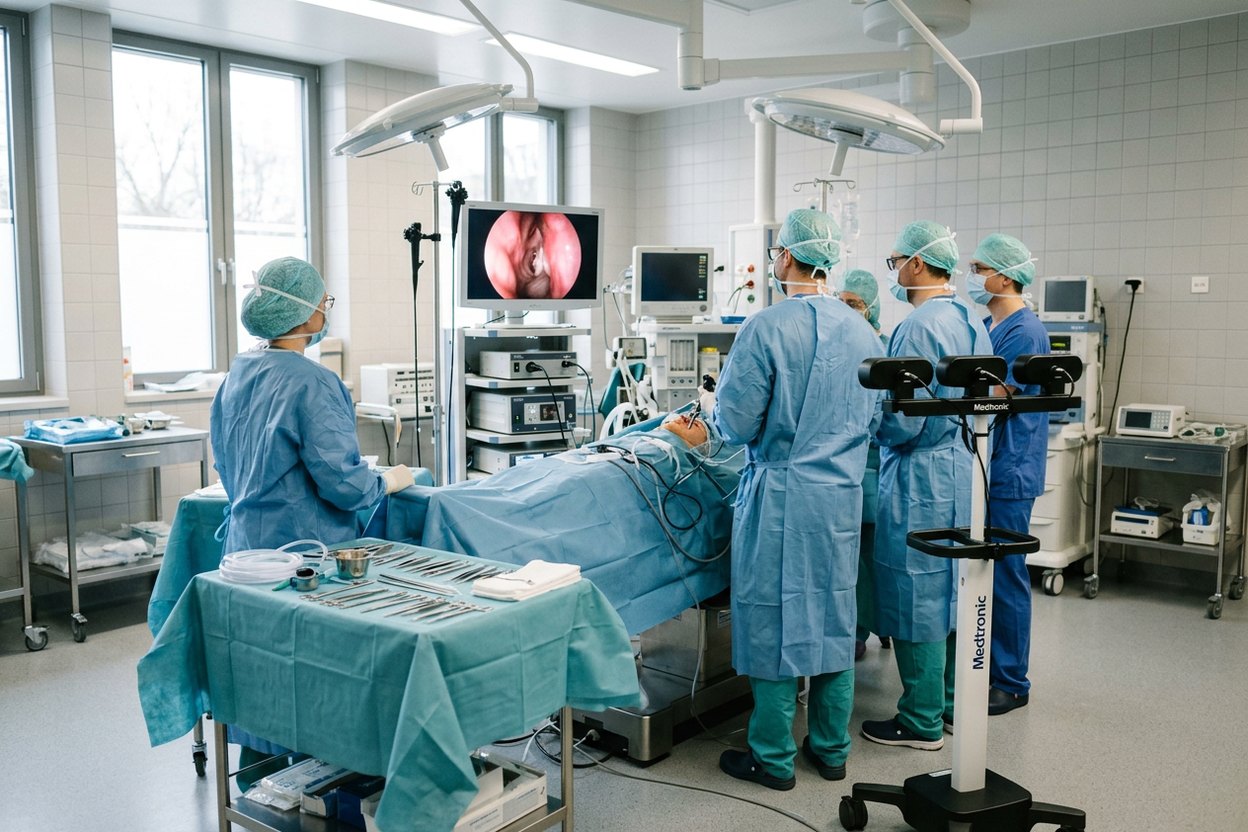
Most adenomas are removed through the nose, with no incision on the head: in transsphenoidal surgery an endoscope, a thin camera tube, passes through a nostril and the sphenoid sinus to the gland. A neurosurgeon often works with an ENT surgeon or second neurosurgeon, using navigation and, in some hospitals, MRI or ultrasound during surgery. The German guideline rates a microscope on the same route as equivalent.
If a large tumour extends far upwards or sideways, surgery through the skull or a combined approach is discussed. Remaining tumour may be watched, removed again or irradiated precisely (see gamma knife in Germany); near the optic nerves the dose is usually split over many sessions.
Patients stay several days in hospital, then avoid nose-blowing, straining and heavy lifting for some weeks. Salt and water balance is watched: diabetes insipidus, heavy water loss in urine, is often temporary, and the opposite, water retention with low sodium, can occur. Missing hormones are replaced, blood tests repeated. Other tumours in the skull: brain tumour treatment in Germany.
Follow-up after treatment
Follow-up lasts years, often for life, because the tumour can return. The first MRI usually comes a few months after surgery, later ones less often; hormones are checked regularly, visual fields if the tumour lay near the optic nerves.
The doctor at home needs the operating report, histology, replacement scheme and follow-up calendar, and with adrenal insufficiency an emergency card. Ask for copies in a language you and your doctor read, to avoid guesswork in an emergency. To find a specialist, see neurosurgeon in Germany.
Frequently asked questions
Can a pituitary adenoma be treated without surgery?
Yes, in some cases. A prolactinoma is usually treated with tablets, and a small inactive adenoma sparing the optic nerves is often just watched. In acromegaly and Cushing’s disease, medication and radiation are used when surgery is impossible or incomplete. Tests and MRI decide the route.
Is surgery through the nose dangerous?
It is a serious operation whose risks are discussed beforehand: brain fluid leaking through the nose, meningitis, salt and water imbalance, hormone deficiency, worse vision and bleeding. Sodium, vision and nasal discharge are watched afterwards. The German guideline advises surgery by neurosurgeons experienced in pituitary operations.
Will I need hormone tablets for life?
Not necessarily: replacement is needed only if the pituitary no longer makes enough of a hormone. After successful surgery for Cushing’s disease, hydrocortisone is taken until the adrenal glands recover. Tests a few weeks after surgery and later show what is needed. Never stop hormones yourself: sudden cortisol lack is dangerous.
How AlenMed arranges pituitary adenoma treatment in Germany
AlenMed arranges everything from remote review of images to follow-up at home. The specialist department reviews the MRI and hormone results; we choose a hospital with a pituitary centre where this operation is routine and arrange the written estimate, visa invitation, dates and an interpreter for consent talks and ward rounds.
After discharge we translate the documents, keep a line open to the surgeon and, six months on, arrange a follow-up visit or remote consultation with fresh scans and tests.
This material is for information only and is not an offer. The treatment plan is decided by a doctor at an in-person consultation.