 EN
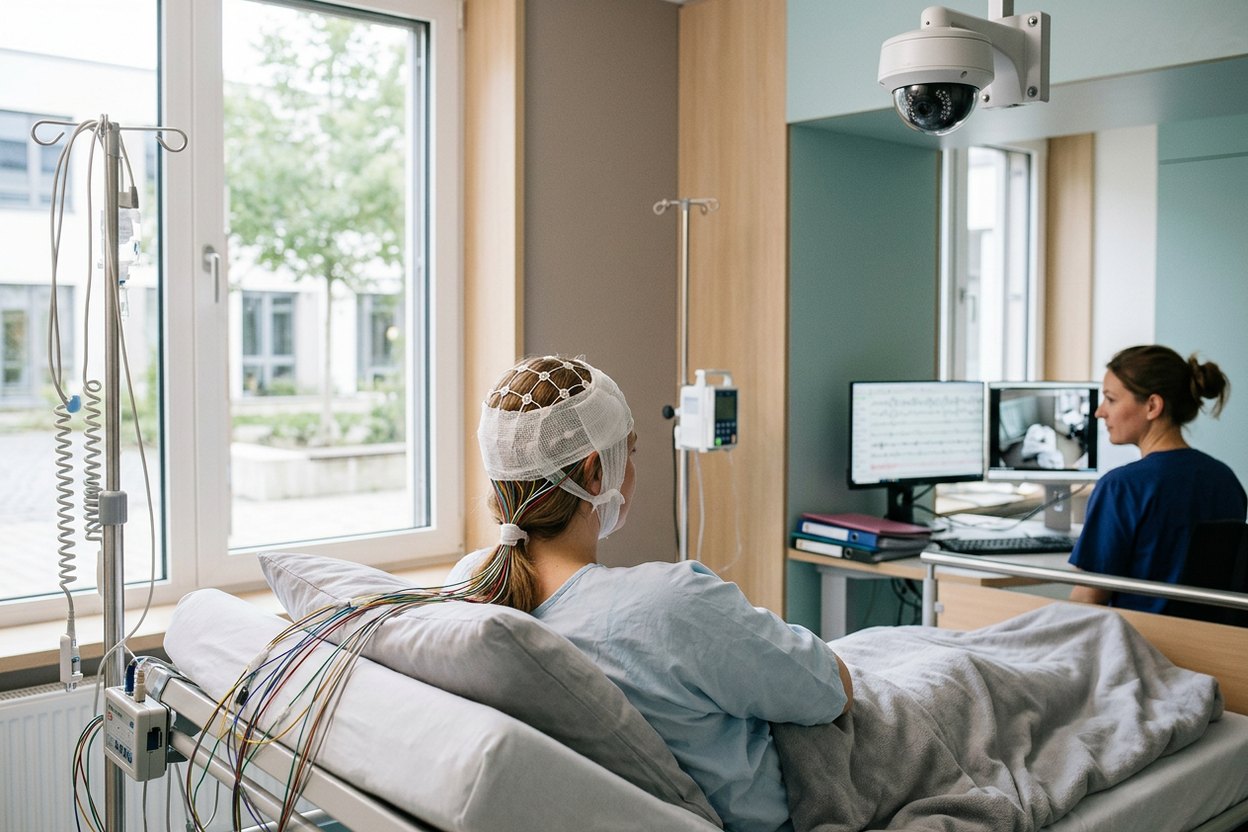
For most people with epilepsy, medication brings the seizures under control. But in some patients two properly chosen drugs at adequate doses have not worked, and going on trying tablets then means losing years. For them, surgery is not an act of despair but a separate, long-established route.
This page explains how German teams decide whether an operation is possible, what the work-up before it consists of, which operations exist, and what AlenMed does.
When surgery is considered at all
Surgery is considered when epilepsy is drug-resistant: seizures continue despite two tolerated, appropriately chosen drugs at adequate doses. That, rather than the number of years with the illness, is what opens the conversation about surgery. The WHO fact sheet on epilepsy also notes that surgery may help patients who respond poorly to drug treatment.
The second condition: the seizures must start from a single focus that can be found and removed without touching speech, movement, vision or memory. That is why the work-up before surgery takes weeks rather than a day.
Surgery is not only an adult matter: in children with severe forms, the more the seizures interfere with development, the sooner the question is settled (more under epilepsy treatment in children). The whole path, from first drugs to surgery, is described under epilepsy treatment in Germany.
The pre-surgical work-up
The backbone of the work-up is video-EEG monitoring: the patient stays on a ward under a camera while scalp electrodes continuously record the EEG, the brain’s electrical activity, and medication is reduced on the team’s decision so that seizures are recorded. The reason: doctors need to see the beginning of a seizure, not its middle, because the beginning shows where it starts.
Next come a high-resolution MRI on an epilepsy protocol, whose thin slices reveal even small structural changes, and, where required, PET and single-photon imaging, which show how different brain areas are working. A neuropsychologist tests memory and language, and functional MRI or a dominance test shows which hemisphere carries language.
If scalp recording gives no answer, implanted electrodes are discussed: thin depth electrodes placed stereotactically, along precisely calculated paths, or strips and grids on the surface of the brain. The patient spends several days with them under observation. A board of epileptologists, neurosurgeons, neuroradiologists and neuropsychologists discusses all the findings; the decision is the team’s, not one doctor’s. See also the page on neurosurgery in Germany.
Which operations are done
Operations fall into three groups, and removing the focus is the largest. In temporal lobe epilepsy, structures inside the temporal lobe are removed. Where a specific lesion is what generates the seizures, such as a cortical malformation (an abnormally formed area of the cortex), a cavernous angioma (a cluster of widened blood vessels) or a benign tumour, that lesion is removed.
Where the focus cannot be taken out, disconnective procedures are used. In dividing the corpus callosum, the fibre bundle linking the hemispheres, the aim is not an end to all seizures but to the most dangerous ones, such as seizures with sudden falls. In children with severe forms, an affected hemisphere can be disconnected from the rest of the brain.
The third group works without open removal: thermocoagulation, targeted heating of small foci through thin electrodes, and neurostimulation. In vagus nerve stimulation an implanted device sends weak impulses to the nerve in the neck, in deep brain stimulation to structures deep in the brain. Availability of a particular method is confirmed with the hospital; see the overview of neurosurgery hospitals in Germany.
After the operation: what to expect and what the outcome depends on
No result is promised in advance. In some patients the seizures stop, in some they become rare, and in some they remain. The odds depend on the form of epilepsy and on whether the focus was found, not on the country where the operation was done.
Medication is not stopped straight after surgery: the doses are reduced gradually and only on the epileptologist’s decision, sometimes a year later or more. The risks of the operation are discussed in advance and depend on where it is done; they may include changes in memory, language or the visual field.
Recovery means a few days in hospital, then follow-up with EEG and MRI on the hospital’s schedule. With adults, driving and work are discussed separately; with children, school and neuropsychological support. Where the condition calls for it, see neurological rehabilitation.
Frequently asked questions
Who is epilepsy surgery suitable for?
It suits people whose epilepsy is drug-resistant, meaning that two tolerated, appropriately chosen drugs at adequate doses have not stopped the seizures, and whose seizures start from one focus that can be removed without harming speech, movement, vision or memory. A board decides after the pre-surgical work-up; in children with severe forms, the question is settled earlier.
How long does the work-up before surgery take?
Usually weeks rather than a day. Video-EEG monitoring continues until seizures have been recorded; an epilepsy-protocol MRI, neuropsychological tests and sometimes PET or single-photon imaging are added. Implanted electrodes, if needed, mean several more days under observation. Ask the hospital in advance how long the monitoring will take in your case.
Will the seizures stop after surgery?
No doctor can promise that. In some patients the seizures stop, in some they become rare and in some they remain; the odds depend on the form of epilepsy and on whether the focus was found. Even when seizures stop, medication is not withdrawn at once: doses are reduced gradually, only on the epileptologist’s decision, sometimes a year later or more.
How AlenMed arranges epilepsy surgery in Germany
AlenMed starts with the documents: discharge summaries, EEG recordings, MRI images and the list of current drugs with doses go to a department that deals with epilepsy. The University Hospital Bonn, for instance, has a separate Clinic for Epileptology whose director is Prof. Rainer Surges. AlenMed works with 86 partner hospitals in 38 German cities and 345 doctors, and its office is in Munich. We arrange an interpreter at appointments, a written cost estimate from the hospital before arrival and help with the visa.
It is worth asking in advance how long the monitoring will last, whether implanted electrodes are planned, who decides about the operation and when, and whether a companion is needed.
This material is for information only and is not an offer. The treatment plan is decided by a doctor at an in-person consultation.