 EN
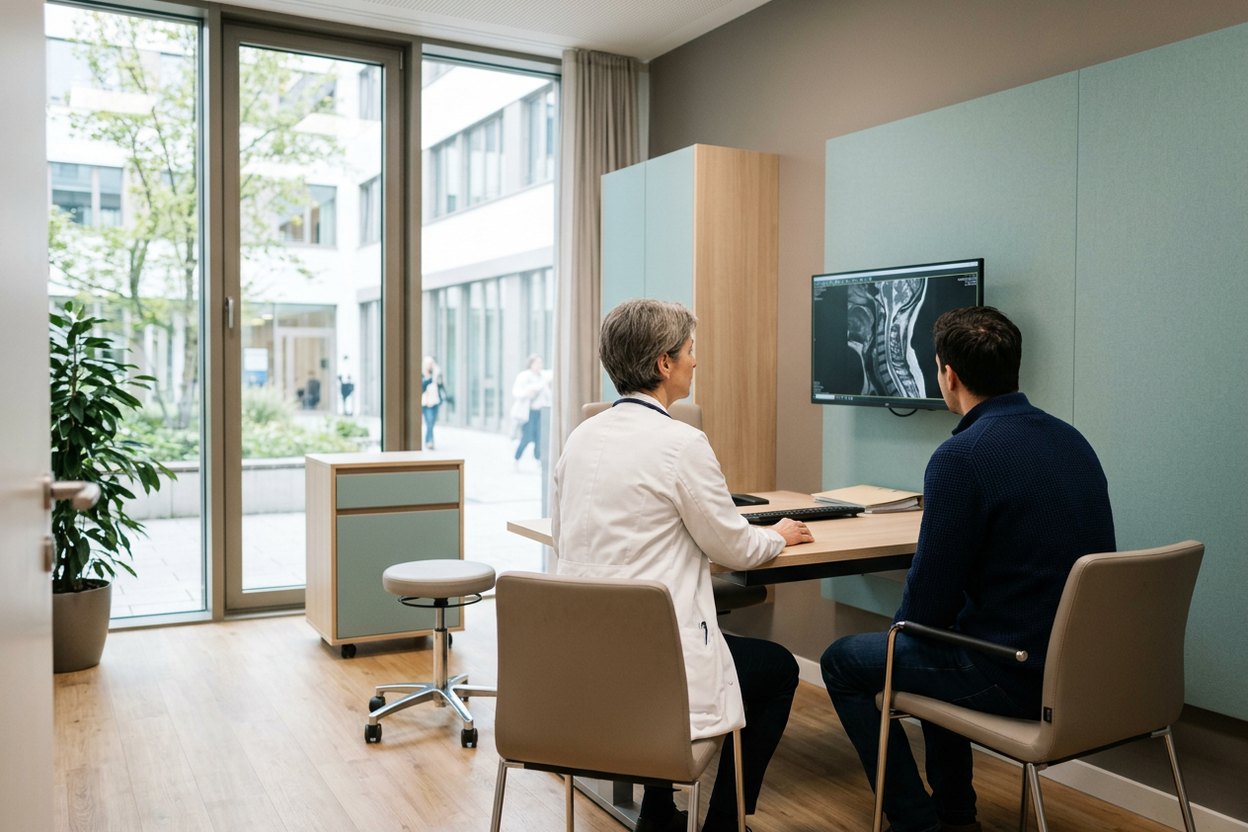
A diagnosis of syringomyelia usually comes unexpectedly: after years with a numb arm, unfelt burns or pain in the shoulders and neck, an MRI shows a cavity inside the spinal cord. Two questions follow: is it dangerous, and does it need surgery?
This page covers syringomyelia treatment in Germany: how doctors find out where the cavity came from, what decides the question of surgery and what happens afterwards. One point first: not everyone needs an operation. The whole field is covered under neurosurgery in Germany.
What syringomyelia is and where the cavity comes from
Syringomyelia is a fluid-filled cavity, or syrinx, inside the spinal cord, most often formed when something obstructs the flow of cerebrospinal fluid, the clear fluid around the brain and cord. The cavity stretches the cord from within and presses on its pathways, the nerve fibres linking body and brain: hence the characteristic complaints.
Sensitivity to pain and temperature is reduced in a cape-like area over the shoulders and arms, while touch is preserved. The hand muscles weaken and waste, and burning pain appears. In children and teenagers, a curving spine (scoliosis) is sometimes the first sign. The complaints build slowly, which is why they go unexplained for so long.
The most common cause is a Chiari malformation: part of the cerebellum, at the back of the brain, sits low in the opening of the skull and obstructs the fluid. Less often the cavity follows an injury, past inflammation of the membranes with adhesions, or a tumour; in some cases no cause is established. The main point: the cause is treated, not the cavity itself.
How the work-up is done in Germany
In Germany the work-up starts with MRI of the brain and the whole spine, not one segment: the cavity can run over several levels, and the junction between skull and neck, where a Chiari malformation shows, has to be seen. The scan itself is described under MRI in Germany.
Next comes a study of fluid flow: an MRI sequence synchronised with the pulse shows whether the fluid, which moves with each heartbeat, passes freely through the opening of the skull. If it is obstructed there, an operation at the junction of skull and neck may help; if it flows freely, the cause is sought elsewhere.
Scans are not enough: a detailed neurological examination maps where pain, warmth and cold are no longer felt; where needed, electrophysiology, testing how nerves conduct signals, and a bladder function check are added. Not only the picture matters but the change over time: two scans a while apart show whether the cavity is growing or standing still. A scientific review of syringomyelia sets out diagnosis and treatment.
When surgery is done and when the cavity is watched
The cavity is watched when complaints are absent or not progressing and it is not enlarging; surgery comes into question when symptoms increase or it grows. Watching is a legitimate approach: the doctor may suggest interval MRI scans instead of an intervention. This is not a refusal to treat.
The operation depends on the cause. With a Chiari malformation, the main operation widens the junction between skull and neck so that fluid flows freely again, with a patch to the covering membrane where needed. With adhesions after injury or inflammation, the spinal cord is freed from them. A tumour is removed, which deals with the cause itself.
A shunt, a thin tube draining the cavity into the surrounding space, is discussed when the other routes do not fit; it has its own problems, such as blockage needing another operation, and is rarely the first choice. Neurosurgeons featured on this site include Prof. Bernhard Meyer, director of the Clinic and Polyclinic for Neurosurgery at Klinikum rechts der Isar in Munich, whose fields include spine surgery, and Prof. Ulrich Sure, director of the Clinic for Neurosurgery and Spine Surgery at University Hospital Essen.
What happens after surgery
After surgery, pain and weakness lessen in some patients, but the realistic aim is to stop the deterioration, not to give back what was lost. The cavity shrinks on the scans slowly and not always completely, and sensation already lost often does not return.
Recovery begins with the first days on the ward, followed by gradually increasing activity, physiotherapy and occupational therapy for everyday skills. Patients also learn to protect their hands when sensitivity to heat and pain is reduced, so that burns and injuries do not go unnoticed.
Follow-up means a control MRI on the doctor’s schedule and a visit if complaints increase. The operation report and images are worth taking home translated. If the indication for surgery is in doubt, a second opinion from a German doctor makes sense before the intervention, not after it.
Frequently asked questions
Is syringomyelia dangerous?
It is dangerous mainly when the cavity grows or complaints increase, because a growing cavity presses ever harder on the spinal cord’s pathways. If it is not enlarging and symptoms are absent or stable, the doctor may suggest watching it with control MRI scans and comparing them over time.
Does lost sensation return after the operation?
Not necessarily: sensation to pain and temperature that is already lost often does not return. The operation aims to stop the cavity growing and the condition worsening. Pain and weakness lessen in some patients, but the hands still need protecting from burns; realistic expectations are worth discussing with the surgeon beforehand.
How much does syringomyelia treatment in Germany cost?
The cost depends on what is needed: tests and a consultation, watching, or an operation and which one, plus the length of stay and recovery. The hospital states the sum and periods in an estimate after the neurosurgeon reviews the discharge summary, neurological report and a complete MRI.
How AlenMed arranges the treatment
AlenMed sends the discharge summary, the neurological report and MRI discs of the head and whole spine to a neurosurgical department. The company works with 86 partner hospitals in 38 German cities and 345 doctors, and its office is in Munich; departments are listed under neurosurgical hospitals in Germany. Without a complete MRI no substantive answer is possible: it is the first thing hospitals ask for.
Ask in advance which operation is planned and why, what happens if watching turns out to be preferable, how long the stay lasts and what the estimate covers. The hospital states the periods and the sums.
This material is for information only and is not an offer. The treatment plan is decided by a doctor in person.