 EN
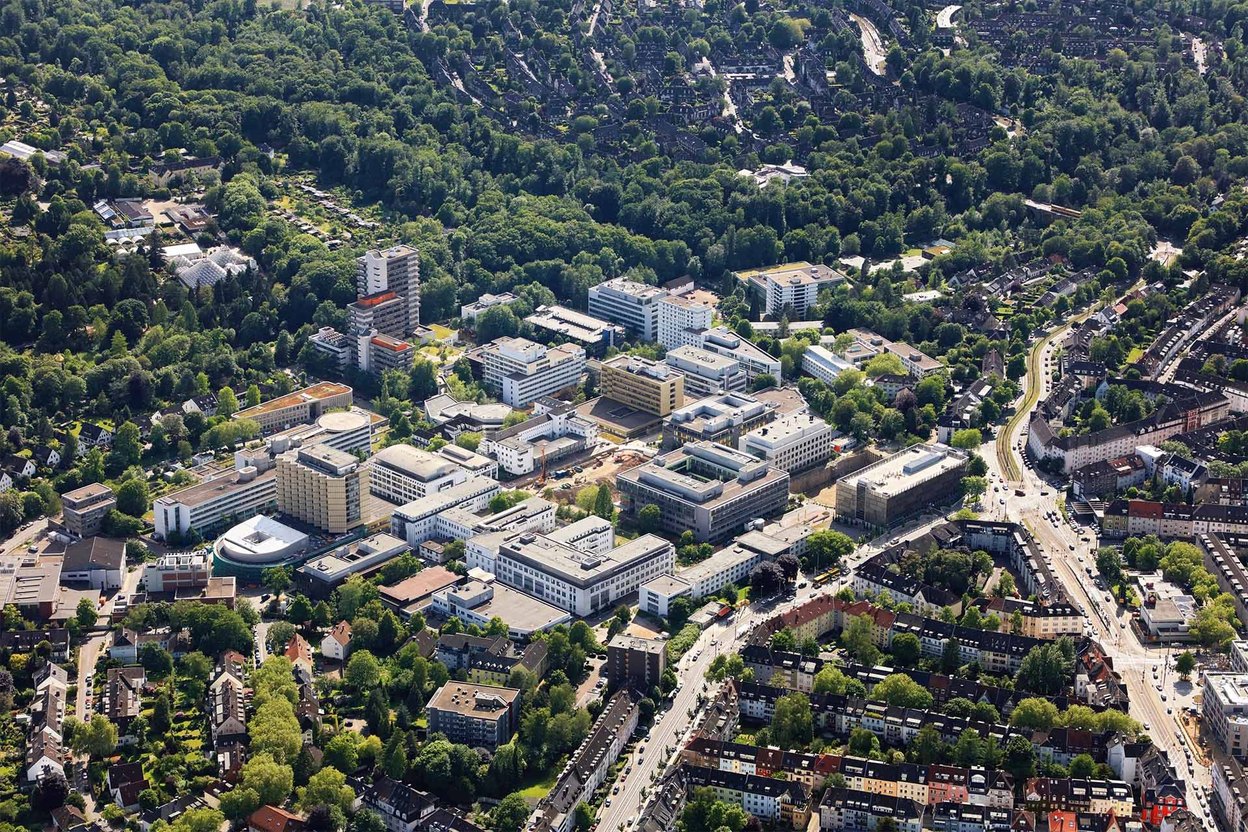
University Hospital Essen, Germany (Universitätsklinikum Essen) is the largest university hospital in the Ruhr area concentrated on a single campus, and a public-law institution attached to the University of Duisburg-Essen. It opened in 1909 as the city’s municipal hospital.
It has about 1,300 beds and more than 8,000 staff, and treats around 55,000 inpatients and 300,000 outpatients a year. Universitätsmedizin Essen, the group formed by the hospital and its subsidiaries, comprises 33 clinics and 24 institutes. Below: its main fields, doctors and the route to treatment from abroad; for comparison, see our overview of university hospitals in Germany.
What University Hospital Essen is known for
University Hospital Essen is best known for transplant medicine, oncology and heart and vascular care, the three focus areas it names itself. It is one of the few university hospitals that transplant all vital organs: kidney, liver, pancreas, heart and lungs. For liver transplants, the Surgical Clinic for Visceral and Transplant Medicine (Chirurgische Klinik für Viszeral- und Transplantationsmedizin) performs the operation, while the clinic for gastroenterology, hepatology and transplant medicine treats severe liver disease, manages the waiting list and provides follow-up care. Our liver transplant page explains who needs one.
The Clinic for Haematology and Stem Cell Transplantation performs what patients call a bone marrow transplant and doctors a stem cell transplant. Blood stem cells in the bone marrow make new blood; high-dose chemotherapy or radiation destroys them along with the cancer cells. Healthy stem cells, the patient’s own or a donor’s, are then given to restart blood production. According to the US National Cancer Institute, the procedure is used most often for blood cancers such as leukaemia, lymphoma and multiple myeloma. Details are on our stem cell transplant page.
Drug treatment of cancer is run by the Department of Medical Oncology, with dedicated clinics for lung, breast and digestive tract tumours. Cancers of the prostate, bladder, kidney and testis are treated in the Department of Urology and its uro-oncology centre. Treatment plans are agreed at tumour boards (Tumorkonferenz), where surgeons, oncologists, radiologists, radiation oncologists and pathologists reach one joint decision.
Departments at University Hospital Essen
Each department is a separate clinic with its own director, doctors and wards. Besides those mentioned above, they include:
- Medical Intensive Care (Medizinische Intensivtherapie)
- Anaesthesiology and Intensive Care (Klinik für Anästhesiologie und Intensivmedizin)
- Ophthalmology (Klinik für Augenheilkunde)
- Dermatology (Klinik für Dermatologie)
- Endocrinology, Diabetology and Metabolism (Klinik für Endokrinologie, Diabetologie und Stoffwechsel)
- Gynaecology and Obstetrics (Klinik für Frauenheilkunde und Geburtshilfe)
- Ear, Nose and Throat (Klinik für Hals-Nasen-Ohren-Heilkunde)
- Infectious Diseases and Nephrology (Klinik für Infektiologie und Nephrologie)
- Cardiology and Angiology (Klinik für Kardiologie und Angiologie)
- Paediatrics and Adolescent Medicine (Klinik für Kinder- und Jugendmedizin)
- Paediatric Surgery (Klinik für Kinderchirurgie)
For patients with several conditions, related specialists and intensive care are all on one campus, usually with no transfer to another hospital.
Doctors: who leads the departments
Prof. Tienush Rassaf directs Cardiology and Angiology: coronary heart disease, heart failure, rhythm disorders and narrowed leg arteries. Prof. Ulf P. Neumann is director of the Surgical Clinic for Visceral and Transplant Medicine (Chirurgische Klinik für Viszeral- und Transplantationsmedizin), which operates on abdominal organs and transplants livers and kidneys.
Prof. Hartmut Schmidt has headed Gastroenterology, Hepatology and Transplant Medicine since 2021; he previously worked at Charité in Berlin and in Münster, where he specialised in liver care before and after transplantation. Prof. Martin Schuler leads Medical Oncology, and Prof. Boris Hadaschik leads Urology and its uro-oncology centre.
Prof. Ulrich Sure has led Neurosurgery and Spine Surgery since 2008, with a focus on vascular neurosurgery and brain tumours. Prof. Christoph Kleinschnitz heads Neurology, focusing on multiple sclerosis and stroke. ENT is led by Prof. Stephan Lang, and Anaesthesiology and Intensive Care by Prof. Thorsten Brenner. The hospital decides which doctor sees the patient; a preference can be stated in the request.
Location, getting there and your stay
University Hospital Essen, Germany, occupies about 60 buildings in the south of the Holsterhausen district near the city centre, in North Rhine-Westphalia. The nearest airports are Düsseldorf and Dortmund; from Düsseldorf, a train or taxi takes you to Essen main station. From there the U17 light rail line runs towards the hospital, and tram line 106 stops at the main entrance. The hospital’s invitation names the exact building.
Patients stay in standard rooms or, for an extra charge, in a room with additional services (Wahlleistung), such as a single room. Meals follow the doctor’s dietary orders, relatives visit under the rules of each ward, and patients can walk in the nearby Grugapark.
Frequently asked questions
Can I come to University Hospital Essen just for a consultation or tests?
Yes. Most of the hospital’s patients are outpatients: around 300,000 a year, against about 55,000 inpatients. A patient from abroad can come for a consultation or tests without being admitted, following the same steps as for treatment: translated documents, a request to the right department, a cost estimate and a deposit.
How much does treatment at University Hospital Essen cost?
There is no fixed price: the hospital states the amount in a cost estimate (Kostenvoranschlag) after reviewing the documents. It depends on the diagnosis, the tests and procedures, the length of stay and the room, as a Wahlleistung room costs extra. Self-paying patients pay a deposit into the hospital’s account before travelling.
Where can relatives stay during treatment in Essen?
The closest option is the hospital’s guest house (Gästehaus) on the south-western edge of the campus. Its ten apartments are meant for patients’ relatives and friends, as well as for outpatients. Parents of sick children can also use parents’ houses. Places are limited, so book early or choose a hotel in the city.
How AlenMed arranges treatment at University Hospital Essen
AlenMed collects the patient’s medical documents, translates them into German and sends a request to the department that treats the condition. It needs recent discharge letters, CT or MRI scans on disc (the images, not just the reports), histology results if a biopsy was done and a list of medications with doses.
The hospital’s doctors review the case and reply with their proposal and a cost estimate (Kostenvoranschlag). Once the deposit reaches its account, the hospital issues the invitation needed for a medical visa. Medical interpreters accompany the patient at appointments, and what makes up the cost of treatment in Germany is explained separately. AlenMed’s office is in Munich; its partner hospitals are across Germany.
This material is for reference only and is not an offer. The treatment plan is set by the doctor at an in-person consultation.