EN
EN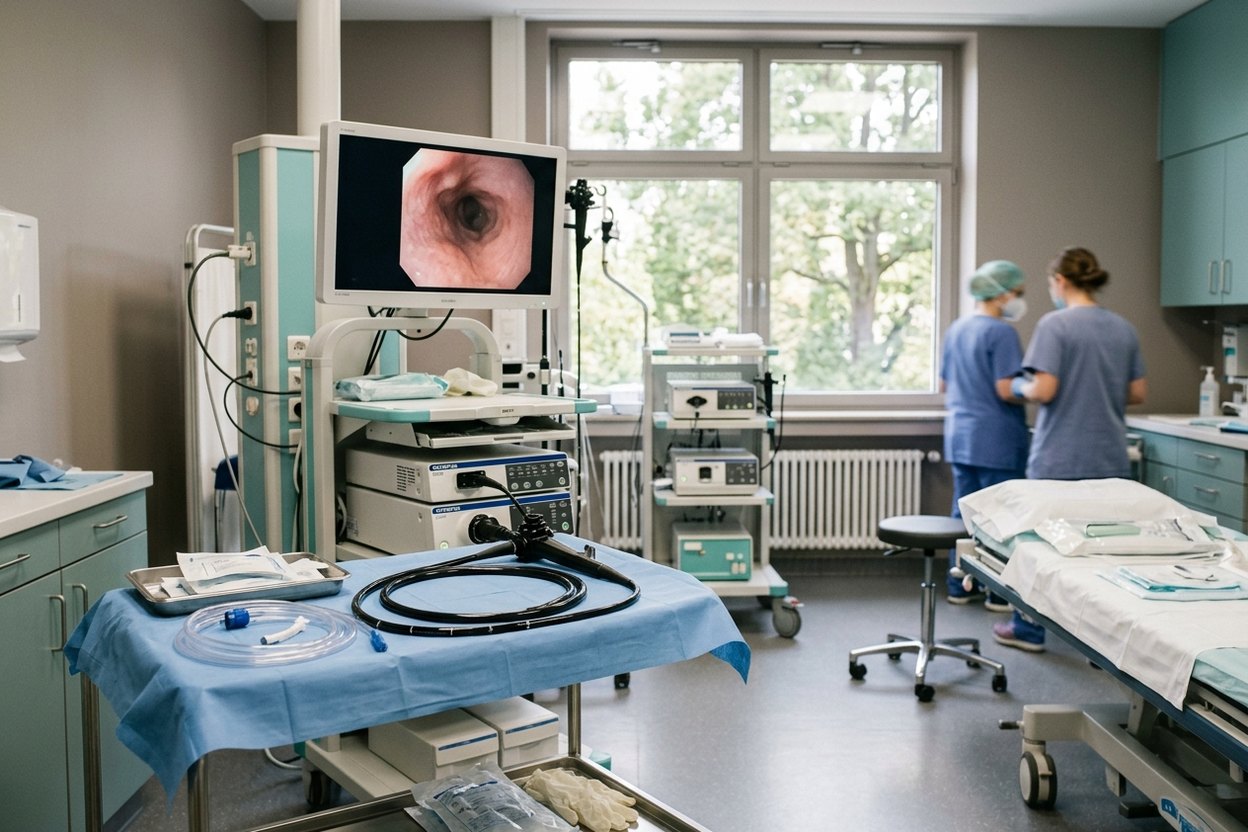
Oesophageal cancer treatment in Germany starts not with surgery but with two precise answers: what type of tumour it is and how far it has spread. Usually swallowing has become difficult, first with solid food, then with soft. It is type and stage that decide whether major surgery is needed or a gentler route will do.
A tumour board of surgeon, oncologist, gastroenterologist and radiation oncologist plans the treatment. This page covers diagnosis, treatment, advanced disease, centres and how AlenMed organises the stay.
Finding out the type and stage
Type and stage are established by endoscopy with biopsy, endoscopic ultrasound and scans. It usually starts with swallowing: solid, then soft food goes down with difficulty or seems to stick, there is pain or burning behind the breastbone, and weight drops for no clear reason. Such complaints need an endoscopy without delay. Benign conditions cause similar symptoms, so only a biopsy gives the answer.
A pathologist determines the tumour type from the biopsy. Squamous cell cancer grows from the flat cells lining the oesophagus, more often in its middle and upper part; adenocarcinoma grows from glandular cells, usually low down near the stomach. The two behave and are treated differently. A tumour at the junction is sometimes classed and treated as stomach cancer: see stomach cancer treatment.
Endoscopic ultrasound from inside the oesophagus shows how deep the tumour has grown and whether nearby lymph nodes are involved; CT, and PET-CT for locally advanced tumours, looks for distant spread. The tissue is tested for HER2, PD-L1 and microsatellite instability, the features used to choose drugs. Bring endoscopy reports with photos, the histology with tissue blocks, and CT discs.
Treatment: from endoscopy to surgery
The method depends on the stage: early cancer is removed through an endoscope, while locally advanced cancer is treated with chemotherapy or chemoradiotherapy and surgery. A superficial tumour confined to the lining is cut out during endoscopy and the oesophagus is kept; the microscope then shows whether this was enough.
When the tumour has grown deeper or reached the lymph nodes, chemotherapy or chemoradiotherapy first shrinks it; then the affected part of the oesophagus is removed with its lymph nodes, and a new oesophagus is usually made from the stomach, shaped into a narrow tube and pulled up into the chest. German surgeons increasingly operate minimally invasively, some with a robot: see oesophageal cancer surgery.
In some squamous cell cancers, chemoradiotherapy without surgery is an option, with close follow-up; if the tumour persists or returns, surgery can still be considered. If tumour cells remain in the tissue removed after chemoradiotherapy and surgery, some patients receive immunotherapy. The tumour board decides to agreed protocols, based on the current German S3 guideline on oesophageal cancer.
If the tumour has spread
With metastases in distant lymph nodes or other organs, the cancer is at stage 4 and treatment rests on drugs: chemotherapy, plus immunotherapy when the PD-L1 level is suitable or a targeted drug in HER2-positive adenocarcinoma. The aim is to hold the disease back and keep the ability to eat. Surgery is an exception: if distant metastases are found before an operation, the German guideline advises against it.
A stent (a mesh tube that widens the passage), radiotherapy or a feeding tube keeps nutrition possible, and palliative care runs alongside treatment, not instead of it, easing pain, weakness and anxiety. What treatment at this stage involves, and what a trip to Germany can add, is covered on the page about stage 4 oesophageal cancer treatment.
Where oesophageal cancer is treated in Germany
In Germany, oesophageal cancer is treated in centres that operate on the oesophagus regularly, as the team’s experience affects complications; the German guideline recommends exactly this. At Helios Hospital Erfurt, the general and abdominal surgery department is approved for complex oesophageal operations and also uses a surgical robot. Not every step needs a surgical centre: at Helios Hospital Munich West, gastroenterologists treat oesophageal, stomach and bowel diseases, including cancer, and perform upper digestive endoscopy.
Prof. Helmut Friess heads the Department of Surgery at Rechts der Isar Hospital, where oesophageal operations are a main area. At Leipzig University Hospital, Prof. Florian Lordick heads the Department of Oncology, Gastroenterology, Hepatology and Pulmonology, which treats digestive tumours with chemotherapy and immunotherapy. Surgeon and oncologist should work as one team, with drugs, radiotherapy and surgery in a single plan.
Frequently asked questions
Can oesophageal cancer be cured?
Yes, if it is found early or is still confined to the oesophagus and nearby lymph nodes: treatment then aims at a cure, by endoscopic removal, chemotherapy or chemoradiotherapy with surgery, or chemoradiotherapy alone in some squamous cell cancers. How realistic this is depends on tumour type, stage and general health. With distant metastases, the aim becomes holding the disease back.
Does the oesophagus always have to be removed?
No. Early superficial cancer is removed through an endoscope and the oesophagus stays. In squamous cell cancer, chemoradiotherapy can replace surgery in some cases and is preferred for tumours in the neck part of the oesophagus. Regular check-ups follow, and if the tumour persists or returns, surgery can still be discussed.
Will the tests have to be repeated in Germany?
Not necessarily. The German hospital first reviews the reports, histology and discs you send. It often asks for the tissue blocks for its own pathologists and repeats endoscopy, endoscopic ultrasound or PET-CT if the images are old or incomplete or the treatment choice depends on them. Any repeat tests are included in the estimate.
How AlenMed arranges oesophageal cancer treatment
AlenMed starts with the documents: endoscopy reports, histology, CT and PET are translated and sent to oncology centres across Germany, whose specialists say whether they agree with the diagnosis and plan. Sometimes a clarified tumour type opens a gentler route; sometimes it simply saves time.
There is no single price: the hospital’s estimate (Kostenvoranschlag) for the specific plan covers diagnostics, surgery with the inpatient stay and drug cycles. Inpatient care is billed by DRG, a fixed rate per case set by diagnosis and operation. At stage 4 the whole course is estimated. The page on the oesophageal cancer treatment price in Germany explains the bill. AlenMed arranges the visa invitation, an interpreter, nutrition advice after surgery and a follow-up plan at home; its office is in Munich, its partner hospitals all over Germany.
This material is for information only and is not an offer. The treatment plan is set by the doctor at an in-person consultation.
News on this topic
Charité treats first beta-thalassemia patient with CRISPR
At Berlin Charité, a 19-year-old beta-thalassemia patient became the first in Germany to receive the newly approved CRISPR gene therapy Exagamglogene Autotemcel.
Real-World Breast Cancer Study Confirms High Five-Year Survival Rates in Germany
A landmark study of over 43,000 German patients reveals a five-year invasive disease-free survival rate of 82.9 percent in early hormone receptor-positive breast cancer.
FDA Approves Jülich Diagnostic Radiotracer FET for Brain Tumor Imaging
The FDA approves the diagnostic radiotracer FET (Pixclara®) for evaluating brain gliomas, highlighting decades of neuro-oncology research at Forschungszentrum Jülich.