EN
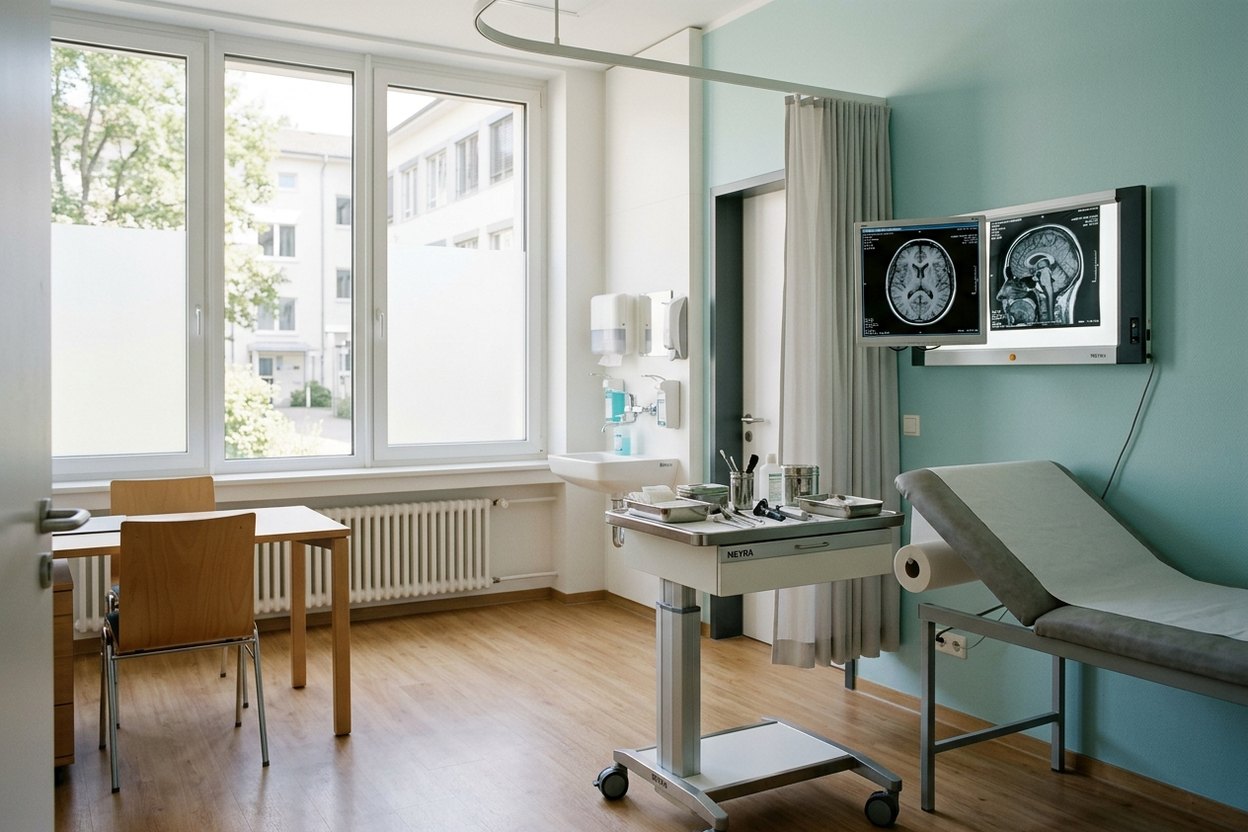
Proton beam therapy in Germany is radiotherapy with protons at a few centres attached to university hospitals, sought when a tumour lies near vital organs and the healthy tissue around it must be spared. As with any cancer treatment in Germany, it is given only when indicated.
It is not «improved radiotherapy for everyone» but a method with a narrow, well-described set of indications. Below: the physics in plain words, where German hospitals actually offer it, how a course runs and who pays.
How a proton differs from ordinary radiation
The difference is where the beam deposits its dose. Conventional radiotherapy uses photons, high-energy X-rays that pass through the body and release energy all along the way, before and beyond the tumour.
A proton slows down in tissue and releases most of its energy at the end of its path, at a depth set by the beam energy: the Bragg peak. Beyond it the dose falls almost to zero. Hence the one real advantage: far less healthy tissue behind the tumour is irradiated.
Whether this helps the patient depends on the diagnosis. For most tumours there is no evidence that protons destroy cancer more reliably than modern photon radiotherapy; the point is fewer late effects. The German Cancer Research Center’s cancer information service states that ion beam therapy, protons included, suits only certain tumours. On conventional radiation therapy in Germany and its cost, see the separate page.
Who is actually offered it
Children are the clearest case. A growing body is especially sensitive to radiation: dose to healthy tissue can later affect growth, hormones, sight, hearing and the nervous system. For many childhood tumours, especially brain tumours, protons have already shown an advantage.
Next come tumours beside critical structures such as the brainstem, optic nerve or spinal cord: skull base tumours including chordomas and chondrosarcomas, some brain and spinal cord tumours, and eye tumours. Re-irradiation with protons is also possible but is still being studied in clinical trials.
Proton therapy for prostate cancer is available in Germany, with caveats: the German clinical guideline finds no proven advantage over modern photon radiotherapy and, for locally advanced tumours, recommends it only in clinical trials; funding is decided case by case. Compare not «protons versus photons» in general but how the dose would fall in your case. See also radiotherapy for prostate cancer in Germany.
What a course looks like
A course starts with preparation, followed by several weeks of daily sessions. The tumour and organs to spare are outlined on a planning CT, often with an MRI; a custom mask or other device keeps the position identical, and a medical physicist calculates the plan, which is checked before the first session. In German centres a CT scan costs approximately 500 €, or around 550 € with contrast, and an MRI approximately 800 €, or 900–1000 € with contrast.
Sessions run every weekday for several weeks; at the Heidelberg centre a course has 20 sessions on average. For most patients the irradiation lasts from 30 seconds to a few minutes; most of the time goes on positioning and check images. Treatment is usually outpatient, so accommodation is needed for the whole course.
Side effects depend on the area treated: mostly fatigue and local reactions of the skin and mucous membranes, plus hair loss when the head is treated. They build up gradually: fatigue usually after one to two weeks, skin irritation often after two to three weeks. A doctor usually reviews the patient weekly, and acute reactions generally settle within a few weeks after treatment.
Where it is delivered in Germany and who pays
Proton beam therapy in Germany is offered at only a handful of centres, all at university hospitals: the machines are rare and expensive. One is the Heidelberg Ion-Beam Therapy Centre (Heidelberger Ionenstrahl-Therapiezentrum, HIT) at Heidelberg University Hospital, treating with protons and heavy ions; its medical director is PD Dr. Semi Harrabi, a radiation oncologist. Essen University Hospital and University Hospital Dresden also run proton centres.
Doctors decide, not the patient: the centre’s radiation oncologists and tumour board review images, histology and previous treatment and judge whether protons offer an advantage in this case; if not, they propose another option. A foreign patient goes through the same procedure, with documents translated and sent ahead.
A course costs more than conventional radiotherapy: roughly three times as much, according to the Heidelberg centre. German insurers do not pay for every diagnosis: in Heidelberg, contracts cover patients who benefit according to the German Society for Radiation Oncology (DEGRO); others must apply. Patients from abroad get everything calculated in advance in the estimate; the cost of proton therapy is broken down on the price page.
Frequently asked questions
Does proton therapy hurt?
No, the irradiation itself cannot be felt. The patient lies still, with a mask if the head is treated, while the beam runs for minutes. Very young children who cannot keep still are often treated under daily anaesthesia. Discomfort may come later as a side effect, such as skin irritation, and is treated during the course.
Who is proton therapy not suitable for?
Those for whom it offers no advantage over conventional radiotherapy, or who face technical obstacles. Protons are mainly used when the aim is cure. Metal in the treatment area, such as an implant, can rule it out if it distorts the dose, as can a tumour moving with breathing when the motion cannot be managed reliably. The radiation oncologist decides.
Do I need to come back to Germany for follow-up?
Not necessarily. Regular check-ups are needed, but they can be done at home: the Dresden centre, for example, accepts results from other hospitals. They catch late effects or a relapse early, so agree before leaving which doctor will follow you at home and how reports and images will be sent.
How AlenMed arranges treatment
AlenMed prepares the case and organises the trip. We collect and translate histology, original image files and any previous radiotherapy plan and send them to a radiation oncology department, which decides whether protons are indicated at all and, if not, says so and offers what is. An interpreter attends the appointment. AlenMed works with 86 partner clinics in 38 cities and 345 doctors; its office is in Munich.
The practical side: the hospital’s written cost estimate (Kostenvoranschlag), a visa invitation, accommodation for the whole course rather than a week, and passing the discharge documents to your doctor at home.
This material is for information only and is not a public offer. Treatment is decided by a doctor at a face-to-face appointment.
News on this topic
Tübingen researchers uncover mechanism of immune suppression during cancer cell death
Researchers at Universitätsklinikum Tübingen discovered that dying cancer cells release PGE2 to suppress immune response during ferroptosis, opening paths for combination therapy.
New single-cell lung cancer atlas LuCaS+ uses AI to predict metastasis risk
German researchers from LMU, Charité, and TU Berlin created the LuCaS+ single-cell atlas, using AI to predict lung cancer metastasis risk from archived tissue samples.
ForTra Funds Clinical Trials for Leukemia and Muscular Dystrophy
ForTra gGmbH provides four million euros to support clinical trials for acute myeloid leukemia and Duchenne muscular dystrophy in Germany.