EN
EN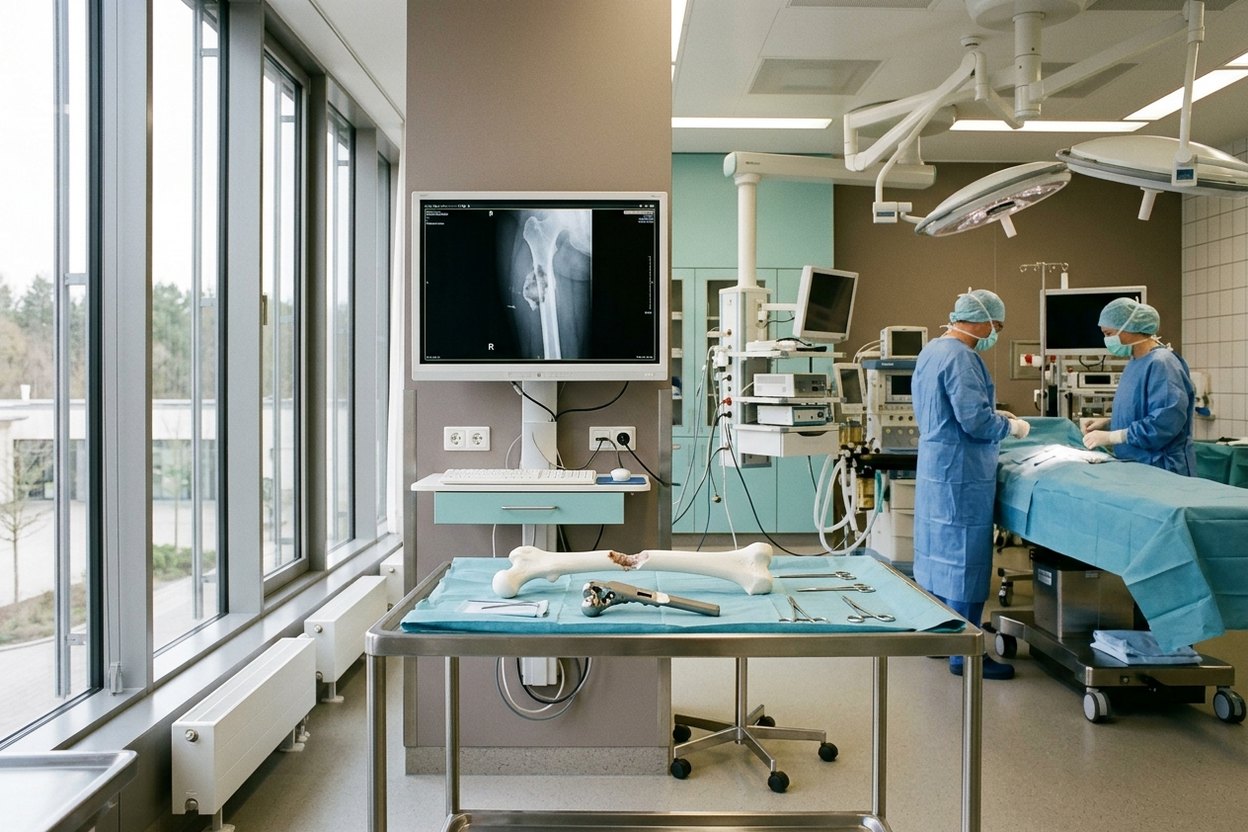
Sarcoma treatment in Germany is organised around specialist sarcoma centres, where one team plans surgery, radiotherapy and medicines. Sarcoma is rare, and a doctor who sees one every few years is at a disadvantage compared with a centre that treats sarcomas constantly. What matters is where it is treated often enough.
If sarcoma has been found, treatment starts with checking the diagnosis, not with surgery. This page covers soft tissue sarcoma, diagnosis, treatment options, children and young people, and how AlenMed helps. Bone tumours, including osteosarcoma, have their own page on bone cancer treatment.
Soft tissue sarcoma: what it is and why the centre matters
Soft tissue sarcoma is a malignant tumour of connective tissue such as fat, muscle, blood vessels or nerve sheaths, most often in the arms and legs, but also on the trunk, head and neck, or in and behind the abdomen (retroperitoneum). Subtypes are many; the commonest include liposarcoma (from fat), leiomyosarcoma (from smooth muscle) and undifferentiated pleomorphic sarcoma, whose cells resemble no particular tissue.
The lump causes no trouble for a long time. See a doctor if it lasts more than a few weeks, grows, exceeds a few centimetres, hurts or lies deep under the muscle sheath. The centre matters because types behave differently: synovial sarcoma often responds well to chemotherapy, nerve sheath sarcomas usually poorly. Adults should look for a cancer centre with its own sarcoma centre (Sarkomzentrum), certified by the German Cancer Society and listed on OncoMap. The Comprehensive Cancer Center Munich LMU has a certified sarcoma centre; Helios Hospital Berlin-Buch has a tumour orthopaedics department (Tumororthopädie), the German term for surgery of bone and soft tissue tumours.
Confirming the diagnosis
Sarcoma is confirmed only by examining tissue, so the biopsy comes first and is planned in advance: its track is placed so that it can be removed with the tumour at surgery. A careless biopsy can complicate the operation, so ideally the centre that will operate takes it.
A pathologist specialising in sarcoma determines the type and grade (how aggressively the cells behave), increasingly with molecular analysis of characteristic genetic changes; a second, reference pathologist reviews the tissue more often than in other tumours. Contrast MRI of the area shows the tumour’s extent; CT, above all of the lungs, where sarcoma most often spreads, looks for deposits elsewhere.
Treatment options: surgery, radiotherapy, medicines
Surgery is the basis of sarcoma treatment in Germany: the tumour is removed in one piece with a margin of healthy tissue. For a sarcoma of the arm or leg, saving the limb comes first. Missing tissue is rebuilt with the patient’s own tissue or, where bone was removed, a prosthesis.
Radiotherapy is given before surgery to allow a smaller, more secure operation, or after it to reduce the risk of recurrence. Chemotherapy and, in some types, targeted drugs are chosen by tumour type and extent. For high-grade sarcomas, some university centres add regional hyperthermia, targeted heating of the tumour area that strengthens chemotherapy; it is never used alone, and the tumour board decides whether it fits. The cancer information service of the German Cancer Research Center gives an overview in German.
Experimental approaches such as dendritic cell vaccines are studied only in clinical trials. The commonest form has its own page on soft tissue sarcoma treatment. The tumour board (Tumorboard) of surgeon, oncologist, radiation oncologist, radiologist and pathologist sets the order of steps in advance.
Sarcoma in children and young people: rhabdomyosarcoma and Ewing sarcoma
The most common soft tissue sarcoma in children is rhabdomyosarcoma, a tumour of cells resembling immature muscle. Paediatric oncologists treat it following the recommendations, trial protocols and registry coordinated in Germany by the soft tissue sarcoma group of the Society for Paediatric Oncology and Haematology (GPOH), combining chemotherapy, surgery and radiotherapy in a sequence set by risk group. More on rhabdomyosarcoma treatment.
Ewing sarcoma grows in bone or soft tissue, mostly in teenagers and young adults, and is also treated by a multi-phase protocol; see Ewing sarcoma treatment.
Children are treated, for example, at Klinikum Stuttgart, which hosts the GPOH soft tissue sarcoma study centre and where PD Dr Claudia Blattmann leads paediatric oncology, haematology and immunology. At Altona Children’s Hospital in Hamburg, Prof. Alexander S. Spiro heads the section for deformities and tumour orthopaedics in children’s orthopaedics. Dr. von Hauner Children’s Hospital in Munich has paediatric haematology and oncology; its director is Prof. Christoph Klein.
Frequently asked questions
Can sarcoma be cured completely?
Yes, it can, but the chances differ. They depend on the type and grade of the tumour, its size and location, whether it has spread and whether it could be removed completely with a healthy margin. That is why a well-planned biopsy and first operation at an experienced centre matter. Only the treating doctor can judge an individual outlook.
Does sarcoma of an arm or leg always mean amputation?
No. Saving the limb is the first aim of surgery; amputation is an exception, usually when the tumour involves important nerves and other options are exhausted. The tumour board decides only after considering every way of keeping the limb, such as radiotherapy, chemotherapy or isolated limb perfusion, in which drugs circulate through the limb alone.
What if the lump was removed and turned out to be a sarcoma?
Have all the material reviewed at a sarcoma centre without delay. An operation done without knowing it was a sarcoma may leave tumour cells at the edge of the removed tissue; the centre then considers a second operation on the area or additional radiotherapy. Bring the pathology report, slides and tissue blocks, the operation report and earlier scans.
How AlenMed arranges sarcoma treatment
AlenMed starts with a second opinion: in sarcoma this is not over-caution but a sensible step, because the tumour is rare. Review of tissue and images at a sarcoma centre sometimes refines the type or changes the surgical plan, so it is best done before deciding on surgery; see second opinion in Germany.
The centre needs the MRI and CT discs, the biopsy report and the paraffin tissue blocks. We translate the documents, send them to German sarcoma centres, and arrange the visa invitation, an interpreter and accommodation, including housing for the whole course for families with children. Costs follow the hospital’s estimate (Kostenvoranschlag); what cancer treatment prices in Germany are made of is explained separately. AlenMed’s office is in Munich; partner hospitals are all over Germany.
This material is for information only and is not an offer; treatment is decided by the doctor at an in-person consultation.
News on this topic
Charité treats first beta-thalassemia patient with CRISPR
At Berlin Charité, a 19-year-old beta-thalassemia patient became the first in Germany to receive the newly approved CRISPR gene therapy Exagamglogene Autotemcel.
Real-World Breast Cancer Study Confirms High Five-Year Survival Rates in Germany
A landmark study of over 43,000 German patients reveals a five-year invasive disease-free survival rate of 82.9 percent in early hormone receptor-positive breast cancer.
FDA Approves Jülich Diagnostic Radiotracer FET for Brain Tumor Imaging
The FDA approves the diagnostic radiotracer FET (Pixclara®) for evaluating brain gliomas, highlighting decades of neuro-oncology research at Forschungszentrum Jülich.