 EN
EN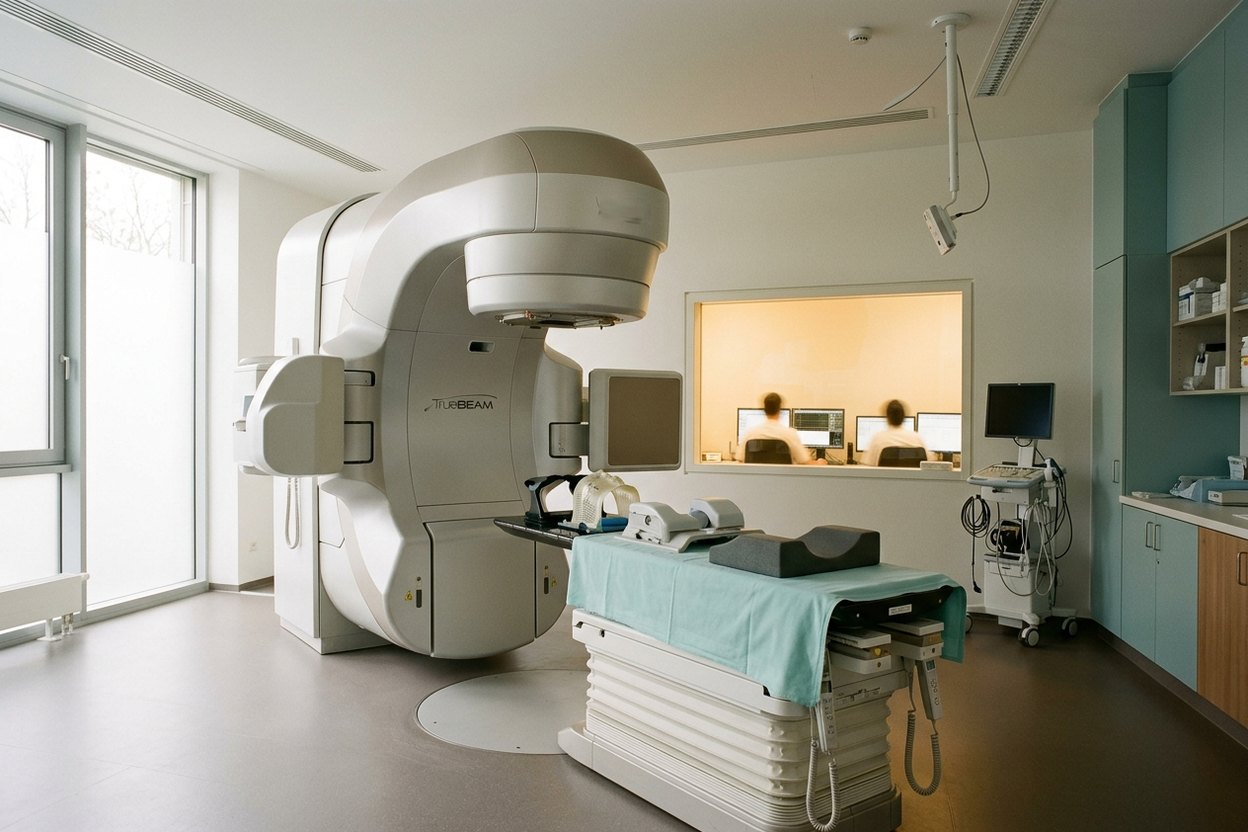
Radiation therapy in Germany is treatment with radiation that damages the DNA of cells: tumour cells repair this damage less well than healthy ones, so the dose is given in small portions and healthy tissue recovers between sessions.
A course has no price “per procedure”: the total depends on preparation, planning and the number of sessions. This page explains the course and how to read a hospital estimate; for the sums, see radiotherapy cost calculation.
Radiation Oncology in Germany: How a Course Is Planned and Delivered
A course has two stages: preparation with a plan, then a series of sessions. Radiation may be the main treatment, replacing surgery in some head and neck or prostate tumours; it is also given before surgery to shrink a tumour, after it to lower the risk of recurrence, or in a short course to relieve pain from bone metastases. It is often combined with chemotherapy or targeted drugs.
The radiation oncologist reviews the reports and orders a planning CT, sometimes with MRI or PET. On the images the doctor outlines the tumour and organs to spare, and a physicist calculates a 3D plan over several days; the hospital sets the start date. In IMRT (intensity-modulated radiotherapy) the beam changes shape and strength during the session; in VMAT the machine also circles the patient. IGRT (image guidance) checks the target’s position on an image before each session, as organs shift with breathing.
It is teamwork: a physicist calculates the plan, a radiotherapy technologist (MTRA) delivers each session, the radiation oncologist approves every step, and the tumour board decides with surgeons and oncologists. The radiotherapy practice in Munich-Pasing is an example: an outpatient practice inside the Helios Klinikum München West that takes part in the hospital’s tumour boards. It is headed by Dr Peter Stoll, a radiotherapy specialist.
What the Estimate Includes
The estimate (Kostenvoranschlag) lists the consultation, planning CT, physics planning, each fraction (a single session) with position checks, and medical reviews. A session’s price covers the team, the linear accelerator (the machine producing the beam) and supervision, so the number of fractions drives most of the total.
| Item | Depends on | Guide price |
|---|---|---|
| CT | area examined; recent scans from home | around €500 |
| CT with contrast | separating the tumour from vessels and organs | around €550 |
| MRI | need for soft-tissue detail | around €800 |
| MRI with contrast | contrast agent needed | €900–1,000 |
Outpatient doctors’ services for self-paying patients are billed under the official German medical fee schedule (GOÄ). A hospital stay, for example with concurrent chemotherapy, is billed under DRG: an amount per case set by its diagnosis-related group, calculated the same way for all patients. So the number of sessions and any hospital stay matter most.
| Technique | Sessions | Used for |
|---|---|---|
| Intensity-modulated (IMRT/VMAT) | 20–35 fractions | complex tumours near organs that must be spared |
| Stereotactic (SBRT) | 1–5 fractions | small tumours and single metastases, high dose per session |
Proton therapy is not in this table: dedicated centres provide it under their own estimate, see proton therapy in Germany. Recent good-quality scans from home are usually not repeated, but the planning CT in the treatment position is always needed.
Radiotherapy for Bladder Cancer
In bladder cancer, radiotherapy can sometimes save the bladder. A urologist first removes the tumour through the urethra (transurethral resection), then radiation is given with chemotherapy that makes the tumour more sensitive to it. This mainly suits tumours that have not spread beyond the bladder’s muscle wall; urologists and radiation oncologists decide at the tumour board, the alternative being bladder removal. See bladder cancer treatment.
For the estimate, drugs, blood tests and monitoring are added: a repeat resection under anaesthesia checks the result, then regular cystoscopies (looking into the bladder) follow. Part of the course may be inpatient and billed under DRG. If tumour remains, bladder removal is discussed, with a new estimate.
Radiotherapy for Benign Conditions
In Germany radiation also treats non-cancerous conditions, following a separate guideline on radiotherapy of benign diseases by the German Society for Radiation Oncology (DEGRO), current version from 2022. It covers heel spur, painful arthrosis of large joints, shoulder and elbow tendon inflammation, Ledderhose disease (nodules on the sole), prevention of bone overgrowth after joint replacement and keloid scars, among others. Other European countries have been more cautious with indications, so it is used less often outside Germany.
For joints, tendons and heel spur the doses are tens of times lower than for tumours and the course is a few short sessions, so the estimate is smaller. Pain often eases, sometimes for a long time, but joint wear remains; in arthrosis, sham-controlled trials have not yet shown a specific effect, while for heel spur the evidence is stronger.
Frequently asked questions
How many sessions does radiation therapy take?
It depends on the aim and technique: intensity-modulated radiotherapy (IMRT/VMAT) usually takes 20–35 fractions, stereotactic radiotherapy 1–5. Pain relief for bone metastases often needs a short course, benign conditions a few sessions. The radiation oncologist sets the number during planning, and it drives most of the estimate.
Can radiation therapy be done as an outpatient?
Yes, usually: the patient comes for each session and returns to the hotel. A hospital stay is needed when concurrent chemotherapy requires monitoring or the patient is too unwell to travel. The estimate states whether admission is planned, since that decides whether billing follows the GOÄ or DRG.
Does radiation therapy hurt?
No, the radiation itself cannot be felt: the patient lies still while the team positions them precisely and checks this on an image. Side effects come later and depend on the area: early ones include tiredness and irritated skin or mucous membranes, late ones can appear months afterwards.
How AlenMed Organises Radiotherapy in Germany
AlenMed handles documents and travel; medical questions are for the doctor before the course: its aim, the number of sessions and why, which organs lie in the field, early and late side effects, and who provides care between sessions. Before radiation to the head and neck, dental treatment is planned in advance.
We translate reports and CT and MRI discs and send them to radiation oncologists at suitable hospitals across Germany. The hospital sends its estimate and is paid directly. We prepare the visa invitation, find accommodation nearby and provide an interpreter at appointments; see arranging treatment in Germany.
This material is for reference only and is not an offer. Figures are indicative; the final estimate comes from the hospital, and indications and regimen are decided by the doctor at a face-to-face consultation.