EN
EN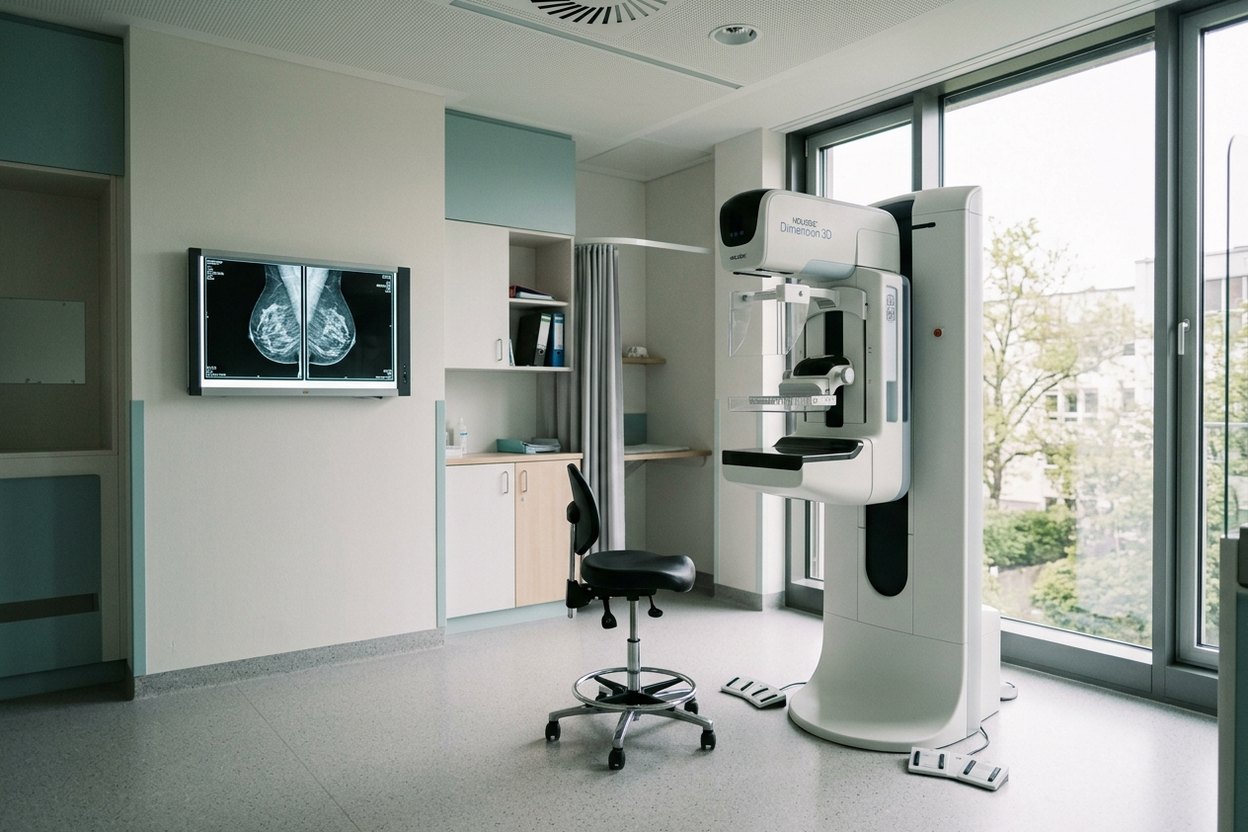
Breast cancer treatment in Germany starts not with surgery but with an exact diagnosis of which tumour the doctors are dealing with; only then does a tumour board combine surgery, radiotherapy and drugs. Breast cancer is the most common cancer in women — according to the WHO, this holds in most countries. That is why so much is said about it, and advice from friends, forums and even different doctors often conflicts. Usually nobody is wrong: one name covers very different tumours.
So the first step is a clear picture rather than treatment. A German work-up assembles it in one place: the pathologist re-examines the tissue, radiologists measure the tumour and check the lymph nodes, and a tumour board reviews the case. The patient leaves with a plan and the reasons for it, not a pile of separate reports.
From biopsy to a plan
The road to a plan runs in steps: imaging, biopsy, a genetic test where needed, staging, and only then the tumour board’s decision. Breast assessment in Germany relies on familiar methods: mammography, ultrasound and, where needed, MRI. The early detection programme offers mammography free of charge to women aged 50 to 75 every two years. Warning signs and the examination itself are covered on the page on breast cancer diagnosis and mammography.
The decisive step is the biopsy. From a piece of the tumour the pathologist establishes not only whether it is malignant but its character: whether it responds to the female hormones oestrogen and progesterone, and whether its cells carry the HER2 protein, which makes a tumour grow faster. Which treatment will work and which will be useless depends directly on these details, so no honest plan exists before that result.
If close female relatives had breast or ovarian cancer, or the disease appeared at a young age, the doctor offers genetic counselling and testing of the BRCA1 and BRCA2 genes. The result can change the extent of surgery and the choice of drugs, since some medicines are meant specifically for carriers, and it tells relatives whether they should be tested too.
Staging then shows how large the tumour is, whether lymph nodes are involved and whether there are distant metastases. Without distant spread, the plan is built around surgery, with drugs and radiotherapy before or after it. Distant metastases mean stage 4: treatment that works throughout the body comes first, and the aim is to keep the disease under control for as long as possible while preserving quality of life. This is explained on the page on stage 4 breast cancer treatment.
Surgery and radiotherapy
Surgery is the basis of treatment for almost every tumour without distant metastases, and it is increasingly conservative. With an early tumour only the affected area is removed and the breast is kept; with radiotherapy afterwards this is as safe as removing the breast. Whether that is possible depends on the tumour’s size and properties and on the patient’s wishes. Where removal of the whole breast (mastectomy) cannot be avoided, reconstruction is discussed, either in the same operation or later.
Radiotherapy usually follows breast-conserving surgery to reduce the risk of the disease returning in the same place; after a mastectomy it is added only when that risk is raised. Proton therapy for breast cancer in Germany is used only in selected situations, such as when standard radiotherapy cannot spare the heart and lungs well enough, and not as a general rule. The method is described on the proton therapy page, and the course of irradiation on the page on breast cancer radiotherapy.
In Germany most breast cancer patients are treated in a certified breast centre (Brustzentrum): a department or network of hospitals where surgeons, pathologists, radiologists, radiation oncologists and medical oncologists work as one team and discuss each patient at a tumour board. An annual audit on behalf of the German Cancer Society (DKG) checks the requirements, and the society cites studies showing fewer complications and better survival in certified centres.
Drug treatment
Treatment in Germany for breast cancer is chosen by the receptor status established at biopsy. A hormone-dependent tumour receives hormone therapy, which cuts off that supply. If the cells carry large amounts of HER2, targeted drugs are used: the “target” is the protein itself on the tumour cells, and blocking it stops the signal to divide. In triple-negative cancer, with neither hormone receptors nor HER2, immunotherapy is sometimes added to chemotherapy to help the immune system fight the tumour; the tumour board decides whether it is suitable.
Chemotherapy is not always needed. It is given where the risk of recurrence is high without it: with a large or fast-growing tumour, several affected lymph nodes, or triple-negative or HER2-positive cancer. When the risk is hard to judge, tissue tests that measure the activity of a group of tumour genes help decide. The point is to treat precisely, not “just in case”.
Among the doctors at AlenMed’s partner hospitals who see many such cases are Prof. Michael Braun, head of gynaecology and of the interdisciplinary breast centre at Rotkreuzklinikum München, and Prof. Marc Thill, head of the Department of Gynaecology and Gynaecological Oncology at Agaplesion Frankfurter Diakonie Kliniken in Frankfurt.
How to compare clinics without rankings
Clinics are best compared by checkable facts rather than rankings. Many people search for “best breast cancer treatment in Germany”, but there is no single best clinic. There are certified centres with a large caseload in exactly this tumour, a tumour board that discusses every patient and in-house pathology. How to check this for a specific hospital is shown on the page on breast cancer hospitals.
There is no single price either: the amount depends on the extent of surgery, whether radiotherapy is needed and how long drug treatment lasts. The clinic’s quote, drawn up from the patient’s documents, covers examinations and the pathology review, the operation and hospital stay, radiotherapy, drugs and check-ups between cycles. Prepayment is made against the clinic’s invoice, directly to the clinic; guide figures are on the page on the cost of breast cancer treatment.
A second opinion
A second opinion is a review of an existing diagnosis and plan by German specialists, and a better place to start than a suitcase. If breast cancer has been confirmed at home, the specialist studies the images, biopsy slides and reports, and says whether the diagnosis and the plan hold. Sometimes that spares an unnecessary intervention; sometimes it opens a gentler option never mentioned at home.
The review needs the original digital images, not photographs of a screen, the pathology report and sometimes the slides or tissue blocks. The documents are translated into German, and the opinion can be taken back to the patient’s own oncologist: either way the family gets something solid to rely on.
Frequently asked questions
Who treats breast cancer in Germany?
In Germany breast cancer is mostly treated in certified breast centres. Surgery is done by gynaecologists and gynaecological oncologists who specialise in breast operations, and the plan is agreed by an interdisciplinary tumour board: surgeon, pathologist, radiologist, radiation oncologist and the oncologist in charge of drug therapy.
Which country is best for breast cancer treatment?
There is no winning country: what matters is the particular centre and how it works. Check whether it is certified as a breast centre (in Germany, to the German Cancer Society’s requirements), whether it treats many similar cases, whether every patient is discussed at an interdisciplinary tumour board, and whether it has its own pathology and radiotherapy.
What is the most effective breast cancer treatment today?
There is no single most effective method: treatment depends on the tumour subtype and the stage. Hormone-dependent cancer is treated mainly with hormone therapy, HER2-positive cancer with targeted drugs plus chemotherapy, and triple-negative cancer with chemotherapy, sometimes combined with immunotherapy. Almost any tumour without distant metastases needs surgery, and radiotherapy follows breast-conserving surgery. The tumour board chooses the combination for each patient from the biopsy results.
How AlenMed organises the treatment
AlenMed takes care of the organisation: matching the clinic and doctor to the patient’s documents, translating the records, booking appointments, arranging the invitation for the visa, providing an interpreter and support on site. The company’s office is in Munich, and its partner clinics are spread across Germany: 86 clinics in 38 cities.
Plan the trips as one route from the start. Treatment runs in stages — surgery, a course of radiotherapy, drug therapy — that together take months. Not every stage requires being in Germany: hormone therapy is usually continued at home under a local doctor, following the German clinic’s plan. Which stages can be done at home is decided by the treating doctor.
This material is for information only, is not an offer and does not replace a consultation with a doctor. Whether treatment is possible, what it will involve and what it will achieve can be determined only after an examination at the clinic in person.
News on this topic
Charité treats first beta-thalassemia patient with CRISPR
At Berlin Charité, a 19-year-old beta-thalassemia patient became the first in Germany to receive the newly approved CRISPR gene therapy Exagamglogene Autotemcel.
Real-World Breast Cancer Study Confirms High Five-Year Survival Rates in Germany
A landmark study of over 43,000 German patients reveals a five-year invasive disease-free survival rate of 82.9 percent in early hormone receptor-positive breast cancer.
FDA Approves Jülich Diagnostic Radiotracer FET for Brain Tumor Imaging
The FDA approves the diagnostic radiotracer FET (Pixclara®) for evaluating brain gliomas, highlighting decades of neuro-oncology research at Forschungszentrum Jülich.