EN
EN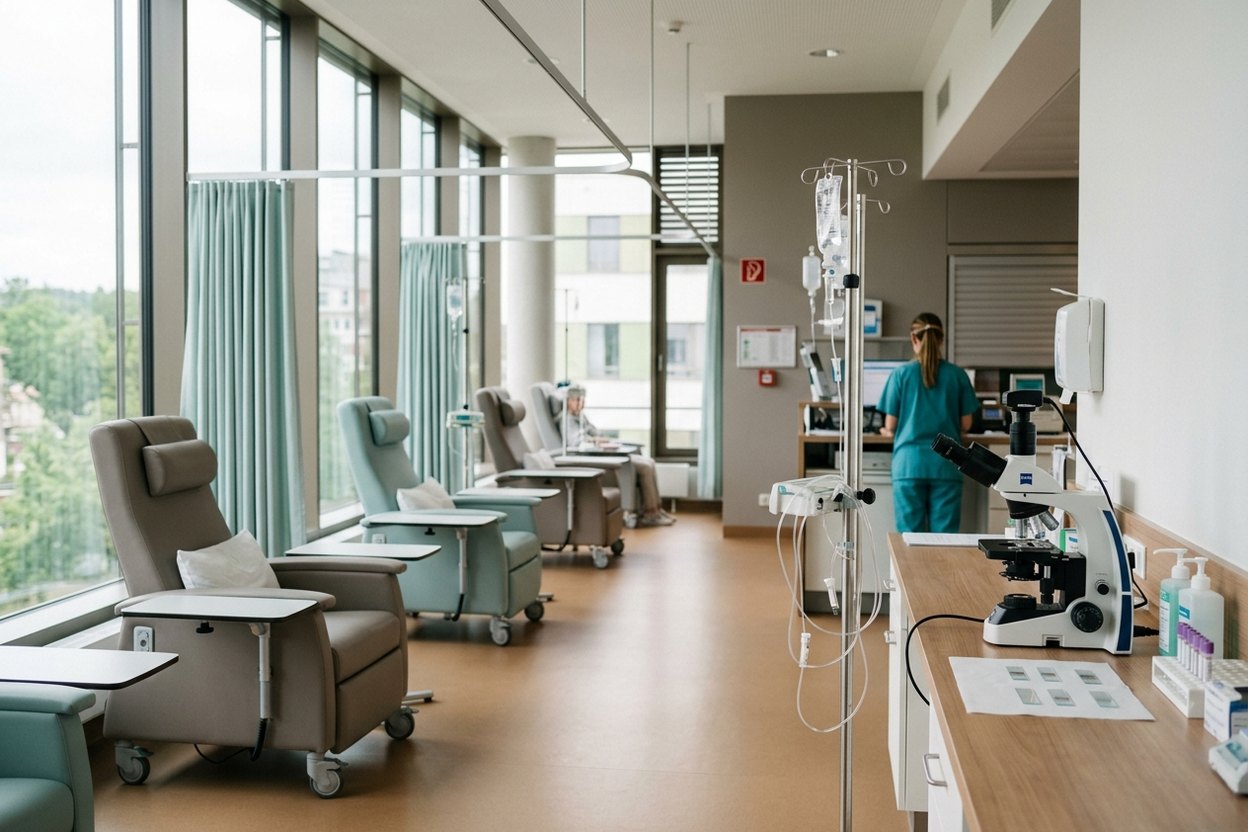
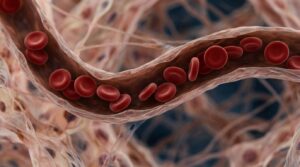
In Germany, blood cancer is treated by haematologists and oncologists in specialised hospital departments across the country. It often begins in an ordinary way: an odd blood test, weakness, frequent colds, bruises. It cannot be felt or seen on a scan — it is a disease of cells that travel through the whole body.
Blood cancer treatment in Germany starts by taking the disease apart down to the molecular level. The term covers leukaemia, lymphoma and myeloma: leukaemia starts in the bone marrow and spills into the blood, lymphoma grows mainly in lymph nodes, and myeloma is a tumour of marrow plasma cells. This page covers leukaemia; for lymphoma see lymphoma treatment, and myeloma will get its own page. Non-cancerous blood disorders are a separate subject.
First, an Accurate Diagnosis: Bone Marrow, Chromosomes, Genes
An accurate diagnosis rests on a full blood count and a bone marrow examination. The blood count shows which cells are too many or too few and whether immature blasts are present. Under local anaesthetic, a thin needle draws marrow from the back of the pelvic bone; the aspiration itself usually causes a brief, pulling pain.
Immunophenotyping reads the proteins on the cell surface like an identity card. Cytogenetics examines the chromosomes for rearrangements. Molecular genetics looks for mutations too small to see under a microscope. Together they show whether the leukaemia is acute or chronic, myeloid or lymphoid, and which mutations it carries.
Without these tests treatment would be guesswork: they decide which drugs will work, how intensive therapy must be and whether a transplant may be needed. In acute leukaemia the work-up takes only days. The U.S. National Cancer Institute has leukaemia pages for patients.
Leukaemia Treatment in Germany: Acute and Chronic Forms
The main difference is pace: acute leukaemia is treated at once and intensively, aiming at cure, while chronic leukaemia is often kept in check for years. In acute myeloid and lymphoblastic leukaemia, induction chemotherapy aims at remission, when no leukaemia cells are found; consolidation follows with more chemotherapy or, at high relapse risk, a stem cell transplant. Certain mutations call for targeted drugs alongside chemotherapy.
Chronic myeloid leukaemia can often be held in check with tablets, tyrosine kinase inhibitors, taken continuously with regular blood tests. In chronic lymphocytic leukaemia that behaves quietly and causes no symptoms, the doctor may choose observation and start treatment only when needed.
Some haematology centres are certified by the German Cancer Society for haematological cancers, among them the department at Munich Hospital Bogenhausen headed by Prof. Tobias Herold, whose focus includes acute and chronic leukaemias, and the centre at Essen University Hospital led by its Department of Haematology and Stem Cell Transplantation. Prof. Jochen Greiner heads haematology and oncology at Diakonie Hospital Stuttgart. Treatment often follows German study group protocols.
Stem Cell Transplantation and Cell Therapy
A stem cell transplant replaces diseased blood formation with a healthy one and is used only on strict indications, such as a high relapse risk. Autologous means the patient’s own stem cells are returned after high-dose chemotherapy; allogeneic means a donor’s, found among siblings or through German and international registries. More on the stem cell transplantation page.
In CAR-T cell therapy, the patient’s own T cells are reprogrammed in a laboratory to recognise the tumour and infused back; it is used in some lymphomas, leukaemias and myeloma, usually after other treatments. Both methods are offered at Rechts der Isar Hospital of the Technical University of Munich, where Prof. Florian Bassermann directs the Department of Internal Medicine III (haematology and oncology).
Blood Cancer Treatment for Children
Children with blood cancer are treated by paediatric haemato-oncologists; the most common form is acute lymphoblastic leukaemia. In Germany almost all children with it are treated within paediatric study protocols. Treatment is long: intensive phases with frequent hospital stays, then gentler maintenance therapy at home.
Examples include Dr. von Hauner Children’s Hospital in Munich, directed by Prof. Christoph Klein, a specialist in paediatric haematology and oncology; the paediatric oncology, haematology and immunology department at Stuttgart Hospital, led by PD Dr Claudia Blattmann; and the paediatric oncology and haematology department at Düsseldorf University Hospital. Psychologists, educators and social workers support the family from diagnosis on, and hospital school teachers help the child keep up. See also treatment for children in Germany.
Frequently asked questions
Which country is best for treating blood cancer?
There is no single winning country; what matters is the centre and how well it suits your disease. Look for full diagnostics including genetics, stem cell transplant experience, access to CAR-T therapy and a tumour board for difficult cases. Germany has such centres in many cities, some certified by the German Cancer Society.
Can blood cancer be cured today?
Many forms of blood cancer can now be cured or controlled for years, depending on the type, its genetics, age and general health. Acute leukaemia is treated with the aim of cure; chronic myeloid leukaemia is often controlled with tablets; quiet chronic lymphocytic leukaemia may need only observation. Only a full work-up shows what to expect.
How long does blood cancer treatment take?
From months to many years, depending on the form. The intensive part of acute leukaemia treatment takes months, initially in hospital; acute lymphoblastic leukaemia then needs maintenance therapy, so treatment lasts years. Tablets for chronic myeloid leukaemia are taken for years. The hospital sets the exact plan after reviewing the records.
Leukaemia Treatment in Germany: Cost and How AlenMed Arranges It
The cost of leukaemia treatment in Germany depends on the form and stage of the disease: tablets for chronic leukaemia and weeks in hospital for acute leukaemia differ by orders of magnitude, and a transplant is the most expensive stage. The hospital gives the price in its estimate after reviewing the records; see also cancer treatment costs in Germany.
For a review, send serial blood counts, the bone marrow report, genetic results and discharge letters. AlenMed has them translated, and a haematologist at a partner hospital gives a second opinion — clarity rather than fear, and the sense that the disease is manageable. In acute leukaemia the decision to travel is made with the treating doctor; starting at home is sometimes safer. AlenMed arranges the invitation, visa and interpreter; the hospital invoices directly. AlenMed’s office is in Munich, the hospitals are across Germany.
This material is for reference only and is not an offer. Whether treatment is possible, its scope and outcome are decided by a doctor after an in-person examination.
News on this topic
Charité treats first beta-thalassemia patient with CRISPR
At Berlin Charité, a 19-year-old beta-thalassemia patient became the first in Germany to receive the newly approved CRISPR gene therapy Exagamglogene Autotemcel.
Real-World Breast Cancer Study Confirms High Five-Year Survival Rates in Germany
A landmark study of over 43,000 German patients reveals a five-year invasive disease-free survival rate of 82.9 percent in early hormone receptor-positive breast cancer.
FDA Approves Jülich Diagnostic Radiotracer FET for Brain Tumor Imaging
The FDA approves the diagnostic radiotracer FET (Pixclara®) for evaluating brain gliomas, highlighting decades of neuro-oncology research at Forschungszentrum Jülich.