EN
EN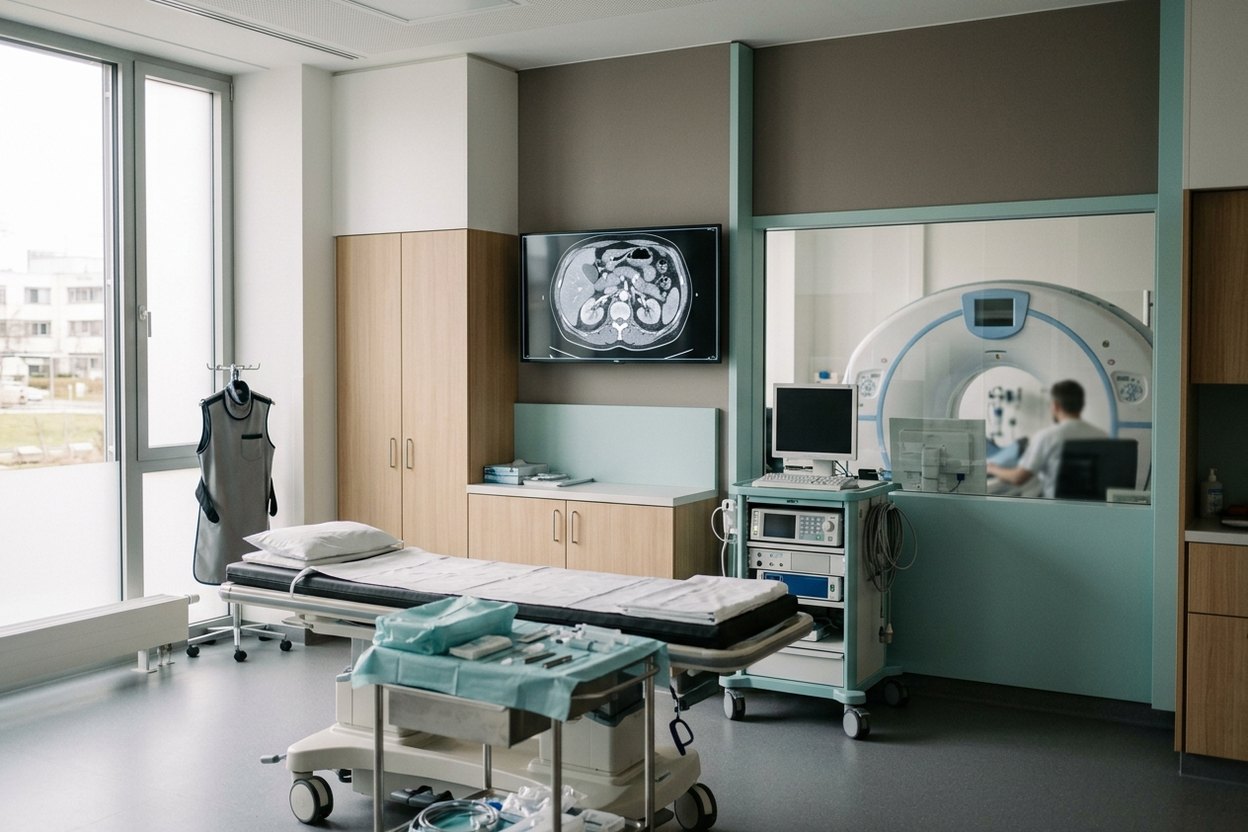
Kidney cancer is often found by chance, on an ultrasound or CT done for another reason, and in Germany a tumour confined to the kidney is removed while keeping the organ wherever possible. People feel well, the news comes as a shock, and kidney cancer treatment in Germany begins with the two questions that crowd out all others: how serious is it, and will the kidney have to go? German urologists first assess the risk and whether the organ can be kept, and only then treat.
This page covers what contrast CT and MRI show, when a biopsy is needed, what decides whether the kidney can be kept and what is done once the disease has spread.
A finding in the kidney that has to be decoded
A mass seen in the kidney on a scan is not yet a diagnosis: it may be a harmless cyst or a malignant tumour, and the two can look alike. Most patients who contact us have such an image but no clear idea what it shows. Symptoms such as blood in the urine or flank pain often appear only once the tumour has grown, so their absence proves nothing.
So the first step is not treatment but an exact description of the finding: its type, size, position and spread. The wider picture of cancer treatment in Germany is on the main oncology page.
Smoking, excess weight and high blood pressure raise the risk, as does severe kidney disease, particularly after years on dialysis. Rare inherited syndromes play a part too, such as von Hippel–Lindau disease, an inherited tendency to tumours of the kidneys and other organs; with them, tumours more often affect both kidneys and appear at a younger age. Still, a risk factor does not mean the disease, and its absence does not rule it out: many patients never learn the cause. The scan decides, not a checklist.
What a German urologist actually reads in the images
A German urologist reads three things in the images: tumour size, position relative to the blood vessels and any growth beyond the kidney. The mass is often first seen on ultrasound, but the work-up rests on contrast CT, with contrast MRI added if a vein may be involved. The distance to the renal vessels and to the collecting system that drains urine is judged separately, because it decides whether kidney-sparing surgery is technically possible; a nephrometry score then grades the complexity of the operation.
A biopsy takes a small tissue sample for histology, examination under the microscope. It is not always needed, but in unclear cases it separates malignant from benign and can spare an unnecessary operation. The German guideline reserves it for cases where the result could change treatment: an uncertain mass, before ablation or active surveillance, and before drug therapy in advanced disease if no tumour tissue has been examined. How a biopsy in Germany works is described separately.
Treatment does not start until the whole picture is in. Unless the tumour is very small, a chest CT checks the lungs, and bones and brain are imaged if symptoms point to them. In advanced disease the histological subtype and risk group are established, as they determine the drug. No single surgeon decides: in certified German cancer centres complex cases go to a tumour board that works from the German S3 guideline on renal cell carcinoma.
Kidney cancer treatment in Germany: keeping the organ where possible
The guiding principle is to keep the kidney whenever this is technically feasible: a small tumour is removed with a margin of surrounding tissue and the kidney goes on working. The national guideline calls for this in small tumours confined to the kidney, and in larger ones where possible. It matters beyond reassurance: kidney surgery raises the risk of chronic kidney failure, and sparing surgery preserves more function than removing the organ. So kidney cancer treatment in Germany for a confined tumour starts with one question: can it come out without the kidney?
Surgery may be open, laparoscopic or robotic. Around the renal vessels the robot gives the surgeon more freedom of movement, with wrist-like instruments and a magnified view. Robotic urology is done, for example, at the Urology Clinic Munich-Planegg, whose chief physicians include Prof. Maximilian Kriegmair, Dr Ralph Oberneder, Dr Bernhard Liedl and Dr Georg Schön. Another example is Essen University Hospital, where Prof. Boris Hadaschik directs the urology clinic and heads the uro-oncology centre; he is also deputy director of the West German Cancer Centre.
The whole kidney is removed when it cannot be kept: a large or awkwardly placed tumour, for instance deep in the centre by the vessels, or growth into a major vein. That is no defeat. The aim is still complete removal, and people can live with one working kidney; follow-up blood tests, including creatinine, check how well it works.
A small tumour in a patient unlikely to cope with surgery can instead be destroyed by cold or radiofrequency heat, called ablation, usually with a thin probe passed through the skin. For a small, slow-growing lesion in an older or seriously ill patient, active surveillance is an option. That is not doing nothing but a schedule of control scans, with treatment if the tumour starts to grow.
When the disease has spread: drug therapy
In advanced disease drug therapy takes over: targeted agents and immunotherapy, today often combined. Targeted agents cut off the tumour’s blood supply by blocking new vessels; immunotherapy helps the immune system recognise tumour cells. The choice follows mainly the risk group and histological subtype; where several options fit, other illnesses, tolerability and the patient’s preferences count. More is on the page about kidney cancer immunotherapy.
A single metastasis is sometimes removed or irradiated. If surgery is impossible and the tumour bleeds or causes pain, embolisation may help: the arteries feeding it are blocked through a catheter, which relieves symptoms but does not cure. After surgery, follow-up catches a recurrence early and watches kidney function; its timetable of scans and blood tests depends on the risk group set from the pathology report. An overview of urology clinics in Germany helps in choosing a centre.
Frequently asked questions
Can kidney cancer be cured completely?
Often, yes: if the tumour has not spread beyond the kidney, surgery frequently cures it. The earlier the disease is found, the better the chances. With metastases a cure is not always possible, and treatment then aims to hold the disease back, ease symptoms and prolong life.
Is chemotherapy used for kidney cancer?
As a rule, no. Classical chemotherapy has almost no effect on kidney cancer, and the German guideline advises against it in advanced clear-cell renal cell carcinoma; targeted agents and immunotherapy are used instead. When the tumour is confined to the kidney, surgery is the main treatment, and drugs afterwards are given only if the risk of recurrence is raised.
Is kidney cancer hereditary?
In most cases, no: inherited forms such as von Hippel–Lindau disease are rare. Clues are several cases of kidney cancer in a family, the disease at a young age and tumours in both kidneys; doctors then advise genetic counselling, and relatives who carry the gene change are followed up at a specialised centre.
How AlenMed arranges treatment in Germany
AlenMed collects and translates discharge letters, CT and MRI images and histology reports, sends them to a uro-oncology centre, obtains the written estimate on the clinic’s letterhead, prepares the visa papers, meets the patient and accompanies them at appointments and on the ward. If removal of the kidney has been proposed at home, start with a second opinion: a German specialist reviews the images and reports and says whether he confirms the diagnosis, agrees with the extent of surgery or sees a gentler option, and it may turn out that the kidney can be kept. The cost is set by the clinic’s written estimate after review of the images and histology; the page on cancer treatment costs in Germany explains how an oncology estimate is built up. The office is in Munich, and partner clinics are across Germany.
This material is for information only and does not replace a consultation with a doctor. Whether treatment is possible, what it will involve and what it will achieve can be determined only after an examination at the clinic in person.
News on this topic
Charité treats first beta-thalassemia patient with CRISPR
At Berlin Charité, a 19-year-old beta-thalassemia patient became the first in Germany to receive the newly approved CRISPR gene therapy Exagamglogene Autotemcel.
Real-World Breast Cancer Study Confirms High Five-Year Survival Rates in Germany
A landmark study of over 43,000 German patients reveals a five-year invasive disease-free survival rate of 82.9 percent in early hormone receptor-positive breast cancer.
FDA Approves Jülich Diagnostic Radiotracer FET for Brain Tumor Imaging
The FDA approves the diagnostic radiotracer FET (Pixclara®) for evaluating brain gliomas, highlighting decades of neuro-oncology research at Forschungszentrum Jülich.