EN
EN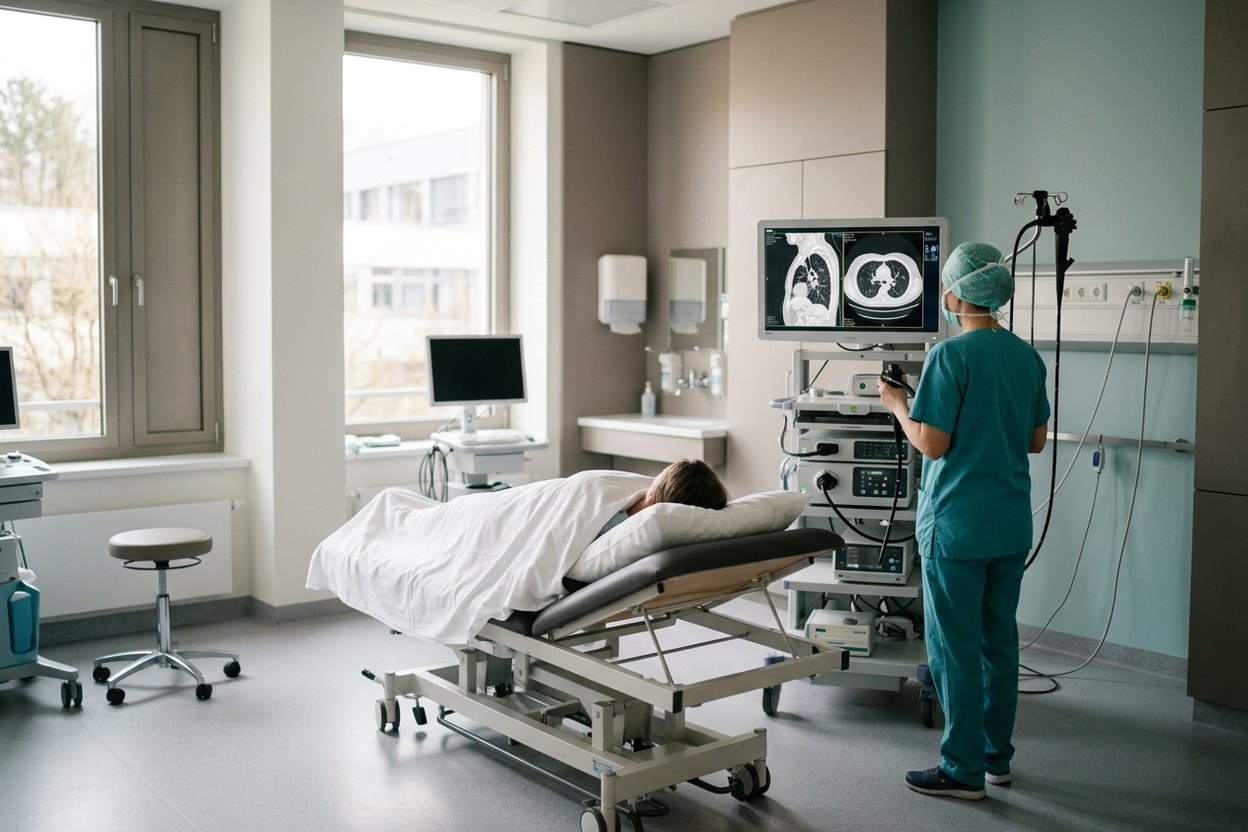
Lung cancer is most often found by chance, on a scan taken for something else, or when a persistent cough, breathlessness or unexplained weakness appears. The first reaction is usually bewilderment: the diagnosis sounds grave and there seems to be no time at all. Yet the choice of treatment depends on details that only a full work-up reveals.
Lung cancer treatment in Germany begins with a work-up that answers two questions: what kind of tumour it is and what its molecular profile looks like. Only then does a tumour board propose a plan: surgery, radiotherapy, drugs or a combination. Families often ask first who is the best lung cancer specialist, but even the most experienced one starts from these two answers.
Small cell and non-small cell: the distinction that decides the plan
Whether a lung cancer is small cell or non-small cell decides almost everything that follows: small cell cancer develops fast, non-small cell usually more slowly, and they are treated differently. Small cell tumours spread early and are rarely operated on; they are treated with chemotherapy and radiotherapy, with immunotherapy added in advanced disease. Non-small cell cancer is far more common, and at an early stage it is usually removed surgically.
Within non-small cell cancer, tumours also differ at the molecular level. Tissue analysis shows whether the tumour carries gene alterations that targeted drugs act on, and features that speak for immunotherapy. A target is the feature of the cancer cell that a drug is aimed at, for example a protein changed by a faulty gene that drives the tumour’s growth. Without the target a targeted drug will not work, so drugs are chosen once the molecular profile is ready.
Treatment also depends on the stage: the size of the tumour, whether lymph nodes are involved and whether there are distant metastases. In stage one the tumour is small and confined to the lung; in stage four distant metastases are present. At the early stages treatment aims at a cure, with surgery or radiotherapy, sometimes combined with drugs. Once metastases are found, drug therapy comes to the fore and the goal is long-term control of the disease; see stage 4 lung cancer treatment.
Getting the diagnosis right
The diagnosis is confirmed with imaging and a tissue sample: the scans show where the tumour is and how far it has spread, the tissue shows what it is. The work-up uses CT of the chest and, to establish whether the tumour has spread beyond the lung, positron emission tomography (PET): it shows not the shape but the activity of the tissue and helps reveal where the disease is behaving aggressively. To obtain the tumour tissue itself, bronchoscopy or a targeted biopsy is done. The individual tests are described on the lung cancer diagnostics page.
What you bring matters, because a German specialist reviews the material again instead of working from a single report. Bring the CT on disc, with the images themselves, not just the report, and the biopsy slides and paraffin blocks: from the blocks the pathologist can cut new sections and run any missing molecular tests. The plan depends on the exact tumour type and molecular profile, so it rests on this review.
Surgery, radiotherapy, drugs
Surgery, radiotherapy and drugs are combined to fit the particular tumour. Where the tumour is operable it is removed, increasingly through small incisions (thoracoscopically) rather than a large one, which makes recovery easier. Not every patient is suited to it, as the page on lung cancer surgery explains. Where an operation is impossible or not wanted, stereotactic radiotherapy delivers the dose very precisely into the tumour while sparing the healthy tissue around it. Chemotherapy is used where indicated, and targeted drugs and immunotherapy where the molecular analysis shows that they suit this particular tumour. Immunotherapy for lung cancer in Germany releases the brakes the tumour puts on the immune system; more on the lung cancer immunotherapy page.
In advanced disease the task shifts to disease control and quality of life: relieving symptoms, supporting breathing, giving the person their strength back. Drugs hold the disease in check while breathlessness, cough and pain are treated alongside; this supportive care is part of treatment, not a step away from it.
The approach is decided by a tumour board: surgeon, oncologist, radiation oncologist and pathologist look at the case together, usually joined by a pulmonologist. The doctor then goes through the board’s recommendation with the patient.
After thoracoscopic surgery the patient is helped out of bed early, with breathing exercises and physiotherapy from the first days, and the clinic decides how long the stay lasts. Then comes regular follow-up (Nachsorge): control CT scans and check-ups on the schedule the doctor sets under the German guidelines. These check-ups can also be done at home if the patient has the German clinic’s report and plan, and rehabilitation follows where needed.
Who treats lung cancer in Germany
“Who is the best lung cancer specialist?” is often the first question families ask, and the honest answer is that there is no single best specialist: lung cancer in Germany is treated by departments where pulmonology, thoracic surgery, oncology and radiotherapy work on the same case. In larger hospitals they form a lung centre where cases are discussed jointly.
Klinikum Stuttgart is one example: Prof. Martin Hetzel is medical director of its Department of Pulmonology and Respiratory Medicine, and Dr Rainer Sätzler is medical director of its Department of Thoracic Surgery. Both departments belong to the hospital’s lung centre. This is an example, not a ranking.
Instead of rankings, look at things you can check when searching for the best lung cancer treatment in Germany: whether the hospital holds the German Cancer Society certificate as a lung cancer centre (Lungenkrebszentrum), which involves regular on-site audits; how many patients with this tumour the department treats; whether a tumour board meets; and whether molecular testing is done in house. Which cancer hospital is best in general is discussed on the page about cancer hospitals in Germany.
Cost and how the quote is put together
There is no single price, because the plan depends on the tumour type and stage; the cost becomes clear only from the clinic’s quote for a specific plan. The quote covers the work-up and review of the material you bring, the inpatient stay and surgery or a course of radiotherapy, drug therapy given in cycles, and follow-up examinations.
Quotes differ between clinics because their scope differs: one includes slide review and molecular testing, another relies on existing results, and inpatient rates and lengths of stay vary. Prepayment is made against the clinic’s own invoice, directly to the clinic rather than to an agency, so you see exactly what you pay for. Guide figures for individual examinations are on the page about the cost of lung cancer treatment.
Frequently asked questions
How is lung cancer treated today?
Lung cancer is treated according to a plan built around the specific tumour, once its type, stage and molecular profile are known. Early tumours are mainly operated on, often thoracoscopically, or treated with stereotactic radiotherapy. In advanced disease targeted drugs lead where the tumour has a target, and immunotherapy is given alone or with chemotherapy. Small cell cancer is treated mainly with chemotherapy, radiotherapy and immunotherapy.
How does recovery after lung cancer treatment work?
Recovery starts in hospital: after surgery the patient is helped out of bed early and begins breathing exercises and physiotherapy in the first days. Follow-up then continues with control CT scans on the schedule the doctor sets, and these can also be done at home with the German clinic’s report and plan. If strength returns slowly, rehabilitation with breathing training and exercise helps.
Can lung cancer be cured completely?
At an early stage it can be: treatment then aims at a cure, removing or irradiating the tumour, sometimes with drugs before or after. Once the disease has spread, the goal is to keep it under control for as long as possible and to preserve quality of life. Only the treating doctor can give a prognosis, once the tumour’s type, stage and molecular profile are known.
How AlenMed organises the treatment
AlenMed matches the clinic and the doctor to the patient’s documents, has the reports translated into German, books the appointments, arranges the invitation for the visa, provides an interpreter for consultations and supports the family on site. The company’s office is in Munich, with partner clinics across Germany. Independent information in German is published by the Krebsinformationsdienst, the cancer information service of the German Cancer Research Center, on its page on lung cancer.
This material is for information only, is not an offer and does not replace a consultation with a doctor. Whether treatment is possible, what it will involve and what it will achieve can be determined only after an examination at the clinic in person; the treatment plan is set by a doctor at a face-to-face appointment.
News on this topic
Charité treats first beta-thalassemia patient with CRISPR
At Berlin Charité, a 19-year-old beta-thalassemia patient became the first in Germany to receive the newly approved CRISPR gene therapy Exagamglogene Autotemcel.
Real-World Breast Cancer Study Confirms High Five-Year Survival Rates in Germany
A landmark study of over 43,000 German patients reveals a five-year invasive disease-free survival rate of 82.9 percent in early hormone receptor-positive breast cancer.
FDA Approves Jülich Diagnostic Radiotracer FET for Brain Tumor Imaging
The FDA approves the diagnostic radiotracer FET (Pixclara®) for evaluating brain gliomas, highlighting decades of neuro-oncology research at Forschungszentrum Jülich.