EN
EN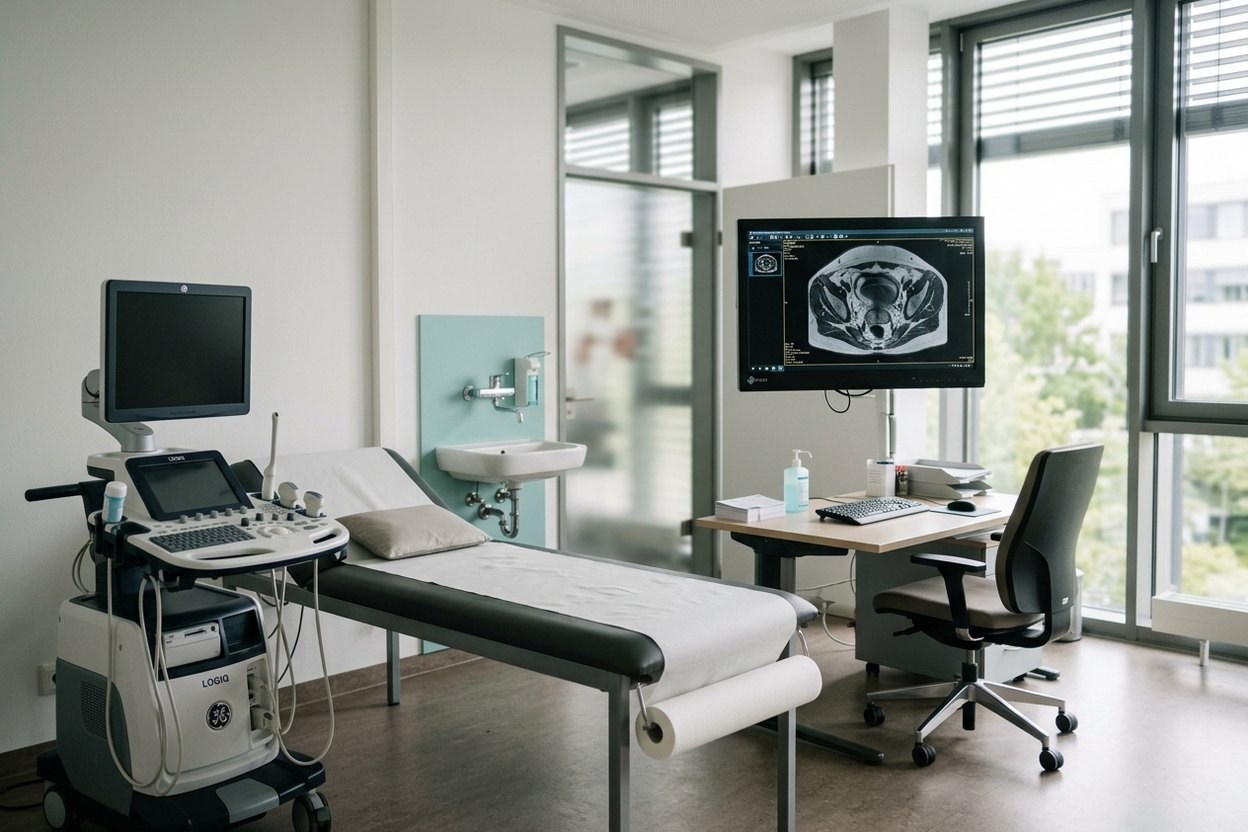
A weak stream, getting up at night, a dragging pain low in the pelvis: many men know these complaints, but they can hide different prostate conditions with different treatments. Prostate treatment in Germany starts with finding out which one a particular man has.
Below: how the conditions are told apart, how prostatitis and an enlarged prostate are treated, briefly cancer, then urologists, hospitals and the trip. For an overview, see urology in Germany.
Three prostate conditions and how they are told apart
The three conditions are told apart by examination, because their early signs are alike. Prostatitis is inflammation of the gland; benign prostatic hyperplasia (BPH) is a non-cancerous enlargement around the urethra that squeezes it; cancer is a malignant tumour. All three may start with a weak stream, incomplete emptying and frequent or painful urges, yet are treated in fundamentally different ways.
The assessment includes a talk about symptoms, a digital rectal examination, a urine test and ultrasound, including transrectal ultrasound. Uroflowmetry measures the flow rate as the patient passes urine into a funnel with a recorder. Ultrasound then shows how much urine stays in the bladder.
A raised PSA is not a cancer diagnosis: it also rises with inflammation and BPH, as the German Cancer Information Service (Krebsinformationsdienst) explains. The doctor looks at the free-to-total PSA ratio and the trend over time. If cancer is suspected, an MRI scored on the PI-RADS scale and a fusion biopsy follow: the MRI image is overlaid on ultrasound to sample exactly the suspicious area. See prostate cancer diagnosis.
Prostatitis treatment in Germany: first, the form of the disease
Prostatitis treatment in Germany does not start with an antibiotic “just in case”: the urologist first establishes which of four forms a man has. Acute bacterial prostatitis starts suddenly with fever, chills and painful urination; it is caused by bacteria, usually the same as in urinary tract infections. Chronic bacterial prostatitis brings recurring flare-ups from infection that stays in the gland. Chronic pelvic pain syndrome means lasting pain in the perineum or lower abdomen, or on urination or ejaculation, without bacteria; its cause is not fully understood, but tense pelvic floor muscles and oversensitive nerves play a part. Asymptomatic prostatitis is found by chance. Acute prostatitis with fever is treated urgently where the patient is, not postponed for a trip.
The most common form is chronic pelvic pain syndrome. With no bacteria present, repeated antibiotic courses do not help.
The forms are told apart by testing urine collected in portions at different stages of voiding and prostatic secretion obtained after massage, which shows whether and where there is infection. Transrectal ultrasound and uroflowmetry complete the picture. PSA may rise with inflammation; the doctor does not alarm the patient with the number.
How prostatitis is treated in Germany
Treatment follows the form: antibiotics for bacterial prostatitis, combined methods for chronic pelvic pain syndrome. The antibiotic is chosen by culture, a lab test showing which drugs the bacteria respond to, and the course must be long enough, considerably longer in the chronic form, and not broken off when symptoms ease. If urine flow is obstructed, drugs relaxing the bladder neck are added.
For chronic pelvic pain syndrome, doctors combine medication for pain and spasm, physiotherapy, pelvic floor work and lifestyle changes to break the circle of pain, tension and more pain. German hospitals take this form seriously rather than dismissing it as “nerves”. Surgery is rarely needed: for an abscess, a pocket of pus in the gland, or urinary retention.
If prostatitis keeps returning for years, a second opinion is worthwhile: often the form of the disease was never clarified. A German urologist reviews the tests, scans and treatment history and says what should change.
Enlarged prostate: from tablets to surgery through the urethra
An enlarged prostate is treated in steps: tablets first, surgery through the urethra when they no longer suffice. Alpha-blockers relax the bladder neck and prostate to ease the flow; 5-alpha-reductase inhibitors gradually shrink the gland. Surgery is offered when medication fails or complications appear: urinary retention, bladder stones, repeated infections. This is set out in the German Society of Urology guideline on benign prostatic syndrome.
These operations need no external incision. In TURP, transurethral resection, excess tissue is cut away with an electric loop; in HoLEP, holmium laser enucleation, it is shelled out with a laser, even in a large prostate; plasma vaporisation evaporates it. The choice depends on prostate size, other illnesses and blood thinners. The goals are normal voiding, continence and preserved sexual function. Ejaculation often changes afterwards, as semen goes into the bladder; the urologist discusses this beforehand.
If cancer is found, that is a separate subject: active surveillance, robot-assisted surgery, radiotherapy, hormonal and nuclear medicine therapy are covered under prostate cancer treatment.
Urologists and hospitals for prostate treatment
Prostate conditions are treated in urology departments across Germany. At Urologische Klinik München-Planegg, HoLEP is performed by clinic director Prof. Maximilian Kriegmair and chief physician Dr. Alexander Kaspin; transurethral resection of the prostate by Dr. Kaspin and Prof. Martin Kriegmair, president of the German Society of Urology in 2023. Incontinence is the field of the clinic’s pelvic floor centre, whose team includes chief physician Prof. Ricarda M. Bauer; see urinary incontinence treatment.
At München Klinik Bogenhausen, urology is headed by PD Dr. Atiqullah Aziz, whose fields include minimally invasive treatment of benign prostate enlargement. Prof. David Schilling heads urology at ISAR Klinikum, with prostate MRI and fusion biopsy among his fields. Prof. Christian Stief is a urologist at LMU Klinikum.
Frequently asked questions
What is the most effective way to treat prostatitis?
There is no single most effective way: it depends on the form of prostatitis. Bacterial prostatitis is treated with antibiotics chosen by culture and taken for the full course. Chronic pelvic pain syndrome involves no bacteria and is treated with a combination of pain medication, physiotherapy and pelvic floor work. The first step is therefore to pin down the form.
Why does the lower back hurt with prostatitis?
Usually it is referred pain: it arises in the pelvis but is felt in the lower back, because these areas share nerve pathways. It occurs in acute bacterial prostatitis and chronic pelvic pain syndrome. Back pain can also come from the spine or the kidneys, so it should be examined. With fever and chills, see a doctor at once.
Can I travel to Germany with acute prostatitis?
No, acute prostatitis with fever is treated immediately where the patient is. Without prompt treatment the infection can form an abscess or spread into the blood; severe cases need hospital treatment. A trip to Germany makes sense later, if the inflammation keeps returning, becomes chronic or the diagnosis remains unclear.
How AlenMed arranges prostate treatment in Germany
AlenMed organises the preparation, the trip and contact afterwards. You will need all PSA results over time, ultrasound reports, MRI on disc, culture results and a list of antibiotics and other drugs already taken, which matters especially in prostatitis. The documents are translated into German.
A urologist gives a preliminary review, the hospital issues an official cost estimate (Kostenvoranschlag), the patient receives a visa invitation letter, and an interpreter attends appointments. The bill covers the urology consultation, urine and prostatic secretion tests with culture, ultrasound including transrectal, uroflowmetry and, for an enlarged prostate, the operation and days in hospital. Prostatitis is usually treated on an outpatient basis, rarely with surgery or a hospital stay. Exact sums come only from the hospital’s estimate. AlenMed’s office is in Munich.
After treatment, the patient receives a report in their own language and a follow-up plan for home.
This information is for reference only and is not an offer. Treatment is decided by the doctor at an in-person appointment.
News on this topic
New Genetic Diagnostic Method Improves Detection of Inherited Kidney Disease
German researchers have developed an advanced genomic workflow to reliably diagnose a historically hard-to-detect genetic cause of chronic renal disease.